Harness Design for Coding Agents: What an Empirical Study Reveals
Harness design matters as much as the model in determining AI coding agent performance.
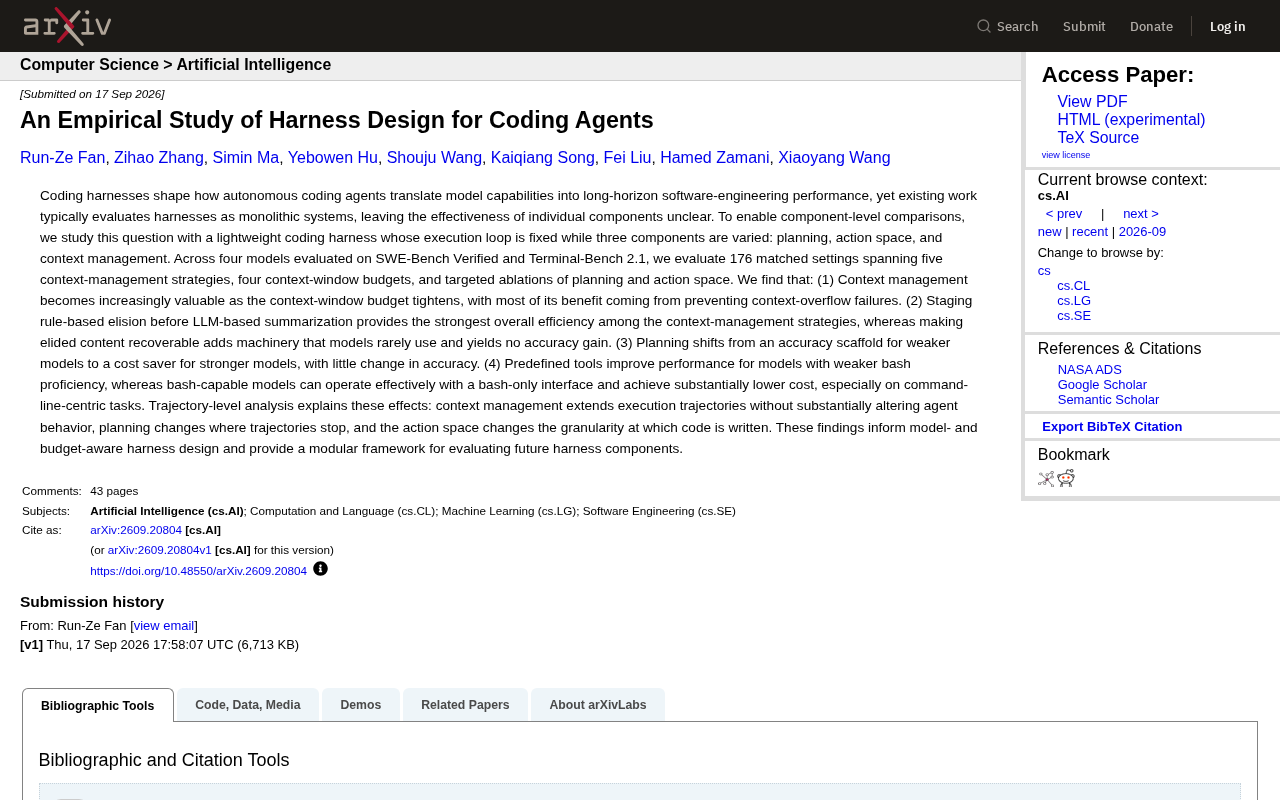
This article analyzes an empirical study on harness design for coding agents. A harness is the engineering layer wrapping a large language model, handling tool calls, context management, error feedback, and multi-step planning. The study shows that the same model with different harnesses can yield dramatically different results on benchmarks like SWE-bench, framing agent capability as the product of "model × framework." Key design dimensions include tool interface granularity, context compression strategy, feedback formatting quality, and planning-execution separation. As base model capabilities converge, harness engineering is poised to become the true competitive differentiator.
What Is Harness Design for Coding Agents
When we talk about AI coding agents, attention tends to concentrate on the capabilities of the underlying large model. But an empirical study on Harness Design reminds us that the model is only one piece of the puzzle — the "shell" built around it, known as the harness, plays an equally decisive role in determining an agent's real-world performance.
A harness refers to the engineering layer that wraps around a large language model. It governs how prompts are structured, how context is managed, how tools are invoked (reading files, executing commands, editing code), how error feedback is handled, and how state is maintained across multi-step tasks. The same model paired with different harnesses can produce wildly different success rates on real-world coding tasks.
Why Harness Design Deserves Its Own Study
Over the past year, benchmarks like SWE-bench have shown the industry what agents can do when tackling real GitHub issues. But many overlook a critical fact: scores on these leaderboards reflect not just model strength, but also the engineering quality of the harness. A well-designed framework can push a mid-tier model to outstanding results; a poorly designed one will squander the capabilities of even the best models.
The value of this empirical study lies in treating the harness as an independent variable, attempting to answer a long-obscured question: of an agent's final performance, how much comes from the model itself, and how much from the engineering design surrounding it?
Core Design Dimensions
From a harness design perspective, several key decisions recur consistently:
- Tool interface granularity: Should the agent be given the full freedom of shell commands, or should actions be encapsulated into structured, high-level operations (e.g., "edit line N of file X")?
- Context management strategy: How do you fit the most relevant code snippets into a limited context window? When should you compress, and when should you retrieve?
- Feedback loop design: How are compilation errors, test failures, and runtime logs fed back to the model? The quality of formatting directly affects whether the agent can self-correct.
- Separation of planning and execution: Should the model act in a single pass, or plan first and then execute step by step?
These may look like engineering details, but they are in fact the core variables that determine whether an agent succeeds or fails.
SWE-bench is one of the most widely used coding agent benchmarks, introduced by Princeton University in 2023. It collects hundreds of closed issues from real open-source GitHub repositories, asking agents to read problem descriptions, generate code patches automatically, and validate correctness against the repository's existing test suite. Its core value lies in authenticity: the tasks are not artificially constructed programming exercises, but real-world bug fixes and feature additions from the open-source community, spanning major projects like Django, Flask, and Pytest. For this reason, SWE-bench scores are considered more reflective of production-level capability than traditional code generation benchmarks like HumanEval. However, systems submitted by different teams differ not only in the underlying model, but also significantly in harness architecture — how relevant files are retrieved, how prompts are organized, how test feedback is processed — making it difficult to attribute scores to any single factor.
Context window management is one of the most technically challenging aspects of harness design. Large codebases can easily span hundreds of thousands of lines of code, while even the most capable mainstream models with 128K token context windows fall far short of accommodating a full codebase. Harnesses typically combine multiple retrieval strategies to filter relevant code snippets: static analysis (such as call graphs and dependency relationships), semantic retrieval via vector embeddings, and keyword matching like BM25. The recall quality of these strategies directly determines whether the model can "see" the context needed to fix a bug. Additionally, as multi-turn conversations progress, the accumulated history of tool calls rapidly consumes the token budget. Harnesses must implement compression or truncation strategies that preserve critical information while controlling costs — an inherently trade-off-laden engineering decision with no one-size-fits-all optimal solution.
What Empirical Research Can Reveal
The value of empirical research lies in replacing intuition with data. Compared to anecdotal claims like "framework X feels better," systematic comparative experiments can reveal which design choices genuinely drive improvement, and which are merely superficial or even counterproductive.
For developers, the practical takeaway is straightforward: if you're building a coding agent from scratch, rather than blindly chasing the latest and most powerful model, first examine whether your harness is wasting the capabilities of your current model. In many cases, optimizing how tool feedback is formatted or improving how context is organized delivers more benefit at lower cost than switching models.
Broader Industry Implications
This research echoes an emerging consensus: an agent's capability is the product of "model × framework," not determined by the model alone. As foundational model capabilities converge, engineering differences at the harness layer may become the true differentiator in product competitiveness.
For startups and open-source projects, this means the moat lies not necessarily in accessing the most powerful model, but in squeezing maximum value out of whatever model is on hand. Whoever pushes harness design to its limits will deliver more reliable coding agents under equivalent compute and model conditions.
It should be noted that this article is based on analysis of the study's title and community discussions circulating on Hacker News. The source material is limited; readers are encouraged to consult the original paper for complete experimental data and conclusions.
The "model × framework" perspective is also gaining traction in academia. Around 2024, multiple studies emerged specifically examining the contribution of agent scaffolding to final performance. Some experiments found that, with the same model, a carefully designed harness can improve SWE-bench resolution rates by 10 to 20 percentage points — a margin that even exceeds the gains from upgrading from GPT-3.5 to GPT-4. This finding is especially relevant for resource-constrained teams: renting a more powerful model's API incurs ongoing costs, while a one-time harness optimization can be reused indefinitely. Of course, there are interaction effects between model capability and framework design — certain harness strategies only deliver results when the model has sufficiently strong instruction-following ability. The two are therefore not fully interchangeable, but rather interdependent and mutually reinforcing.
Conclusion
Harness design is moving from behind the scenes to center stage. It reminds the entire industry that progress in AI coding agents depends not only on larger models, but also on smarter engineering shells. Understanding and optimizing this layer may be one of the highest-return investments available right now.
Related articles

Robinhood Executive to Speak at TechCrunch Disrupt 2026 on Winning the Modern Financial Consumer
Robinhood VP of Product Marketing Abhishek Fatehpuria will speak at TechCrunch Disrupt 2026 on winning the modern financial consumer. Early-bird saves up to $200 before Sept 25.

Using ChatGPT to Batch-Generate Editable Academic Slides: A Practical Efficiency Tool for Researchers
A complete workflow for batch-generating editable academic PPTs with ChatGPT: upload a PDF and template, use a structured prompt to render slides as images, then convert to editable format — all in under 30 minutes.

GPT-6 Full Power Guide: Unlocking Ultra Thinking Intensity via GPT-work
Step-by-step guide to using GPT-6 at full power: Apple ID registration, Plus/Pro subscription, and unlocking GPT-6 Ultra max thinking intensity via GPT-work client.