Harness Engineering: A New Paradigm for Agent Development from Prompts to System Architecture
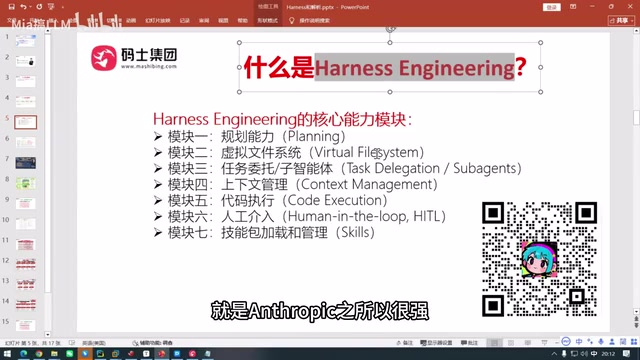
Harness Engineering unifies prompt and context engineering into a complete agent architecture paradigm.
Harness Engineering, proposed by Anthropic, represents the next evolution in AI agent development — moving beyond Prompt Engineering and Context Engineering to a comprehensive system architecture. It encompasses seven core capabilities: context management, memory, tool calling, planning, state management, observation, and security, solving critical pain points like context explosion, state loss, and security risks in complex multi-step agent tasks.
From Prompt Engineering to Harness Engineering
If you've been following the development of AI agents, you'll notice that the engineering focus shifts every so often. In 2024, the hottest topic was Prompt Engineering — the art of writing better prompts to drive large models. Prompt Engineering emerged in 2022–2023 after large language models began deploying at scale. Its core idea is to guide models toward desired outputs by carefully designing the structure, wording, and format of input text. Typical techniques include Few-shot Prompting, Chain-of-Thought, Role-playing, and more. As model capabilities grew, people gradually realized that optimizing prompts alone was insufficient for complex multi-step tasks, which gave rise to the demand for more systematic engineering approaches.
In 2025, the discussion shifted to Context Engineering, and interviewers began asking candidates how they manage and organize an agent's context. Context Engineering reflects a key insight: the quality of a model's output depends not just on the prompt itself, but on all the information fed to the model — including system prompts, conversation history, retrieved document fragments, tool call results, and more. Typical practices include document chunking and retrieval strategies in RAG (Retrieval-Augmented Generation) architectures, dynamic context window management, information compression and summarization, etc. Shopify CEO Tobi Lütke called it "the new hotness" in early 2025, and AI thought leaders like Andrej Karpathy have repeatedly emphasized its importance.
Now entering 2026, a more ambitious concept is emerging in the industry — Harness Engineering (sometimes translated as "harness architecture" or "harness framework," but we'll stick with the original English term here). This terminology originates from Anthropic's official framing. Anthropic is an AI safety company co-founded in 2021 by former OpenAI VP of Research Dario Amodei and his sister Daniela Amodei. Its flagship Claude series of large language models excels in code generation, long-text comprehension, and multi-step reasoning. Harness Engineering doesn't aim to replace the previous two approaches — rather, it encompasses both Prompt Engineering and Context Engineering within a more complete agent development system.
You can understand the evolution of these three concepts through a simple containment relationship:
Harness Engineering ⊇ Context Engineering ⊇ Prompt Engineering
In other words, Harness Engineering contains Context Engineering, which in turn contains Prompt Engineering. The three build upon each other progressively, reflecting a shift in agent development thinking from "tuning the model" to "building the system."
What Is Harness Engineering
Here's a definition: Harness Engineering is a core development methodology and software architecture approach in the current agent development landscape. Its key shift is this — developers no longer focus solely on prompts, nor solely on context, but instead concentrate on building a comprehensive, systematic infrastructure that wraps around the model.
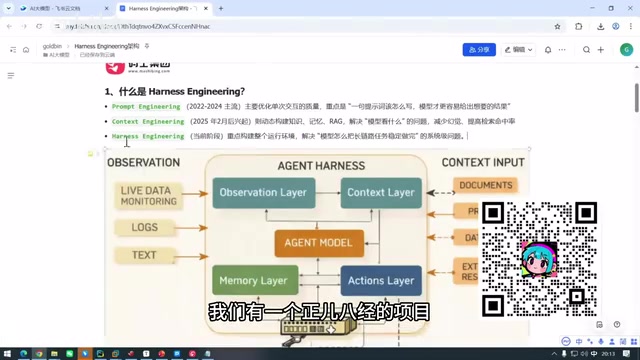
Put another way, in a complete agent system, everything other than the large model itself can be encompassed by the concept of a Harness. In the broadest sense, a Harness refers to all the infrastructure built around a large model during agent development. This is an important point: some online explanations define Harness too narrowly, when in reality its scope is much broader.
The Seven Core Capabilities of a Harness
Anthropic's Harness Engineering framework consists of seven core modules that together form a complete agent architecture. Collectively, it encompasses at least the following elements:
-
Context Management: How to organize, compress, and retrieve context while avoiding context explosion. A Context Window refers to the maximum number of tokens a large language model can process at once — early GPT-3 had a context window of only 4,096 tokens, while by 2025 Claude 3.5 supports 200K tokens, and Gemini has reached the million-token level. However, even as windows keep expanding, the "context explosion" problem persists: overly long contexts cause the model's attention to scatter (the "Lost in the Middle" phenomenon), burying key information. At the same time, token consumption directly affects API call costs and response latency. Therefore, intelligent context management — including information filtering, compression/summarization, and hierarchical storage — is a critically important capability in Harness Engineering.
-
Memory (Storage & Memory): Persistence solutions for both short-term and long-term memory. Short-term memory typically corresponds to the context cache of the current conversation, while long-term memory requires persistent storage via vector databases (such as Pinecone or Weaviate) or traditional databases, enabling agents to maintain awareness of user preferences, project states, and historical decisions across sessions.
-
Tools (Tool Calling): Enabling agents to invoke external tools and APIs. Tool Use / Function Calling is the key technology that elevates large models from pure text generators to agents capable of performing real actions. The basic principle is: during generation, the model identifies scenarios requiring external capabilities and outputs structured function call requests (usually in JSON format), which are executed by an external system that returns results for the model to continue reasoning. Under the Harness framework, tool calling is no longer a one-off API interaction but is integrated into a unified orchestration system supporting tool chain composition, error retries, concurrency control, permission validation, and other enterprise-grade requirements.
-
Planning (Multi-task Planning): Decomposing complex tasks into multi-step execution plans
-
State (Execution Loop & State Management): Maintaining the agent's running state during long-cycle tasks
-
Observation (Observer Mechanism): Observing and providing feedback on execution results
-
Security (Safety & Permissions): Sandbox isolation, file system access, permission control, etc. A Sandbox is a security isolation technology that creates a restricted execution environment for programs, preventing access to sensitive resources on the host system. In agent scenarios, the importance of sandboxing is greatly amplified: when an AI Agent has code execution and file operation capabilities, a Prompt Injection attack that tricks the model into executing malicious code could lead to data leaks, file deletion, or even system takeover. Common sandbox implementations include Docker containers, WebAssembly (Wasm) runtimes, and OS-level seccomp and AppArmor policies.
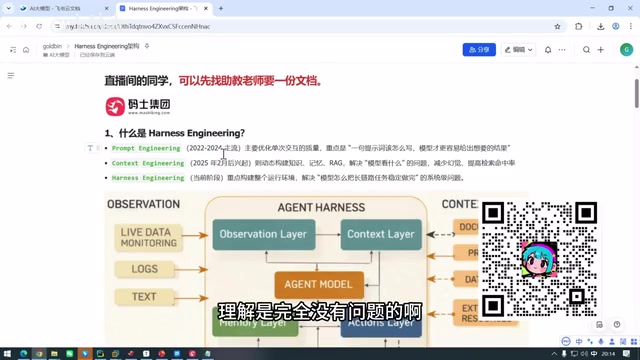
Additionally, it includes more granular capabilities such as Skills, sandboxes, and file systems. All these capabilities are unified within the Harness framework to work in concert.
What Problems Does Harness Solve
The best way to understand an architecture is to look at what real pain points it addresses. Traditional agents often encounter a series of thorny problems when facing long-cycle, multi-step complex tasks:
- Context Explosion: As tasks progress, context accumulates until it eventually exceeds the model's context window
- State Loss: Intermediate states during multi-step execution cannot be effectively saved and passed along
- Chaotic Tool Calling: Without a unified orchestration mechanism, tool calls can easily spiral out of control
- Lack of Planning Ability: Inability to break large tasks into executable sub-steps
- Security Risks: For example, if a script contains malicious code, without sandboxing and permission controls it could pose serious risks
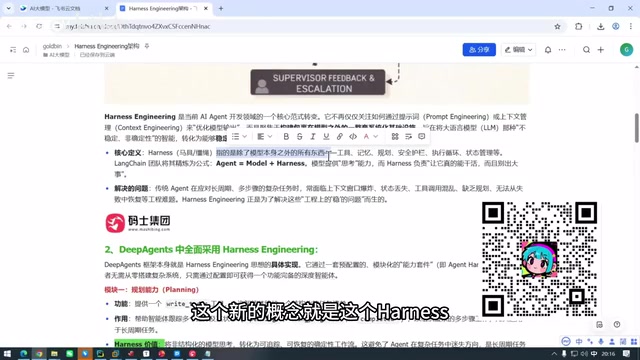
The core value of Harness Engineering is precisely in unifying all these scattered concerns — context, state, tools, planning, security, permissions, file operations — into a single architecture for centralized resolution. This is also why tools like Claude Code perform so well: under the hood, it implements a complete agent architecture in TypeScript, and this architecture is essentially the engineering realization of Harness Engineering principles. Claude Code is a command-line AI programming tool launched by Anthropic that allows developers to interact with Claude in the terminal to write, debug, and refactor code. It employs a multi-layer security model, including file system permission whitelists and network access controls — a practical application of Harness Engineering's security module.
Why It's Worth Paying Attention To
From an industry trend perspective, the focus of agent development is elevating from "how to write a good prompt" to "how to design a comprehensive infrastructure around the model." This means the core competitive advantage in future agent development will no longer be just prompt crafting skills, but system architecture capabilities.
For developers, the significance of understanding Harness Engineering lies in this: it provides a top-down holistic perspective that helps us break free from the local thinking of "tweaking prompts" and instead consider systemic issues like memory, planning, tools, and security. In enterprise-grade multi-agent collaboration scenarios, this systematic architectural thinking is especially critical — because state synchronization, task scheduling, and permission isolation between multiple agents are precisely where things are most likely to go wrong.
Multi-Agent Collaboration refers to an architectural pattern where multiple AI agents work together within the same system to accomplish complex tasks. Typical frameworks include Microsoft's AutoGen, LangChain's LangGraph, and CrewAI. In multi-agent scenarios, core challenges include: state synchronization — how multiple agents share task progress and intermediate results without conflicts; task scheduling — how to determine which agent executes which sub-task at what time; communication protocols — what formats and protocols agents use to exchange information; and permission isolation — different agents should have different tool access permissions following the principle of least privilege. These challenges correspond precisely to the design goals of the State, Planning, Tools, and Security modules in Harness Engineering, confirming why Harness Engineering's systematic thinking has become indispensable in the multi-agent era.
It's foreseeable that as products like Claude Code continue to evolve, Harness Engineering is poised to become one of the most important architectural paradigms in agent development. Mastering it means holding the key to the next phase of agent engineering.
Key Takeaways
Related articles
ASR Hallucination Explained: Why Speech Recognition Produces False Outputs
Dissecting the hallucination mechanism in ASR speech recognition systems. Research reveals the final encoder stage as the critical node for grounding failure, uncovering why speech recognition produces false outputs.

RAMageddon: AI Devours Chip Capacity, Consumer Electronics Supply Under Siege
AI training demand sparks a "RAMageddon" memory crisis as HBM and DDR5 chips are devoured by data centers, threatening consumer electronics with shortages and price hikes.

Claude Code Academic Research Skills: A Deep Dive into the Five-Stage End-to-End AI Research Assistant Framework
Deep dive into the GitHub project academic-research-skills: how Claude Code's five-stage Skills framework (Research, Write, Review, Revise, Finalize) builds a structured AI-assisted academic workflow.