Claude Code Academic Research Skills: A Deep Dive into the Five-Stage End-to-End AI Research Assistant Framework

A structured five-stage Claude Code skills framework that transforms AI into an end-to-end academic research collaborator.
The GitHub project academic-research-skills creates a comprehensive AI-assisted academic workflow using Claude Code's Skills mechanism, decomposing the research process into five stages: Research, Write, Review, Revise, and Finalize. With over 44K stars, it demonstrates how modular AI skill encapsulation can transform a general-purpose LLM into a multi-role research collaborator while maintaining academic integrity boundaries.
When AI Coding Tools Enter Academic Research
As AI-assisted programming continues to mature, a noteworthy trend is taking shape: more and more developers are extending the capabilities of AI coding tools like Claude Code into professional domains beyond programming. Claude Code is a command-line AI programming tool developed by Anthropic that allows developers to interact deeply with Claude models in a terminal environment. Unlike traditional chat-based AI interfaces, Claude Code can directly read, write, and modify code files, execute terminal commands, and understand the contextual structure of an entire project — and now, this deep interaction capability is being expanded into knowledge work far beyond coding.
A GitHub project called academic-research-skills is a prime example. It provides Claude Code with a comprehensive academic research skills framework, breaking the research workflow into five interconnected stages: "research → write → review → revise → finalize."
The project has rapidly garnered over 44,000 Stars and more than 3,500 Forks, with 161 new stars added in a single day — a clear indicator of the community's strong interest in "AI-driven academic workflows." It's worth noting that AI applications in academic research have already formed a multi-layered tool ecosystem: tools like Semantic Scholar and Elicit leverage AI for semantic search and paper summary extraction; Writefull and Paperpal focus on academic language polishing and standardized proofreading; and various disciplines have long adopted machine learning for data analysis and pattern recognition. What makes this project unique is its attempt to consolidate these capabilities — typically scattered across different tools — into a coherent, end-to-end workflow covering the complete research lifecycle from literature review to final manuscript.
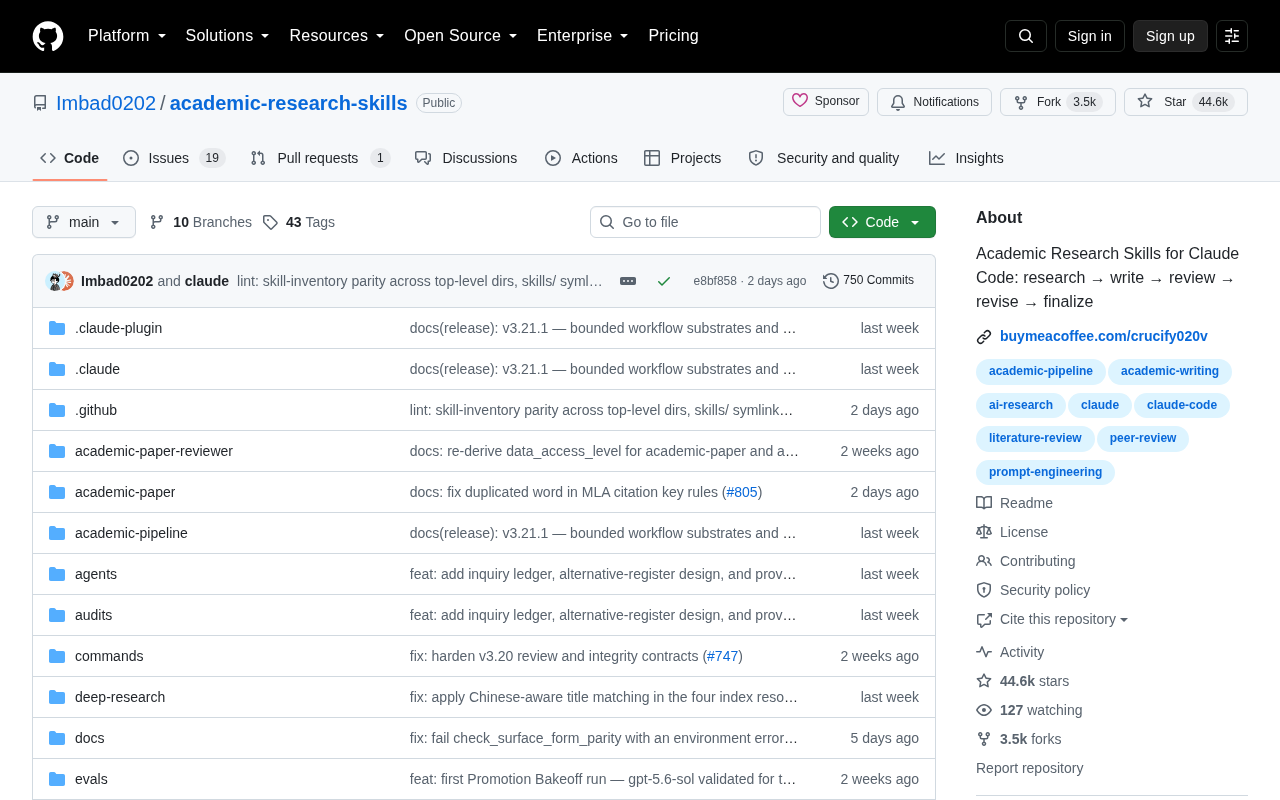
A Deep Dive into the Five-Stage Research Workflow
The core value of this project lies in the fact that it doesn't simply equate AI-assisted research with "having AI write my paper." Instead, it structurally models the real academic research process, assigning AI different roles at each stage.
Research: Literature Review and Material Collection
The starting point of any research endeavor is gathering materials, surveying existing literature, and defining research questions. In this stage, Claude Code can help researchers quickly search relevant literature, extract key insights, and identify research gaps. When facing a massive volume of papers, this AI-assisted literature review capability can dramatically shorten preparation time.
Take the biomedical field as an example: PubMed alone adds over one million new papers per year, and researchers often spend weeks or even months completing a literature review when starting a new project. AI-assisted search not only accelerates this process but can also leverage semantic understanding to discover related studies that traditional keyword searches might miss, helping researchers gain a more comprehensive view of their field.
Write: Drafting the Manuscript
Once the research framework is established, the AI-assisted writing stage begins. Based on materials collected in the previous stage, Claude Code helps generate an initial draft and organize the argument structure. The key here isn't "ghostwriting" — it's helping researchers transform scattered ideas into structured text, lowering the psychological barrier of starting from a blank page.
This stage is particularly valuable for non-native English speakers. Approximately 80% of high-impact academic journals publish primarily in English, and the language barrier has long been a significant pain point for researchers in non-English-speaking countries. AI-assisted writing can help researchers generate expressions that better conform to English academic writing conventions while preserving their original scholarly ideas, allowing them to devote more energy to the core research questions themselves.
Review: Simulating Peer Review
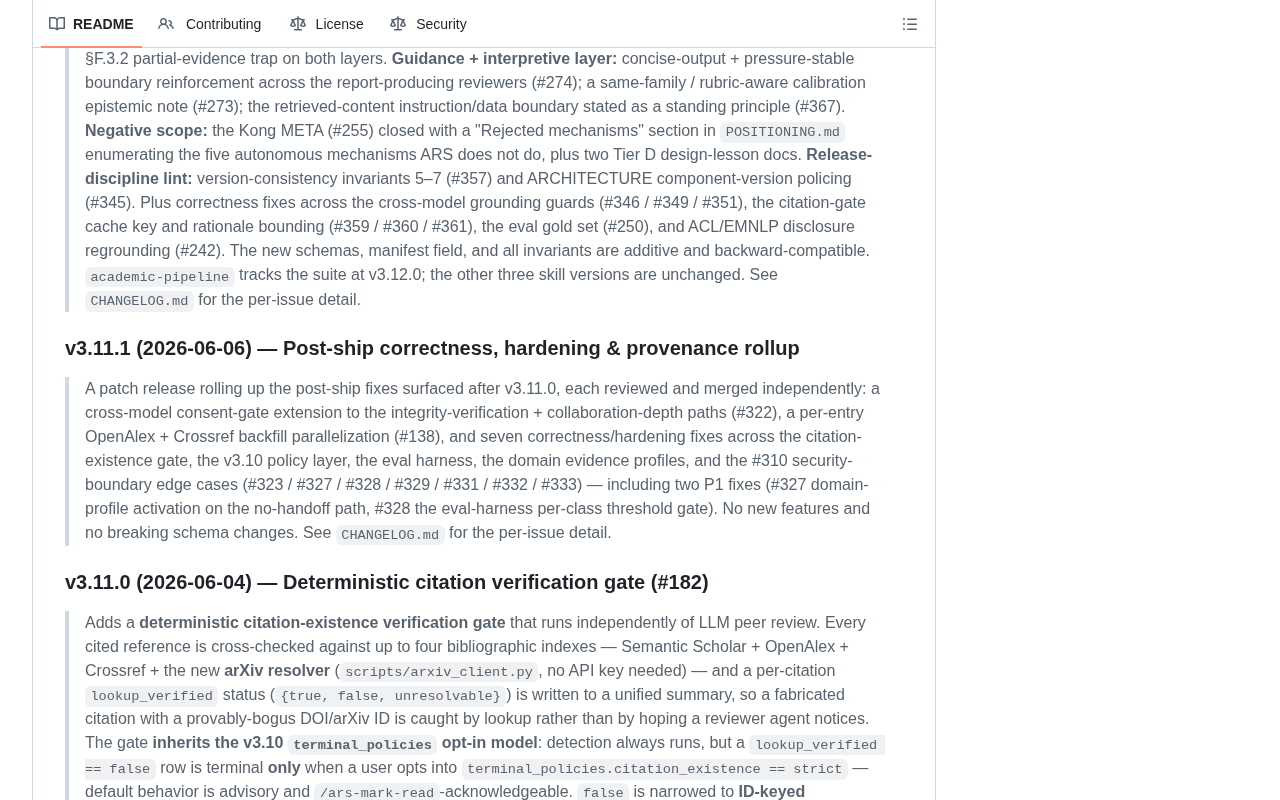
This is the most cleverly designed component of the entire framework. It switches Claude Code into a "reviewer" role, conducting a critical review of the completed draft — pointing out logical gaps, weak arguments, or ambiguous expressions. This "self-adversarial" mechanism essentially simulates a round of academic peer review before formal submission.
Peer review is the core quality control mechanism of the academic publishing system, with a history dating back to the Royal Society of London in the 17th century. In the traditional process, after a paper is submitted, the journal editor invites 2-3 anonymous experts in the same field to independently review it, evaluating the originality of the research, methodological rigor, data reliability, and soundness of conclusions. The review cycle typically takes weeks to months and often involves multiple rounds of revision. While this mechanism is a vital safeguard for academic quality, it has long faced structural challenges including reviewer resource shortages, lengthy review cycles, and inconsistent evaluation standards. AI-simulated review isn't meant to replace genuine peer review — rather, it provides researchers with a "pre-check" opportunity before formal submission, helping them identify and fix obvious flaws in advance, thereby improving the acceptance rate during formal review.
Revise: Iterative Revision Based on Feedback
Based on the review comments from the Review stage, targeted modifications are made to address identified issues one by one, forming a complete writing feedback loop. This iterative cycle of "write → review → revise" is the core methodology behind producing high-quality academic papers.
The design philosophy behind this reflects the concept of "structured multi-stage workflows," with intellectual roots traceable to pipeline design in software engineering and task decomposition principles in cognitive science. In the AI application domain, extensive practice has shown that breaking complex tasks into multiple clearly defined subtasks and having a large model execute them step by step yields significantly better output quality than a single prompt attempting to complete the entire task at once. This aligns with the core philosophy of prompt engineering techniques like Chain-of-Thought — guiding AI to think step by step rather than jumping directly to a final answer. The separation of Review and Revise is precisely about decomposing "critical evaluation" and "modification execution" into two independent stages, preventing the AI from losing its critical perspective during self-editing.
Finalize: Final Formatting and Standardized Output
The final stage handles format standardization, reference management, language polishing, and other finishing tasks, producing a submission-ready final manuscript. Academic paper formatting requirements vary by journal — from citation styles (APA, MLA, Chicago, etc.) to figure numbering conventions and abstract word limits, the details are numerous and error-prone. AI has a natural advantage in these tasks that are rule-based and highly repetitive, freeing researchers from tedious formatting details.
Why This Framework Deserves Attention
Claude Code Skills Mechanism: Modular Encapsulation of AI Capabilities
This project leverages Claude Code's Skills mechanism. Skills are essentially a method for pre-configuring professional capabilities for AI — by defining clear role positioning, execution processes, and output specifications, they enable a general-purpose large model to perform more like a domain expert on specific tasks. Specifically, Skills are stored as Markdown files in the project's .claude/ directory, with each skill file containing system-level instructions, task constraints, and output templates. When a user triggers a particular skill, Claude Code loads the corresponding instruction set, ensuring the model strictly follows the preset professional norms and process constraints during that interaction. Compared to direct conversational interaction, this modular skill encapsulation delivers more stable and controllable output quality.
Breaking down academic research — a highly specialized and process-intensive endeavor — into reusable skill units embodies an important principle in AI application design: rather than pursuing a single omnipotent prompt, build structured multi-stage workflows. This principle is being adopted by an increasing number of AI application frameworks — from LangChain's chained Agent calls, to AutoGPT's separation of task planning and execution, to the rise of various AI workflow orchestration platforms. "Decomposing complex tasks into orchestratable modular steps" is becoming the dominant paradigm in AI application development.
From "Tool" to "Collaborator": An Upgraded Role
In traditional usage patterns, we typically treat AI as an auxiliary tool for looking up information or fixing grammar. This framework's design logic is fundamentally different: it assigns AI different responsibilities at different stages of the research process — sometimes acting as a literature research assistant, sometimes as a writing aide, and sometimes transforming into a rigorous reviewer — forming a multi-role collaborative research partner system. This design philosophy better reflects the complexity of real research work.
From a human-computer interaction perspective, this multi-role design shares a striking similarity with the "rubber duck debugging" method in cognitive science. Programmers often discover bugs while explaining their code to a rubber duck; similarly, when AI poses challenges in its reviewer role, researchers often spark deeper academic thinking in the process of responding and revising. The value of AI as a "collaborator" lies not only in the suggestions it directly provides, but also in how it prompts researchers to re-examine and refine their own thought processes.
A Realistic Perspective: Opportunities and Boundaries
While these AI research tools present exciting prospects, several critical issues cannot be ignored.
First, academic integrity is an inviolable red line. There is a fundamental distinction between AI-assisted research and AI ghostwriting. The "review → revise" iterative mechanism emphasized in this framework is, in a sense, designed to ensure researchers remain deeply engaged throughout and maintain strict quality control, rather than outsourcing the entire thinking process to AI. Researchers bear ultimate responsibility for the originality, accuracy, and academic standards of their content. Currently, top academic journals including Nature and Science have successively published AI usage policies, generally requiring authors to disclose their use of AI tools upon submission and explicitly stating that AI cannot be listed as a paper's author, since it cannot bear academic or legal responsibility for the research content.
Second, the reliability of AI-generated content still requires human verification. Large language models suffer from "hallucination" problems and may fabricate non-existent literature citations or false facts. The root cause of this issue is that large models are fundamentally probability-based text generation systems — they construct responses by predicting the next most likely token rather than retrieving facts from a verified knowledge base. This means that when the model lacks sufficient training data on a particular topic, it may generate content that is grammatically fluent but factually incorrect, even fabricating entirely plausible-looking academic paper titles, DOI numbers, and author names. Especially in stages like Research and Finalize that involve source citations, item-by-item manual verification remains indispensable. The industry is currently exploring techniques like Retrieval-Augmented Generation (RAG) to mitigate hallucination issues, but in academic research — a domain with extremely high accuracy requirements — human verification will remain an irreplaceable step for the foreseeable future.
Additionally, as an open-source community project, its actual effectiveness will vary depending on the user's research field, writing habits, and specific needs. A high star count does not mean it's suitable for every academic scenario. Different disciplines have vastly different paper requirements — natural science papers emphasize data and experimental reproducibility, humanities and social science papers focus on theoretical construction and critical analysis, and engineering papers prioritize practical feasibility and performance evaluation. Whether a single generalized five-stage framework can evenly address these differentiated needs remains to be tested through broader practice.
Conclusion
The rapid rise of the academic-research-skills project reflects a broader trend of AI applications evolving from general-purpose conversation toward deep specialization in vertical professional domains. It decomposes the complex intellectual activity of academic research into a clear five-stage workflow, implemented through Claude Code's Skills mechanism, offering researchers an AI collaboration paradigm worth exploring.
For researchers, rather than debating whether "AI will replace research," it's more productive to consider "how to leverage AI to optimize your research workflow." This framework provides at least one concrete and pragmatic entry point — provided, of course, that we always clearly position AI as a collaborator rather than a replacement. In academic research — a field where originality and rigor are its lifeblood — human critical thinking, creative insight, and scholarly judgment remain core values that AI cannot replace.
Related articles
10 Free AI API Platforms Tested: Zero-Cost Guide to Calling GPT/Claude/Gemini
Hands-on review of 10 platforms offering free API keys for GPT, Claude, Gemini, DeepSeek, Grok & more. Covers signup, free quotas, and Codex integration.

RawY2K: A Chrome Retro Theme Extension That Sends Any Webpage Back to the 90s with One Click
RawY2K is a Chrome extension that transforms any modern webpage into 90s Windows 98 and GeoCities retro style. Explore its features, the Y2K aesthetic revival, and product analysis.
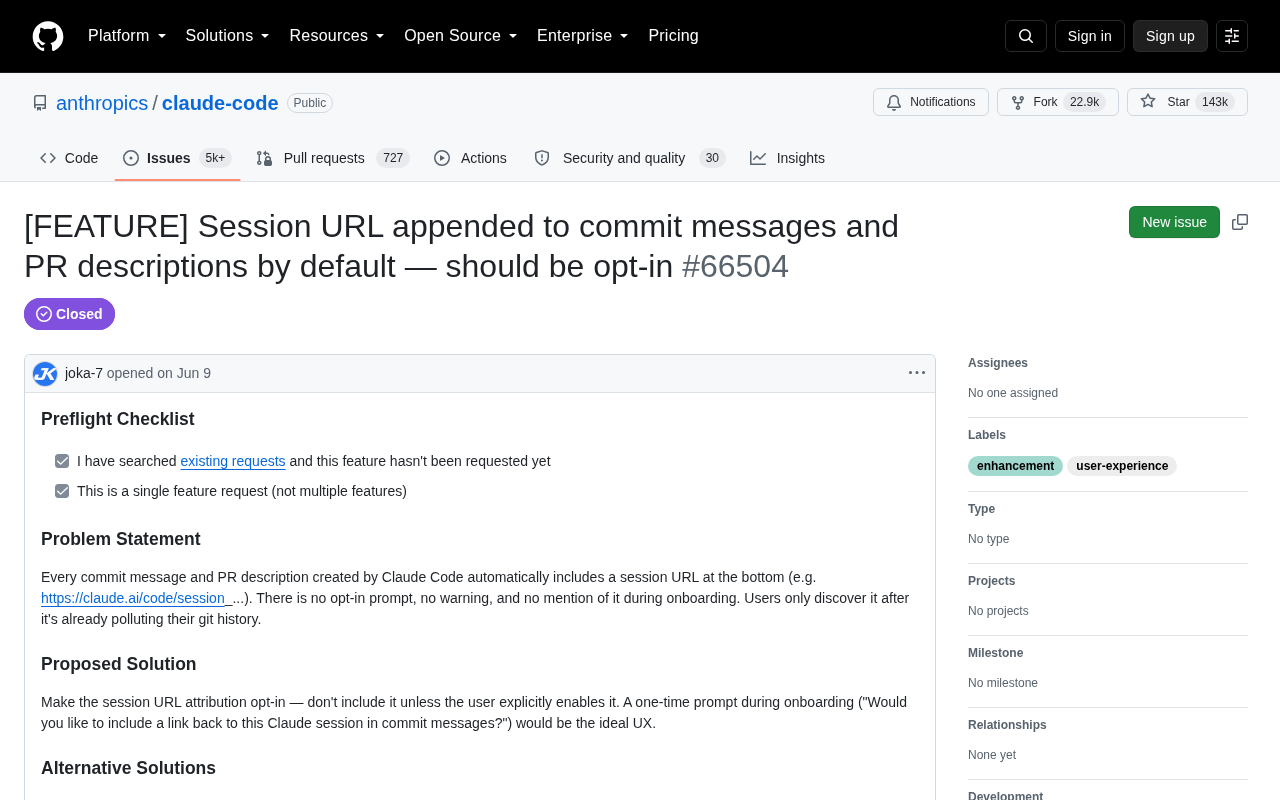
Claude's Default Behavior of Appending Session Links to Git Commits Sparks Controversy
Claude AI appends Session URLs to Git commits and PRs by default, sparking developer debate over privacy, commit history pollution, and the power of defaults.