Harness Engineering: A Three-Layer Architecture for Production-Ready AI Agents

Harness Engineering introduces a three-layer framework to make AI Agents production-ready and controllable.
Harness Engineering represents the next evolution in AI engineering beyond Prompt and Context Engineering. Its three-layer architecture — Information Layer (project understanding), Constraint Layer (error prevention), and Automation Layer (self-correction) — provides a systematic framework for deploying AI Agents in enterprise environments with stability, controllability, and verifiability.
From Prompt Engineering to Harness Engineering: Three Paradigm Shifts in AI Engineering
As large model capabilities continue to evolve, AI engineering methodologies are iterating rapidly. This Harness Engineering: From Beginner to Expert course outlines three evolutionary stages of the AI engineering paradigm: Prompt Engineering → Context Engineering → Harness Engineering.
The progression across these three stages isn't simply a matter of stacking technologies — it represents a deepening of the problem-solving layer at each step:
- Prompt Engineering: Focuses on how to craft a single, effective instruction
- Context Engineering: Addresses how to provide the model with sufficient and precise background information
- Harness Engineering: Centers on how to orchestrate multiple Agents in real-world engineering environments so they can collaborate and complete complex tasks in a stable, controllable manner
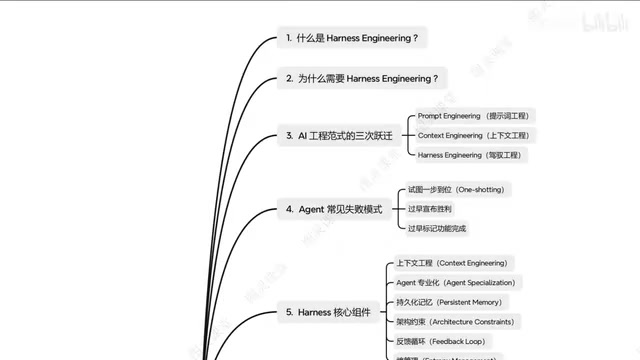
Prompt Engineering first emerged around 2020 with the release of GPT-3, when developers discovered that carefully designed instructions — such as Few-shot Prompting and Chain-of-Thought — could significantly improve model output quality. However, as task complexity grew, a single instruction was far from sufficient. Starting in 2024, the industry began widely discussing the concept of Context Engineering, which emphasizes systematically managing all information fed to the model. This includes external knowledge introduced through Retrieval-Augmented Generation (RAG), compression and filtering of conversation history, and structured return of tool invocation results. The essence of this shift is moving from "writing one good sentence" to "managing an entire information pipeline." Harness Engineering takes this a step further, elevating the focus from information management to system-level engineering control.
The word "Harness" originally refers to horse tackle or harness gear, and by extension implies "control and constraint" over a system. The core proposition of Harness Engineering is precisely this: how to fit a controllable engineering framework around highly unpredictable Agents, transforming them from "lab toys" into "enterprise-grade productivity tools."
Why Harness Engineering Is Needed: Core Pain Points in Agent Development
Every engineer who has worked on Agent development encounters the same pain point: AI-generated content frequently goes off track. You want it to implement Feature A, but it writes a pile of code you never asked for. You ask it to fix a bug, and it might introduce new problems. This lack of controllability is the biggest obstacle to deploying Agents in production today.
In the AI field, an Agent refers to an AI system capable of perceiving its environment, formulating plans, invoking tools, and autonomously executing multi-step tasks. Unlike traditional single-turn Q&A, Agents possess core capabilities such as Planning, Memory, Tool Use, and Reflection. The 2024–2025 period marks a critical window for Agents transitioning from concept to engineering practice. OpenAI's Swarm framework, Anthropic's Claude Agent, and LangChain's LangGraph are all exploring paths toward controllable Agents. But the non-deterministic output of Agents — where the same input can produce different execution paths and results — poses challenges far greater than traditional software development.
Common failure modes of Agents include:
- Direction drift: Generated content misaligned with intended goals
- Context loss: Forgetting critical information during long-chain tasks
- Hallucinated output: Generating results that seem reasonable but are actually incorrect
- Inability to self-verify: Lacking the ability to judge the quality of their own output
Among these, the "hallucination" problem of large language models deserves deeper understanding. The root cause lies in the model's working mechanism: an LLM is fundamentally a probability-based next-token predictor — it doesn't possess genuine "knowledge verification" capabilities. During training, the model learns statistical patterns of language, not a verifiable fact database. In Agent scenarios, hallucination is further amplified because Agent outputs are often directly executed (e.g., generating and running code). A seemingly reasonable but erroneous output can cause the entire task chain to fail. This is why Harness Engineering must have built-in verification mechanisms rather than relying on the model's "confidence level" to judge output quality.
The root cause of these problems is that relying solely on prompts and context cannot provide sufficiently strong constraints and feedback mechanisms for Agent behavior. Harness Engineering addresses this by building a complete engineering closed loop that encompasses information supply, behavioral constraints, and automated verification — keeping Agents running on a controllable track.
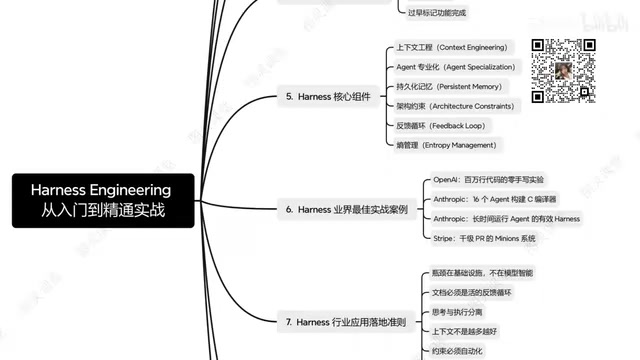
The Three-Layer Architecture in Detail: Information Layer, Constraint Layer, Automation Layer
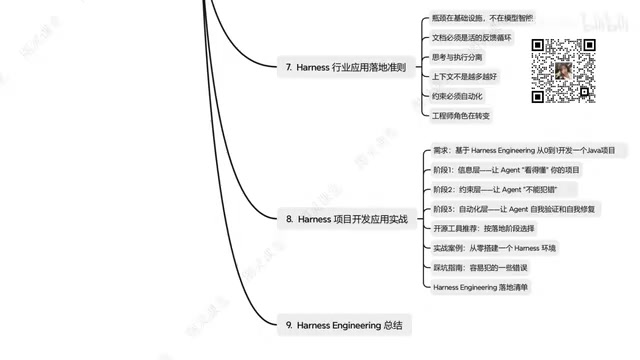
The hands-on section of the course uses Java project development as an example, demonstrating how to build a Harness development environment from scratch. The entire process is clearly divided into three layers — the key framework for understanding Harness Engineering's philosophy.
Information Layer: Helping the Agent Truly Understand Your Project
The goal of the Information Layer is to enable the Agent to comprehensively understand your project — including project structure, coding conventions, business logic, dependency relationships, and more. Only when the Agent "understands" the project can subsequent code generation have a correct foundation.
The structured design of the Information Layer typically includes several key components: project-level rule files (such as Cursor's .cursorrules or Windsurf's .windsurfrules), Architecture Decision Records (ADRs) for the codebase, API contract files (such as OpenAPI Spec), and dependency relationship graphs. More advanced approaches also include building vector indexes of the codebase, enabling the Agent to perform semantic retrieval of relevant code snippets rather than relying solely on mechanical file path matching. This structured information supply is fundamentally different from traditional RAG: while RAG focuses on external knowledge retrieval, the Information Layer emphasizes panoramic, continuous maintenance of the project's own context.
The Information Layer addresses the "context" problem, but in a far more systematic way than traditional Context Engineering. Rather than cobbling together text fragments on the fly, it establishes a structured information supply mechanism that keeps the Agent continuously aligned with an accurate understanding of the project.
Constraint Layer: From "Praying It Doesn't Break" to "Designing Mechanisms That Prevent Breakage"
The core objective of the Constraint Layer is to prevent the Agent from making mistakes — a direct response to the pain point of generated content going off track.
The Constraint Layer uses rules, boundaries, and checkpoints to restrict Agent behavior within reasonable bounds. When the AI attempts to deviate from its intended direction, constraint mechanisms can pull it back in time, preventing directional errors. This reflects a critical mindset shift: from "praying the AI doesn't mess up" to "designing mechanisms that prevent the AI from messing up."
In engineering practice, the Constraint Layer can be implemented in multiple ways. The most basic is output format constraints (e.g., requiring JSON Schema-compliant output). More advanced approaches include: AST (Abstract Syntax Tree) validation during code generation — ensuring that generated code is syntactically legal; rule-engine-based behavioral whitelists/blacklists — explicitly defining what operations the Agent can and cannot perform; and using a Guardian Model to perform secondary review of the primary Agent's output — using another model to verify the first model's output quality. In enterprise scenarios, the Constraint Layer also needs to integrate with CI/CD pipelines, where every code change generated by the Agent must pass through automated gates such as static analysis (e.g., SonarQube), type checking, and security scanning. This "defensive programming" philosophy extends from human developers' code review practices, but in Agent scenarios it needs to be far more automated and real-time.
Automation Layer: Giving the Agent Self-Verification and Self-Correction Capabilities
The Automation Layer builds a complete feedback closed loop:
- Agent generates code
- Automated verification runs
- Problems are detected
- Autonomous correction is applied
This feedback loop mechanism draws from the negative feedback regulation concept in Cybernetics: the system self-corrects by continuously sensing the deviation between output and the expected target. In AI programming scenarios, this typically manifests as a Generate-Compile-Test-Fix Loop. In concrete implementation, the Agent automatically triggers compilation, runs unit tests, and executes integration tests after generating code. If failures are detected, error information is fed back to the Agent for self-correction. Research shows that this closed-loop mechanism can raise an Agent's first-pass accuracy from approximately 40% to over 80%. However, it's important to set an upper limit on loop iterations (typically 3–5 times) to prevent the Agent from falling into an infinite repair cycle — repeatedly attempting fixes but never solving the problem, potentially making things worse.
This mechanism gives the Agent "self-correction" capabilities, dramatically reducing the cost of manual intervention. This is also the key to achieving the goal of "virtually never needing to write a single line of code manually."
AI Coding Tool Selection: Different Tools for Different Stages
Interestingly, Harness Engineering isn't tied to any specific tool. Instead, it emphasizes choosing the most appropriate AI coding tool for each development stage.
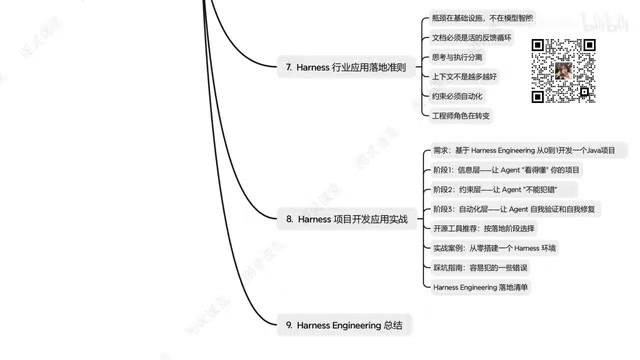
The course introduces the current mainstream AI coding tools and provides recommendations for tool selection across different stages — Information Layer, Constraint Layer, and Automation Layer. This "tool combination" approach reflects engineering maturity — there's no silver bullet, only optimal combinations for specific scenarios. For example, during the Information Layer stage, tools that support project-level rule configuration and codebase indexing have a clear advantage; during the Automation Layer stage, tools that deeply integrate with terminals and testing frameworks become more critical. Tool selection fundamentally serves the implementation of the three-layer Harness architecture, rather than being constrained by the tools themselves.
Industry Best Practices and Harness Implementation Guidelines
The course also references engineering practice cases from leading organizations such as OpenAI and Anthropic. These companies have each developed their own methodologies as they push Agents toward production environments.
In its 2025 Agent building guide, OpenAI proposed the "single Agent first" principle — don't rush to build multi-Agent systems before proving that a single Agent can't handle the job, because the coordination overhead and debugging complexity of multi-Agent systems are often severely underestimated. Anthropic, in its research, emphasizes the concept of "deterministic boundaries for tool use" — the scope within which an Agent can make autonomous decisions should be clearly defined, and when that boundary is exceeded, human confirmation must be requested (Human-in-the-Loop). Both companies stress the central importance of Evaluation: without a reliable automated evaluation system, iterative optimization of Agents is simply impossible. Google DeepMind's practice focuses on Agent Observability — through detailed trace logs and decision tree visualization, developers can understand "why the Agent did what it did" rather than merely seeing the final output.
By distilling the common principles from these best practices, the course summarizes a set of implementation guidelines for Harness in industry applications. The value of mastering these guidelines is that developers can integrate Harness principles into their actual projects rather than staying at the conceptual level. From setting up the environment from scratch, generating code, and completing projects to summarizing common pitfalls and implementation checklists, the entire process forms a reusable practical pathway.
Conclusion: The Inevitable Path to Agent Engineering
Harness Engineering represents a critical direction in AI development's evolution from "craftsmanship" to "engineering discipline." When we're no longer satisfied with AI occasionally delivering impressive answers and instead demand that it produce stable, controllable, and verifiable output consistently in enterprise-grade projects, a comprehensive harness framework becomes indispensable.
- Information Layer solves "Does it understand?"
- Constraint Layer solves "Will it make mistakes?"
- Automation Layer solves "Can it self-repair?"
These three layers together form the skeleton of Agent engineering. For teams looking to truly deploy AI in production environments, understanding and practicing Harness Engineering may be the crucial step in crossing the chasm between "the demo is amazing" and "production is a disaster." This chasm has a classic name in the tech world — the "gap" in the technology adoption lifecycle described by Geoffrey Moore in Crossing the Chasm. And the three-layer engineering framework provided by Harness Engineering is precisely the bridge that helps Agent technology cross from early adopters to mainstream market adoption.
Related articles

Chain of Thought Isn't Just for AI: How Humans Can Use CoT to Improve Thinking Quality
Chain of Thought isn't just a prompt trick for large models. Starting from a Hacker News discussion, this article analyzes why CoT works for human thinking too, breaks down actionable ways to transfer it, and highlights the key differences between human CoT and machine CoT.
Cloudflare Teams Up with OpenAI: Closi…
Cloudflare Teams Up with OpenAI: Closing the Loop from Vulnerability Discovery to Defense with AI
Cloudflare uses OpenAI Daybreak to investigate security vulnerabilities and generate reviewable remediation plans, while developers use Codex to boost coding efficiency and quality.

Orca Multi-Agent Orchestration in Practice: A Guide to Parallel Collaboration with Claude and Codex
Orca is Stable AI's free open-source agent workbench supporting 34 agents like Claude Code and Codex in parallel. Learn its Git worktree isolation, multi-model orchestration, and mobile management.