Harness Engineering: An Advanced Methodology for Programmers to Master AI Coding

How programmers can master AI coding through Harness engineering methodology in enterprise projects.
AI coding has evolved from prompt engineering to context engineering to Harness engineering. This article explains how Harness—an engineering methodology—solves core pain points like hallucinations, non-standard code, and infinite loops in enterprise-grade AI development, and why programmers' true value lies in harnessing AI.
From Prompt Engineering to Harness: The Three Evolutions of AI Coding
When ChatGPT first launched, "Prompt Engineering" quickly rose to fame, even spawning a job title called "Prompt Engineer." Its core logic was simple: the clearer you describe the problem, the more accurate the AI's answer. This question-and-answer style of interaction works well for simple scenarios with clearly defined boundaries.
But as task complexity grew, prompts alone started to fall short. This gave rise to the second stage—"Context Engineering." For instance, if you want AI to mimic a particular author's writing style, a single instruction is far from enough. You need to feed the model a large amount of historical articles, stylistic features, and tone habits as "context" before it can truly reproduce the effect you're after.
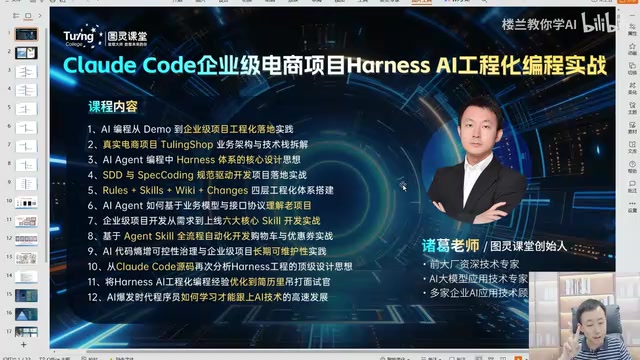
When we turn our attention to highly complex scenarios like enterprise-grade software development, the approaches of the first two stages begin to look inadequate. This brings us to the core topic of this article—Harness Engineering.
What Is Harness? And Why Is It Key to Enterprise AI Coding
Harness literally means the gear used to control and steer a horse. The metaphor is quite vivid: a large AI model is like a powerful yet hard-to-control wild horse, while the Harness is the "steering system" that lets you ride it steadily and guide it in the right direction.
According to a public lecture shared by Bilibili tech blogger Teacher Zhuge, Harness AI engineering-based coding is not a single tool, but an entire engineering methodology designed around the question of "how to get AI to stably and controllably produce high-quality code." It specifically addresses the core pain points that programmers repeatedly encounter in day-to-day AI coding.
Interestingly, most content on the market that discusses Harness stays at the conceptual level—after listening, you get a general idea, but when it comes to actually implementing it, you're still at a loss. Yet the true value of engineering-based coding lies precisely in every detail of hands-on implementation.
The Real Dilemma of AI Coding: Why Many People Retreat to "Old-School Programming"
Many developers face repeated setbacks when actually using AI for coding, and some simply give up on AI and return to writing code entirely by hand. These problems mainly fall into the following categories:
Hallucination Problems
AI-generated code looks reasonable but actually calls APIs or methods that don't exist at all—only to discover at runtime that it won't run.
Non-Standard Code
The generated code has a chaotic style that doesn't conform to team standards, resulting in extremely high maintenance costs later on.
"Dumbing Down" and Infinite Loops
This is the most maddening scenario: when facing a problem AI can't solve, dozens of rounds of back-and-forth still fail to resolve it. For people without a technical background, the problem gets stuck here forever, with no solution.

Teacher Zhuge points out that these are exactly the problems Harness engineering-based coding aims to systematically solve. In other words, whether you use AI coding well or not depends less on how powerful the model itself is, and more on whether you have a mature engineering methodology to "harness" it.
Can Beginners Really Build Enterprise-Grade Projects from Scratch with AI?
There's a popular claim circulating online: "Even non-technical product managers can use AI to build a complete project from scratch," which has left many programmers feeling career anxiety.
On this point, Teacher Zhuge offers a calm judgment: there's no need to worry at all. If you look closely at those "beginner-builds-from-scratch" cases, most of what gets built are simple small products or demos with straightforward business logic—and for such projects, it's indeed feasible.
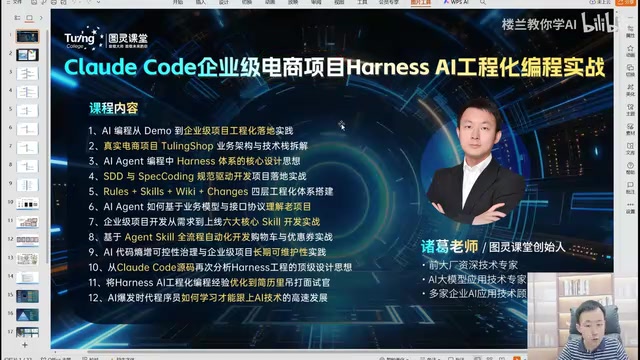
But real enterprise-grade projects are a different matter entirely:
- Internal management systems with extremely complex business logic, such as ERP
- Large-scale internet systems with extremely high technical requirements, involving microservices, distributed systems, and high concurrency
Once such projects hit a bottleneck that AI can't solve, people without technical skills simply can't step in to debug, and the entire development process grinds to a halt. According to the presenter, even at top companies like Anthropic and OpenAI—where over 90% of the code is generated by AI—senior engineers' oversight and engineering systems are still needed behind the scenes. This precisely confirms that a programmer's core value won't disappear; the skill requirement has simply shifted toward "harnessing AI."
Practice-Oriented: Building an E-Commerce Project with Claude Code
Unlike tutorials that stay at the conceptual level, Harness engineering-based coding places greater emphasis on hands-on practice. Teacher Zhuge's course is built around an e-commerce project, for a straightforward reason: everyone is familiar with e-commerce business, so there's no need to explain the business logic in detail, allowing attention to focus on the engineering methodology itself.
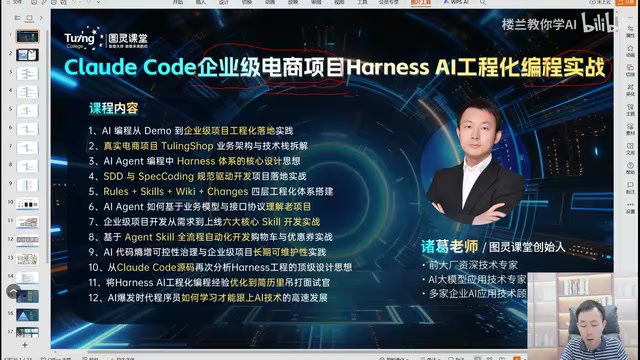
In terms of the tech stack, the hands-on practice uses a development environment combination of Claude Code + VS Code, with the backend model being China's top-performing Zhipu GLM large model. The presenter specifically notes that using a domestic model in the demo is for compliance reasons, but the Harness methodology itself is model-agnostic—pairing it with the more powerful Claude model will only produce better results.
This method is also highly general-purpose: although an e-commerce project is used as an example, it applies to the development of all enterprise-grade, large-scale projects. Master the methodology, and you hold the key to harnessing AI for complex engineering tasks.
Conclusion: The Programmer's Role Is Changing
The wave of AI coding is irreversible, and having AI produce 80%–90% of enterprise code is already the general trend. But this doesn't mean programmers will be obsolete—humans still have plenty of irreplaceable work. The focus simply shifts from "writing code by hand" to "designing engineering systems, harnessing AI, controlling quality, and cracking the hard problems AI can't solve."
From prompt engineering, to context engineering, and now to Harness engineering, the evolution of AI coding is essentially an ongoing upgrade of the "way humans and machines collaborate." For programmers, rather than worrying about being replaced, it's better to proactively master this engineering methodology and become the person who can truly harness AI.
Related articles

Alibaba Launches Happy Shrimp: AI-Powered One-Click Complete Song Generation
Alibaba launches Happy Shrimp, an AI music generation tool that creates complete songs with lyrics, melody, arrangement, and vocals from natural language descriptions. In-depth analysis of its core features, differentiation from competitors like Suno, and industry impact.
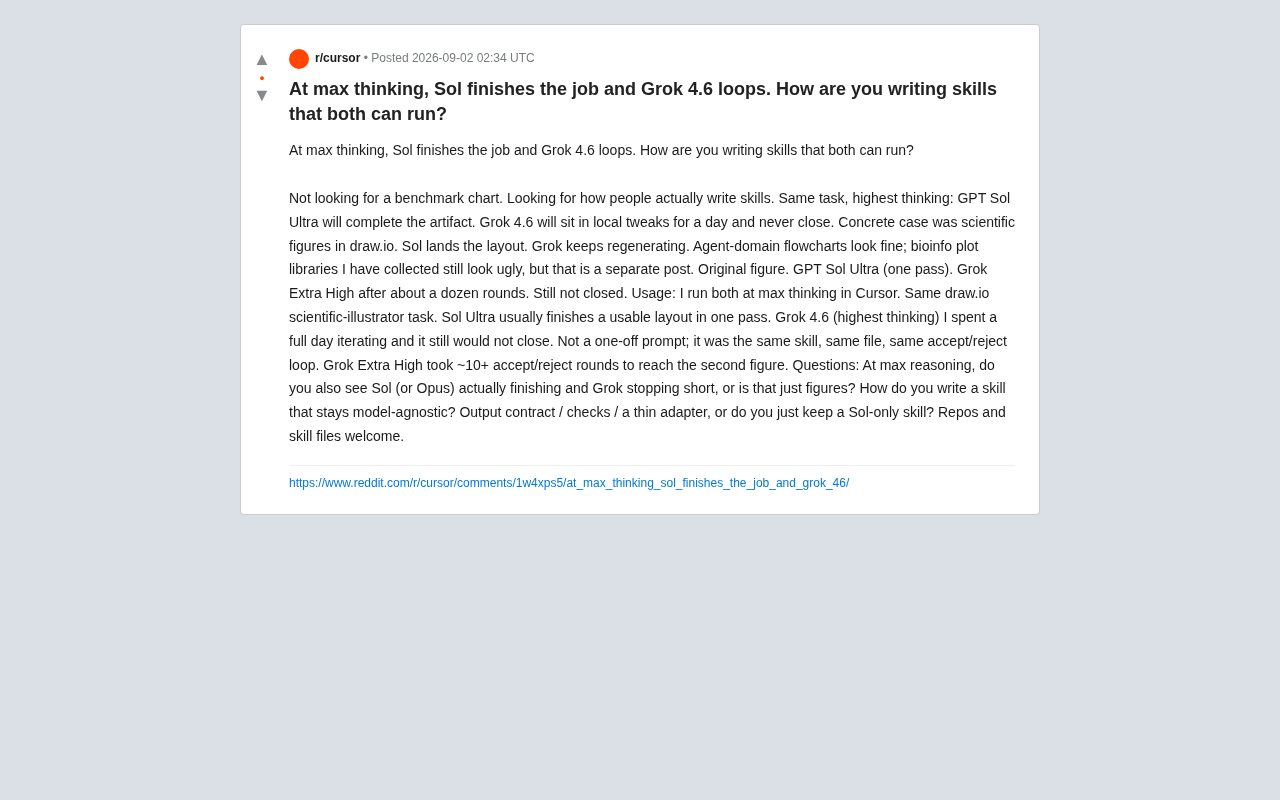
GPT Sol Ultra vs Grok 4.6: Real-World Task Completion Benchmark in Reasoning Mode
Developer benchmark reveals GPT Sol Ultra completes draw.io scientific diagrams in one iteration while Grok 4.6 fails to converge despite maximum reasoning mode, exposing that reasoning depth ≠ task delivery capability.

OpenAI Authorship Dispute: The Battle Over Academic Boundaries in the AI Era
OpenAI disputes authorship with mathematician Tristan Buckmaster over Navier-Stokes research, raising ethical questions about AI involvement in science.