Harness Engineering from Basics to Practice: A Complete Guide to Multi-Agent Project Development
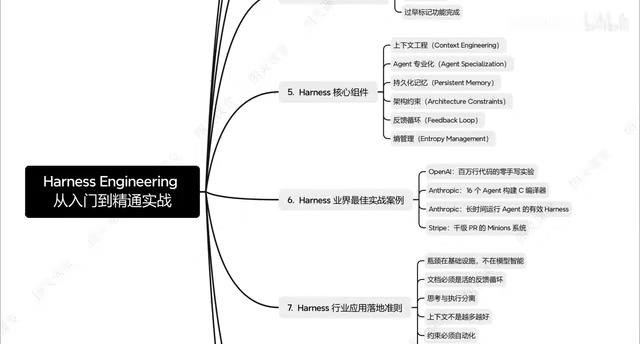
A systematic guide to harnessing AI agents with a three-layer architecture for controlled, end-to-end Java project development.
This article covers the core content of a tutorial series on AI-assisted programming, tracing the paradigm evolution from Prompt Engineering to Context Engineering to Harness Engineering. Harness Engineering uses a three-layer architecture — information, constraints, and automation — to systematically address agent failures in real projects. The information layer helps agents understand the project, the constraint layer prevents directional errors, and the automation layer closes the generate-verify-correct loop. The course distills best practices from OpenAI and Anthropic and provides a ready-to-use deployment checklist, making it ideal for developers struggling with unpredictable agent output or teams integrating agents into enterprise projects.
From Prompt Engineering to Harness: Three Paradigm Shifts in AI Engineering
AI-assisted programming is undergoing a fundamental paradigm shift. This tutorial series breaks AI engineering into three distinct stages: Prompt Engineering → Context Engineering → Harness Engineering.
In the early days, we crafted clever prompts to coax models into producing the output we wanted. Then we realized that feeding the model the right context was what actually mattered. Harness Engineering takes this a step further — it focuses on systematically harnessing agents, enabling them to autonomously complete complex tasks within a controlled engineering framework.
The underlying logic of this evolution is simple: a single prompt or a well-crafted context window isn't enough to prevent the recurring failures agents encounter in real-world projects. When we ask an agent to generate code and handle end-to-end development, the real challenge isn't "getting it to write code" — it's "keeping it from writing the wrong code" and "making sure it can self-correct when it does."
Context Engineering serves as the transitional paradigm between the prompt phase and the Harness phase, and it deserves its own explanation. Its core insight is that model output quality is tightly correlated with what's inside the context window — not just the question itself, but also relevant code snippets, file structures, conversation history, tool call results, and externally retrieved documents. RAG (Retrieval-Augmented Generation), long-context filling, and few-shot example construction are all concrete implementations of Context Engineering. However, as task complexity increases and agents need to make autonomous decisions across multiple steps, simply "feeding the right content" is no longer sufficient. The agent's behavioral trajectory and intermediate decisions also need to be constrained and validated — which is precisely the next-level problem Harness Engineering aims to solve.
Why Agents Fail: The Core Problems Harness Engineering Solves
Anyone who has used AI coding tools has experienced this: you ask an agent to generate code, and it goes completely off the rails — producing something totally different from what you wanted, heading in entirely the wrong direction. This is exactly the "common agent failure patterns" that this course digs into.
The value of Harness Engineering lies in using a set of core components to directly address these failure modes. It's not about switching to a smarter model — it's about using engineering techniques — constraints, validation, feedback loops — to bring the agent's uncertainty within an acceptable range.
The tutorial also references industry engineering practices from companies like OpenAI and Anthropic as benchmarks. After unpacking the core ideas behind these best practices, the course distills them into Harness industry deployment principles, so learners don't just imitate case studies but internalize a transferable methodology.
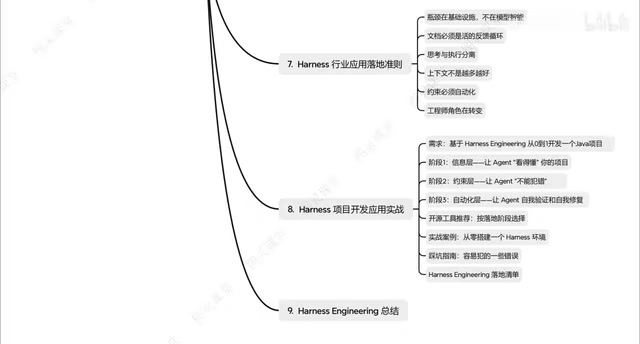
Agent failures in real projects typically fall into three categories: goal drift (the agent gradually deviates from the original intent during multi-step execution, especially in long tool-call chains), hallucination cascades (errors generated in one step are treated as facts by subsequent steps, causing mistakes to compound), and context forgetting (in very long tasks, critical constraints established early on are implicitly "forgotten" by the model). What these three failure modes share is that a single prompt can't prevent them — constraints and verification must be continuously applied throughout the entire execution pipeline. The three-layer Harness architecture — information layer, constraint layer, and automation — directly defends against each of these failure modes respectively.
The Three-Layer Architecture: Information, Constraints, and Automation
The most hands-on section of the course maps Harness onto a Java project built from scratch, breaking the entire development process into three progressive phases.
Information Layer: Helping the Agent Understand Your Project
The first phase is the information layer. Its core goal is to ensure the agent genuinely "reads" your project structure, code logic, and business context. The agent needs to understand the full picture of the project before meaningful autonomous development can happen. This phase answers the question: what needs to be done?
Constraint Layer: Keeping the Agent from Making Mistakes
The second phase is the constraint layer — the key to solving the "agent going off the rails" problem. By establishing reasonable limits and boundaries, you prevent the agent from generating content that deviates from requirements or making fundamental directional errors. The essence of the constraint layer is codifying human engineering standards into rules the agent must follow, reducing error probability at the source.
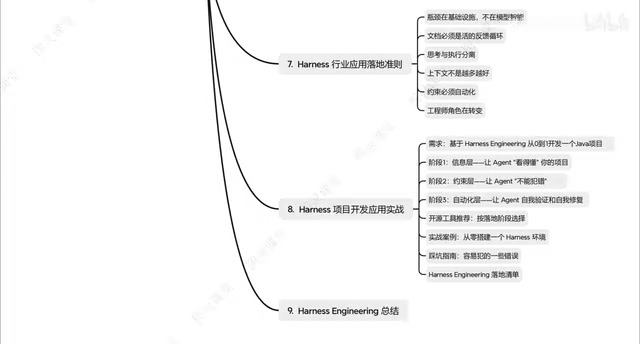
Automation: Enabling Self-Verification and Self-Correction
The third phase is the automated feedback loop. Once development is complete, how do you get the agent to automatically verify whether the generated code has issues? And how does it automatically correct problems when it finds them? This layer chains "generate → verify → correct" into an automated pipeline — the technical foundation for achieving the goal of "writing virtually zero code by hand."
The three layers build on each other: the information layer ensures you're heading in the right direction, the constraint layer ensures the process stays error-free, and the automation layer ensures results are verifiable and fixable — together forming a complete agent harnessing system.
This "generate → verify → correct" automated loop typically relies on two mechanisms in practice: first, static analysis and unit testing, where the agent automatically triggers compilation, linting, and test suites after writing code, feeding failure logs back to the model as correction input; second, reflection and self-critique loops, where the model treats its own output as new input and reviews it in a "critic" role. Anthropic refers to the latter as a "critic loop" in its agent best practices documentation, and OpenAI's Swarm framework has a similar handoff mechanism. Combined, these allow agents to complete multiple rounds of iteration without human intervention, dramatically reducing the cost of manual review. This is the engineering foundation behind the course's claim of "writing virtually no code by hand."
Tool Selection and Hands-On Practice: From Environment Setup to Project Delivery
The course emphasizes choosing different AI coding tools for different development phases, and introduces how today's mainstream tools fit into each phase. This is highly practical advice — there's no universal tool. The key is picking the right combination for information comprehension, code generation, validation, and testing.
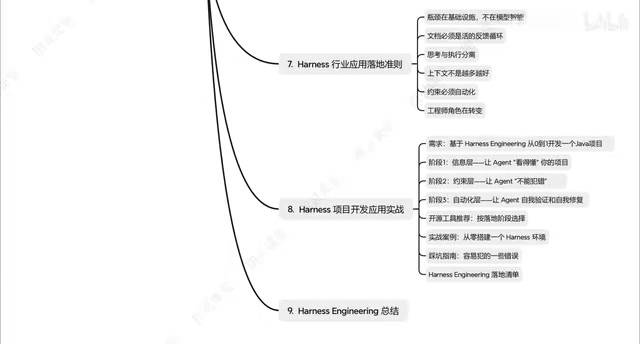
The hands-on section centers on "setting up a Harness development environment from scratch," walking learners step by step through getting the environment running, generating code, and completing a full Java project. The entire process emphasizes "writing virtually no code by hand," giving learners a concrete feel for what a complete Harness environment build looks like end to end.
After the project is complete, the course includes a retrospective that covers common mistakes and pitfalls encountered during development, and provides a Harness Engineering deployment checklist so learners can quickly apply this methodology to their own projects.
Who Is This Course For?
Based on how the content is structured, this tutorial is well-suited for two groups: developers who are already using AI coding tools but struggling with unpredictable agent output, and technical teams who want to systematically understand the evolution of AI engineering paradigms and genuinely integrate agent capabilities into enterprise-grade projects.
Its value isn't in teaching you to write better prompts — it's in establishing a reusable engineering framework that transforms agents from "occasionally reliable assistants" into "controllable, trustworthy productivity tools." For anyone looking to avoid common pitfalls in multi-agent project development, understanding the three-layer Harness architecture and its deployment principles is an excellent starting point.
Related articles

LynnReal-Omni: 32B Unified Video Diffusion Model Goes Open Source with Multi-Task Coverage in Four Steps
LynnReal-Omni is a 32B unified video diffusion model on MiniMax H3, covering text-to-video, pose guidance, style transfer, restoration in 4 steps. Flash version generates 540p video in 377ms on one H100.

Anthropic Co-Founder: AI 'Kill Switch' May Need to Be Mandatory by Law
Anthropic's co-founder tells the BBC that AI 'kill switches' may need to be legally mandated. We analyze the industry logic, technical challenges, and the tension between regulation and innovation.

The AI Data Center Boom Is Colliding With Cities Scarred by Heavy Industry
The AI data center boom is clashing with post-industrial communities. Philadelphia's case reveals structural conflicts between AI growth, energy use, water, and environmental justice.