Harness Engineering: From Concept to Enterprise-Grade Agent Deployment

Harness Engineering is becoming a must-test topic in AI Agent interviews, assessing production-grade engineering implementation capability.
The article explores Harness Engineering, an emerging concept in AI Agent interviews, noting that interviewers have shifted from concepts to engineering details like tool-call fault tolerance, data security, high concurrency, tenant isolation, and memory management. It traces the term's origin—first used in a February 2026 blog post, later promoted by OpenAI—though related practices were already explored by multiple companies in late 2025. The author stresses that deliverable Agent projects must explicitly design fault tolerance, isolation, concurrency, and memory mechanisms rather than stacking frameworks, and recommends learning through a "concept—code—demonstration" approach to prove implementation capability, concluding that Harness Engineering is shifting from a bonus point to a must-ask question.
If you've been preparing for interviews in the AI Agent space lately, you've probably been hearing a term come up frequently: Harness Engineering. But most content on the market either stays at the conceptual level or only walks through building a simple demo, which is still a long way from the "deployable delivery" that enterprises actually require.
According to a share from Bilibili creator Teacher Xiao of Ma's Education, interviewers' focus when evaluating agent projects has now shifted to engineering details: how tool-call errors are handled, how data security is guaranteed, how high-concurrency scenarios are designed, how users and tenants are isolated, and how memory gaps are repaired. The answers to these questions are precisely what constitutes the core practice of Harness Engineering.
What Harness Engineering Is and Where It Comes From
Harness Engineering is a systems engineering approach for agent development that emphasizes making agents run stably in real production environments, rather than merely completing a one-off task demonstration. It covers multiple dimensions including tool invocation, long-task orchestration, context management, and secure execution.
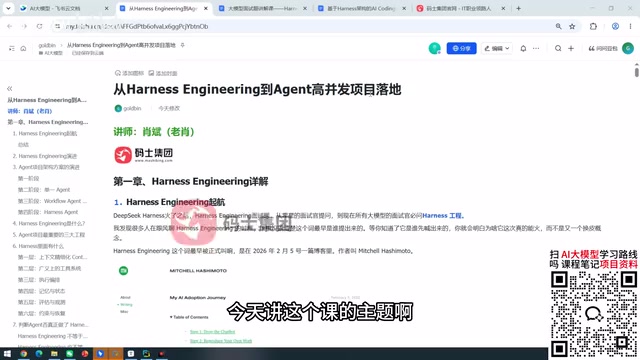
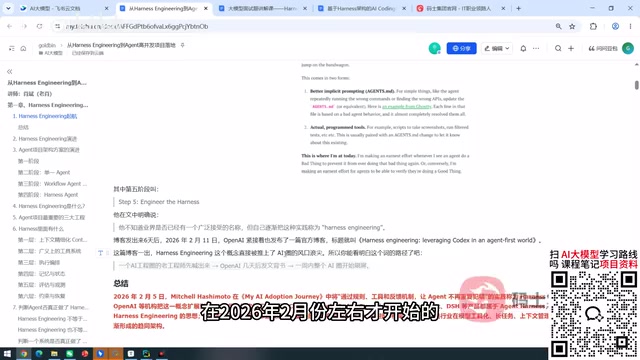
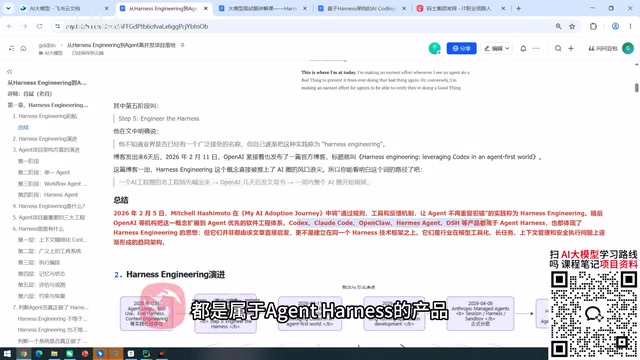
According to Teacher Xiao's account, the term Harness formally appeared in the agent context on February 5, 2026. An author named Michelle Hashimoto used the expression "Harness" in the fifth chapter of her blog. Six days later, on February 11, OpenAI published a blog post with "Harness Engineering" in the title, extending the term to the entire agent architecture level. After that, products such as OpenCloud, Claude Code, Hermes Agent, and DeepSeekAd's DSH emerged one after another, and the industry gradually reached a consensus.
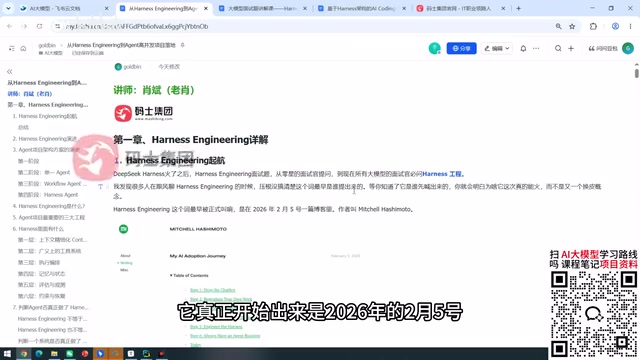
One common misconception needs to be clarified: the ideas behind Harness Engineering were not born from that blog post. According to Teacher Xiao's observations, in the second half of 2025, companies such as OpenAI, Anthropic, and China's DeepSeek were already exploring similar architectures—they just didn't have a unified name at the time. The blog post and OpenAI's follow-up simply "gave a name" to engineering practices that already existed.
Agent Harness refers to the entire runtime support system wrapped around a language model, typically including components such as tool registration and scheduling, context window management, state persistence, error retry and fallback, sandboxed execution environments, and observability (logging and tracing). You can think of it by analogy as the "baseboard" of a microcontroller or the "wiring harness" of a car chassis: the model itself is only responsible for reasoning and generation, while the Harness determines whether those outputs can be executed safely and controllably and fed back to the model to form a closed loop. Therefore, Harness is not the name of a specific framework or SDK, but an umbrella term for a layer of architectural responsibility, implemented in different forms by different products—for example, the agent loop, function-calling protocols, memory storage layers, and permission gateways.
"Harness" in the agent context differs from the concept of the same name in the testing field. In software testing, a harness refers to the driver framework used to automate test execution; in the Agent context, it emphasizes the engineering layer that "harnesses" model behavior, constrains its action space, and ensures execution reliability. This semantic difference can easily cause confusion, so it should be understood as a "runtime container and control system" rather than a testing tool.
Engineering Challenges of Enterprise-Grade Agent Projects
When interviewers probe into project details, they are essentially judging whether the candidate has genuinely dealt with production-grade problems. A deliverable agent project must have clear designs at least at the following levels:
- Tool-call fault tolerance: how to degrade or retry when external APIs time out, return malformed responses, or have insufficient permissions.
- Data security and tenant isolation: how to avoid data crosstalk in multi-user scenarios and how to enforce permission boundaries.
- High-concurrency support: how to combine mechanisms such as task queues, rate limiting, and asynchronous execution.
- Memory management: how to maintain task continuity when context is truncated in long conversations or memory retrieval fails.
These capabilities cannot be obtained simply by stacking frameworks; they need to be explicitly designed into the project architecture. Teacher Xiao emphasizes that interviewers won't ask these questions in isolation, but will verify whether the candidate has truly implemented them by following up on project details.
Multi-tenant isolation (Tenant Isolation) refers to partitioning independent data and execution boundaries for different users or organizations within the same Agent service, preventing one tenant's conversation history, tool credentials, memory vectors, or temporary files from being accessed by another tenant. Common implementations include: logically partitioning by tenant_id at the storage layer and forcing tenant conditions on every query; assigning independent keys and tool authorization scopes to each tenant; restricting namespaces during vector retrieval; and isolating sandbox execution environments at the process or container level. Incomplete isolation often does not surface in functional testing, but can cause data crosstalk under concurrency or privilege-escalation scenarios—which is why interviews often probe into specific implementations rather than concepts.
Memory gaps refer to the phenomenon in long conversations or long tasks where, due to context window truncation, loss of key information during summarization/compression, or failure of external memory retrieval, the Agent forgets prior constraints or completed steps. Mitigation approaches typically include layered memory (short-term conversation buffers, long-term vector stores, structured task state), externalizing critical state as explicit variables rather than relying on the model's implicit memory, and generating a traceable task summary before each truncation. From an engineering standpoint, you also need a fallback strategy for when memory retrieval fails—for example, reverting to the most recent complete snapshot—to avoid the task being irrecoverably interrupted from an intermediate state.
From Concept to Practice: The Value of Project Demonstrations
To illustrate how Harness Engineering is reflected in code, Teacher Xiao drew on two projects he covered in April and from July to August, breaking down the project code and demonstration process against the requirements of Harness Engineering. This "concept—code—demonstration" three-in-one approach is closer to how companies actually assess candidates in hiring than pure theory or single-point demos.
For learners, the key to understanding Harness Engineering is not memorizing the definition of the term, but being able to answer in your own projects: what does the system do when a tool call fails? How are resources isolated when multiple tenants make requests simultaneously? How does the task continue when the memory window overflows? The answers to these questions are the evidence that harness engineering has been implemented.
Interview Preparation Advice
According to Teacher Xiao, he has already compiled the Harness-related questions interviewers might ask. Judging from the trend, Harness Engineering is shifting from a "bonus point" to a "must-ask question." Developers preparing for Agent-focused interviews should clarify the engineering details of their projects—especially the frequently probed areas of fault tolerance, isolation, concurrency, and memory management—rather than stopping at model invocation and prompt tuning.
Although the name Harness Engineering comes from the early 2026 blog post and OpenAI's follow-up, its engineering practices had already been evolving in the agent products of multiple companies. Understanding this timeline helps you demonstrate a grasp of the industry's trajectory in interviews and gives your project design more direction.
One-line Summary
Harness Engineering is becoming a must-test topic in AI Agent interviews, assessing production-grade engineering implementation capability.
Paragraph Summary
The article centers on Harness Engineering, an emerging concept in AI Agent interviews, noting that interviewers have shifted from conceptual questions to engineering details such as tool-call fault tolerance, data security, high concurrency, tenant isolation, and memory management. It traces the term's origin: first used in a blog post in February 2026 and subsequently promoted by OpenAI, though related practices had already been explored by multiple companies in the second half of 2025. The author emphasizes that deliverable Agent projects must explicitly design fault tolerance, isolation, concurrency, and memory mechanisms in their architecture rather than stacking frameworks. For learning, one should combine "concept—code—demonstration" and use project details to prove implementation capability. Finally, it offers interview preparation advice, arguing that Harness Engineering is shifting from a bonus point to a must-ask question.
Related articles

DeepCell: One-Click AI Generation of Documents, Spreadsheets, and Slides
DeepCell tops Product Hunt with one-click generation of documents, spreadsheets, and slides, using the .deepcell format for linked updates, designed for System 2 tasks like modeling and sales reviews.

Doneas: 15-Minute Daily Accountability Calls That Keep Indie Developers From Procrastinating
Doneas is a daily accountability tool for indie developers: plan tasks on Monday, join a 15-minute call with five builders each day, and log deliveries on a public progress page. This article analyzes its core mechanics, effectiveness, and potential issues around retention and matching.

Fastlane 2.0: Fully Automated AI Ad Campaigns, From Creative to Optimization
Fastlane 2.0 is an AI ad automation tool: enter your website and it learns your brand, generates video and image ads, and runs and optimizes them on Meta, TikTok, Instagram, and YouTube.