Harness Engineering: Origins of the Next-Gen Agent Development Paradigm and Key Delivery Considerations

Harness Engineering shifts AI agent development from demo-grade to production-ready, focusing on robustness, security, and scalability.
Harness Engineering is an emerging architectural philosophy in AI agent development that emphasizes stable, enterprise-grade delivery over mere demo capability. The term was first introduced by Mitchell Hashimoto and later expanded by OpenAI into a systems-level concept. Importantly, the underlying engineering patterns predate the term itself — OpenAI, Anthropic, DeepSeek, and others had already been independently converging on similar architectures. For developers, Harness Engineering's core value is a mindset shift: competitive agent projects must account for tool call robustness, multi-tenant data isolation, high-concurrency support, and long-conversation memory management from the outset.
What Is Harness Engineering?
A new term has been making the rounds in the agent development community lately — Harness Engineering. It's not a single framework, but rather a new engineering approach and architectural philosophy for building AI agents. Simply put, it shifts the focus from "can we ship a demo?" to "can we deliver an agent system that runs reliably in an enterprise environment?"
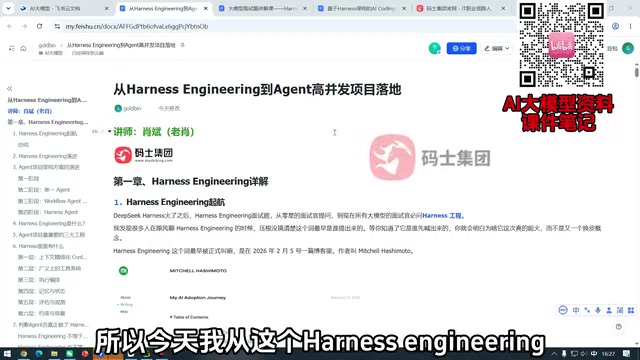
According to content shared by Bilibili creator 马氏教育肖老师, most existing material on Harness falls into one of two extremes: pure theory, or framework walkthroughs with trivial examples. Neither approach maps well to what companies actually need when hiring. When interviewers evaluate agent, fine-tuning, or RAG projects, they increasingly care about whether the project has real-world delivery capability — not just conceptual understanding.
Why Interviewers Care So Much About It
Delivery-readiness means the project must address a whole range of real engineering challenges: recovering from tool call errors, ensuring data security, handling high-concurrency scenarios, isolating multiple users and tenants, and repairing memory gaps in long-running agent sessions. Interviewers typically don't ask "what is Harness Engineering?" outright — instead, they drill into the specific details of your project and use those answers to determine whether it's demo-grade or production-grade.
Multi-tenancy isolation is one of the most commonly overlooked engineering problems in enterprise agent systems. In SaaS or platform products, the same agent infrastructure often serves multiple clients (tenants) simultaneously. Each tenant's conversation history, tool permissions, and data access scope must be strictly isolated to prevent data leakage or privilege escalation. Demo projects typically simulate a single-user scenario, and once deployed in a real enterprise environment, the absence of isolation mechanisms directly creates security and compliance risks. Memory gaps, on the other hand, refer to the phenomenon where an agent loses critical early information or makes contradictory decisions during long conversations or multi-step tasks — usually due to context window overflow or poor state management. Solving this typically requires introducing external memory storage (e.g., vector databases), summarization and compression strategies, or explicit state serialization mechanisms, rather than relying solely on the model's native context window.
Where the Term "Harness" Comes From
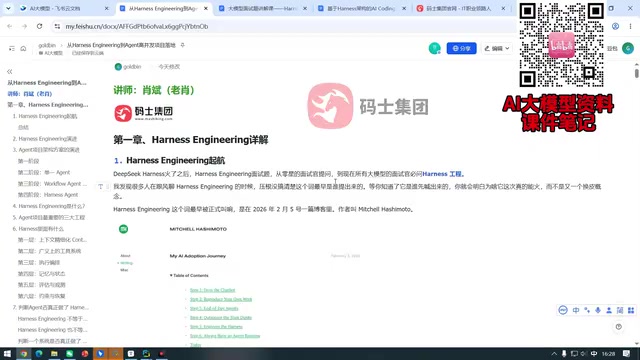
There's a common misconception worth clearing up about the term's origins. Based on available accounts, "Harness" as a formal term entered the agent space when Mitchell Hashimoto used a "Harness"-related heading in Chapter 5 of his blog — marking the word's first appearance in an agent development context.
Six days later, OpenAI published a blog post with "Harness Engineering" in the title, expanding the concept from a single point to the entire agent architecture layer, elevating it into a systems engineering philosophy for agent development. Industry consensus around the term gradually formed from there.
The Term Came Late, but the Technology Was Already Brewing
Here's a critical distinction: the name "Harness" appeared late, but the architectural thinking it represents didn't emerge out of thin air. Long before the term was formalized, companies like OpenAI, Anthropic, and domestic players such as DeepSeekAd, Tongyi Qianwen, and Tencent had already been exploring new agent architectures internally along similar lines.

In other words, these next-generation agent products were not "inspired" by a single blog post, nor are they built on a shared technical framework. Each company took different technical routes, independently converging on similar architectural patterns when tackling problems like tool-integrated models, long-task processing, long-context management, and secure execution. For a long time, this architecture simply lacked a unified name.
Early Products That Embody the Harness Paradigm
If there's one early product that relatively maturely exemplified the Harness engineering philosophy, the presenter personally points to OpenCloud — which was already active before the term became widespread. Products like Claude Code, Codex, Hermes Agent, and DeepSeek's related offerings (DSH) have since emerged as well, all classified as Agent Harness products that reflect the core thinking of Harness Engineering.
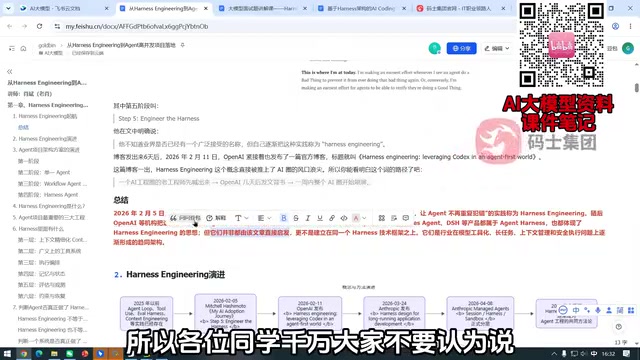
What these products share is an attempt to solve the engineering challenges agents face in real-world scenarios: how to make models reliably call tools, how to manage context across extremely long tasks, and how to execute operations within security boundaries. These are precisely the factors that distinguish a "production-ready project" from a "demo project."
Claude Code is Anthropic's developer-facing coding agent, capable of reading and writing code in the local filesystem, executing terminal commands, and autonomously completing multi-step development tasks. Codex was OpenAI's early code generation model, which later evolved into an agent form with autonomous execution capabilities. Hermes Agent is another type of agent implementation with an emphasis on the reliability of tool-calling pipelines. What these products share as an engineering characteristic is that they go beyond "generating text" — they build a complete execution loop (Plan → Act → Observe → Reflect) and design explicit recovery strategies for failures at each step. This combination of "execution loop + fault-tolerance mechanisms" is the core structural feature that distinguishes Harness Engineering from ordinary LLM application development.
What Harness Engineering Means for Developers
For developers entering or deepening their work in the agent space, the significance of understanding Harness Engineering lies in a shift of mindset. Projects with real competitive value need to incorporate engineering constraints from the very start of design:
- Tool call robustness: Can the system automatically retry, fall back, or surface errors to users when a call fails?
- Data security and isolation: How do you ensure data doesn't cross tenant boundaries in a multi-tenant environment?
- High-concurrency capacity: Can the architecture handle the concurrent load of real-world business traffic?
- Memory and context management: How do you prevent agents from experiencing "memory gaps" during long conversations?
These capabilities collectively form the foundation that makes an agent project "production-ready and deliverable" — and they're exactly what interviewers keep probing for.
High-concurrency capacity poses more complex challenges in agent scenarios than in typical web services. For a conventional API, concurrency pressure is mainly about I/O throughput. But each agent request may trigger multiple rounds of LLM calls, multiple external tool calls (APIs, databases, code execution sandboxes), each with unpredictable latency and failure probability. Addressing this typically requires introducing async task queues (e.g., Celery, BullMQ), streaming decomposition of long tasks, timeout and circuit-breaker mechanisms for tool calls, and distinguishing between "fast-response channels" and "background execution channels" at the architecture level. Robust tool call design also demands systematic thinking: beyond automatic retries, it's essential to differentiate between retryable errors (network timeouts) and non-retryable errors (permission denied, malformed parameters) to avoid blind retries that cause side effects or waste resources.
Conclusion
Harness Engineering represents a paradigm shift in agent development — from "getting it to run" to "making it deliverable." While the term only recently achieved industry-wide consensus, the underlying engineering evolution had been underway inside major companies long before the name existed. For developers, rather than getting hung up on the terminology itself, the better investment is in the engineering details that actually determine project success: tool call robustness, data security, high concurrency, and memory management. These are the keys to taking an agent out of the demo stage and into production.
Related articles

OpenAI Codex CLI Practical Guide: The Open-Source AI Coding Agent in Your Terminal
OpenAI Codex CLI is an open-source AI coding agent that runs in your terminal. This guide covers its 2025 launch, 2026 desktop app, ChatGPT merger, and a three-step setup and workflow.

AI for Beginners Course Review: ChatGPT, Gemini, and AI Agents in Practice
A hands-on review of a complete beginner AI course covering ChatGPT, Gemini, Notebook LM, Manus, and DeepSeq, with 18,000-record dataset analysis, AI agent website building, and LLM principles and limits.

How Do AI Agents Autonomously Complete Complex Tasks? The ReAct Framework Explained
What's the core difference between an AI Agent and a chatbot? Using competitive research as an example, this article breaks down the ReAct framework's three-step loop of reasoning, acting, and observing, explaining how Agents autonomously decompose tasks, call tools, spot data gaps, and dynamically adjust plans to ultimately deliver complete results.