Harness Manager: A Unified AI Coding Tool Manager for Mac

Harness Manager brings an app-store model to managing fragmented AI coding CLI tools on Mac.
As command-line AI coding assistants like Claude Code and Codex multiply, developers face a new management burden of scattered tools, version confusion, and hard-to-track configs. Harness Manager tackles this on Mac with an app-store-plus-control-center approach — supporting discovery, installation, and updates of major AI coding harnesses, unified MCP server and AI skills configuration, and version checks with fault diagnostics. It earned 71 upvotes on Product Hunt on launch day and is seen as a signal that the AI coding ecosystem has entered a phase demanding better tooling infrastructure.
As AI coding tools explode in popularity, developers' terminals are increasingly cluttered with a growing collection of command-line agents: Claude Code, Codex, OpenCode, Pi, and more. Each comes with its own installation method, configuration files, and update cadence. Managing all of these tools has quietly become a headache in its own right. Harness Manager aims to solve exactly this problem — positioning itself as an "app store" and control center for AI coding tools on Mac.
An Overlooked New Pain Point
Over the past year, command-line AI coding assistants have risen rapidly. Most are distributed as CLI tools, deployed via npm, Homebrew, or standalone install scripts — with no unified management layer connecting them. This creates a number of real-world problems: it's difficult to see at a glance which tools you have installed, what versions they are, or where their executables live. When a tool fails to launch due to a broken environment variable or corrupted config file, troubleshooting can be a tedious ordeal.
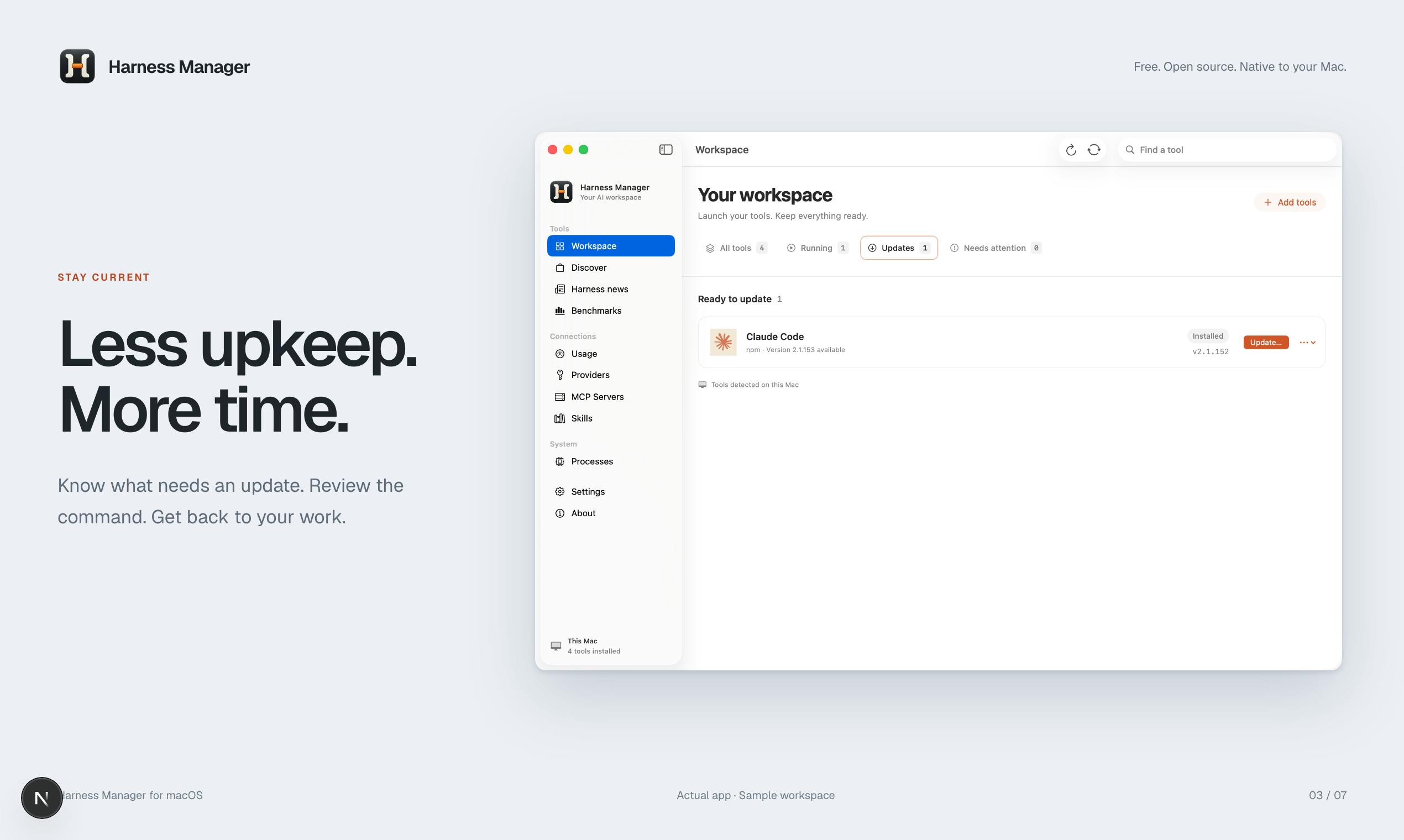
Harness Manager consolidates these scattered tools into a single interface. According to the official description, it automatically detects AI coding tools already installed on your machine, displays version numbers and installation paths, and helps diagnose broken installations or misconfigured setups. For power users running multiple agents simultaneously, this kind of "unified overview" is valuable in itself.
Core Features: Discovery, Installation, and Unified Management
In terms of product positioning, Harness Manager borrows the mental model of an app store. Its functionality can be broken down into several layers:
Tool Discovery and Installation
Users can discover, install, and update popular AI coding harnesses — including Claude Code, Codex, OpenCode, Pi, and others. This essentially converts what used to be a manual process of reading documentation and running commands into a series of clicks in a graphical interface, lowering the barrier to trying out new tools.
MCP Server and AI Skills Management
Notably, Harness Manager also supports managing MCP servers (Model Context Protocol) and AI skills. MCP is an open protocol that has seen widespread adoption, enabling AI tools to connect to external data sources and capabilities. As developers integrate more and more MCP servers into their workflows, the need to centrally manage these connections and skill configurations has grown significantly — this is where Harness Manager goes beyond being a simple "installer."
MCP (Model Context Protocol) was proposed and open-sourced by Anthropic in late 2024, with the goal of establishing a standardized communication interface between AI assistants and external tools or data sources. The design philosophy is similar to the USB protocol — before MCP, every AI tool that wanted to connect to a database, code repository, browser, or third-party API had to implement its own proprietary integration, resulting in high maintenance overhead. MCP defines a common Client-Server architecture: the AI application acts as the Client, and external capability providers act as MCP Servers, with both sides exchanging context and instructions via a standard protocol. Today, mainstream AI coding tools including Cursor, Claude Code, and Cline all support MCP, and the number of MCP Servers in the ecosystem is growing rapidly — covering everything from file system operations and Git commands to Slack messages and database queries. This means a heavy user might be running dozens of MCP Servers simultaneously, with configuration complexity rising exponentially.
Diagnostics and Maintenance
Checking versions, verifying paths, and diagnosing broken installations or misconfigured setups — these maintenance functions make up the other half of its value as a "control center." It turns the kind of routine upkeep that's easy to overlook but frequently necessary into a set of visual, actionable checks.
Initial Reception on Product Hunt
On Product Hunt, Harness Manager received 71 upvotes and 4 comments, ranking 16th for the day, and was listed under the Productivity, Developer Tools, and Artificial Intelligence categories. It was created by Sebastian Solano.
This isn't a breakout hit, but for a tool targeting a specific niche — heavy AI coding users on Mac — the numbers are a reasonable showing. Its target audience is inherently focused: developers who have accumulated a pile of AI agents and are exhausted by managing them all.
What It Reflects About Industry Trends
The emergence of Harness Manager is itself a signal that the AI coding tool ecosystem has reached a certain level of maturity. When a domain starts producing "tools to manage tools," it typically means the underlying tools have become numerous and fragmented enough to warrant an abstraction layer to reduce complexity. Much like the early days of package managers, the appearance of a harness manager category has its own internal logic.
Of course, this type of meta-tool also faces inherent challenges. It needs to continuously keep pace with the update cadence of the underlying tools — if mainstream tools like Claude Code or Codex iterate rapidly or change their distribution methods, the cost of keeping the manager compatible rises significantly. Additionally, Harness Manager currently only supports Mac, limiting its reach. For teams working across platforms, this may be a factor worth weighing.
The history of package managers offers a useful precedent: npm emerged after the Node.js ecosystem reached a certain scale, and Homebrew only gradually became the de facto standard for Mac development tools after years of fragmentation. The typical evolution path for this kind of infrastructure tooling is: rapid growth in underlying tools → fragmentation creates management friction → meta-tools emerge to reduce complexity → meta-tools themselves become standardized or are natively integrated into platforms. AI coding tools are currently in the transition from the second stage to the third. Harness Manager and products like it are characteristic of this transitional period. Worth noting: if major players like Anthropic or OpenAI eventually build unified management capabilities directly into their own toolchains, the survival space for third-party managers will be directly compressed — a platform risk that meta-tools of this kind universally face.
Conclusion
Harness Manager has identified a genuine and increasingly prominent pain point in the wake of the AI coding tool explosion: fragmented tool management. Through an app-store-style interface, it unifies discovery, installation, updates, MCP management, and fault diagnosis into a single entry point for AI coding users on Mac. The product concept is clear, and the use case it targets is concrete and specific. Whether it can establish long-term staying power will depend largely on how quickly it can adapt to a rapidly evolving underlying tool ecosystem — and whether it expands beyond the Mac platform.
Related articles

Random Pruning of the DPO Computation Graph: 1.4x Training Speedup and Lower Peak Memory
DPO training too slow and memory-hungry? This paper proposes a random pruning framework for the DPO computation graph, sampling independently across position, sequence, and branch dimensions; branch pruning achieves a 1.426x step-time speedup and cuts training time by about 30%, with in-depth attribution of memory and time gains.

Why Does JEPA Underperform MLM in Longitudinal EHR Representation Learning?
New study compares JEPA and MLM for longitudinal EHR representation learning on MIMIC-IV: three JEPA variants train stably without collapse but underperform MLM; target size, not heterogeneity, drives prediction error.

Transfer Learning + Visible Light Communication: A New Approach to Energy-Efficient Indoor Positioning
A study proposes a transfer learning-based visible light communication indoor positioning method, achieving 47% accuracy improvement on the BOSCH factory dataset, 67.5% model efficiency under high noise, and introducing the ME composite metric for energy-efficient positioning in energy-constrained industrial IoT scenarios.