Harvard AI Safety Course CS 2881R Sparks Discussion
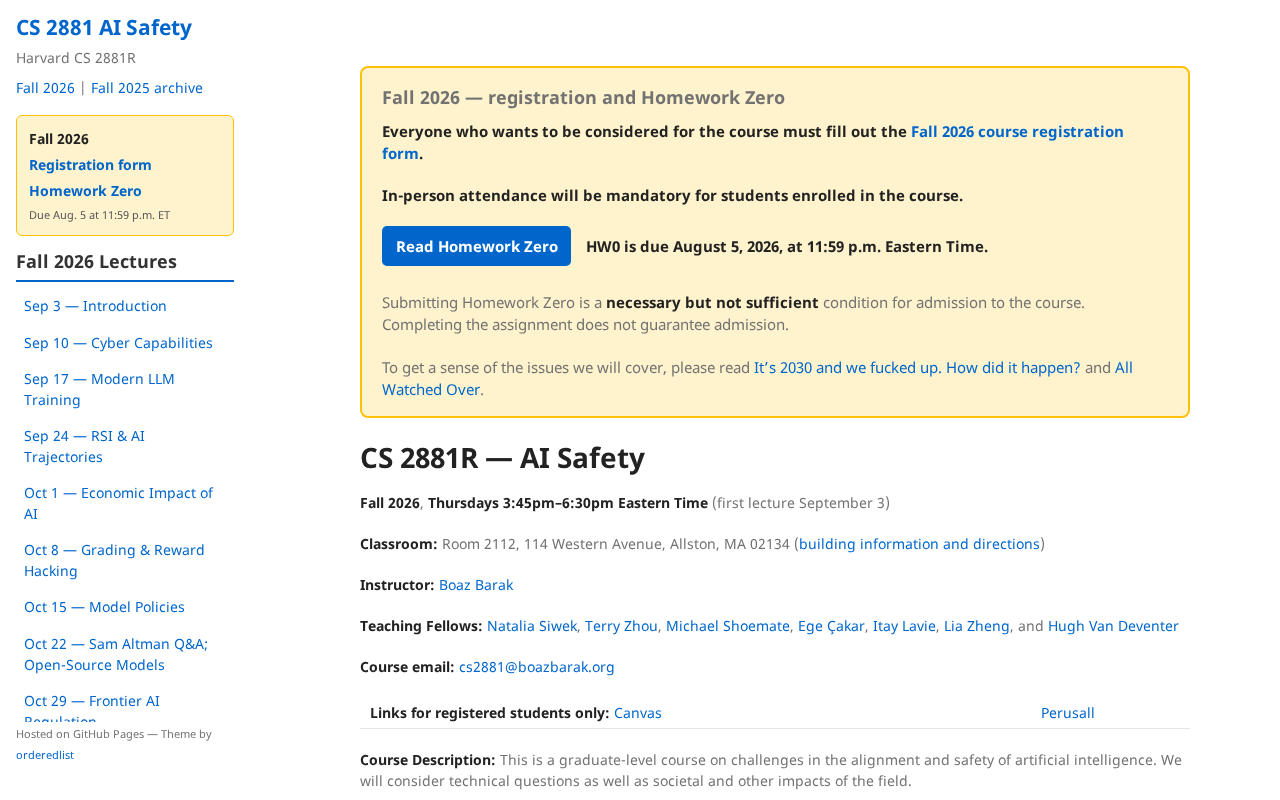
Harvard offers CS 2881R AI Safety, reflecting universities' emphasis on AI safety talent development and course frameworks.
The article discusses Harvard University's CS 2881R AI Safety course being mentioned on Hacker News. Although discussion wasn't particularly heated, the course offering reflects top universities' emphasis on AI safety. The article analyzes the graduate seminar positioning implied by the course number, outlines AI safety's shift from academic fringe to industry core, and speculates the course may cover alignment, adversarial attacks, interpretability, governance policy, and long-term risks. It argues AI safety has become a core competency for developers and researchers, suggests self-learners can build knowledge systems using similar frameworks, and recommends watching for whether course materials are made public.
Course Overview
Harvard University's CS 2881R AI Safety course was recently mentioned on Hacker News. Although the discussion wasn't particularly heated, the course offering itself reflects how top universities are prioritizing AI safety issues.
Judging by the course number, 2881R is an upper-level or graduate-level seminar (the R likely stands for Research or Seminar), typically focused on cutting-edge topics. As an interdisciplinary field, AI safety spans computer science, ethics, policy-making, and more.
Why It's Worth Noting
AI safety has moved from a fringe academic topic to a core industry concern. As large models rapidly grow more capable, issues like alignment, interpretability, and robustness have become key bottlenecks for real-world deployment. Harvard offering a dedicated course signals that talent development programs are responding to this need.
For developers, understanding the basic principles of AI safety helps mitigate risks in engineering practice. For researchers, courses like this provide a systematic knowledge framework and prevent fragmented learning.
Alignment is a core concept in AI safety, referring to ensuring that an AI system's goals, behavior, and outputs remain consistent with human intentions and values. In large language models, alignment problems manifest as the model potentially generating harmful content, producing hallucinations, or pursuing goals that diverge from designer intent. Current mainstream alignment techniques include reinforcement learning from human feedback (RLHF), direct preference optimization (DPO), and constitutional AI, among others. Alignment is difficult because human values themselves are ambiguous and diverse, and hard to fully express in formal rules. Alignment failures can lead to models being jailbroken, exhibiting deceptive behavior, or behaving unpredictably out of distribution, which is why it's considered one of the primary bottlenecks for safely deploying large models.
Adversarial attacks refer to carefully crafted input perturbations designed to induce incorrect outputs from AI models. In computer vision, adding tiny, imperceptible noise to an image can cause a classifier to misclassify; in language models, adversarial attacks take the form of prompt injection, jailbreak prompts, and bypassing safety guardrails through specific token sequences. Defenses include adversarial training, input sanitization, safety classifiers, and red teaming. Understanding adversarial attacks is fundamental to evaluating model robustness and an indispensable part of responsible AI deployment.
What the Course Might Cover
Based on common syllabi in the AI safety field, CS 2881R likely covers:
- Alignment problems and value learning
- Adversarial attacks and defenses
- Model interpretability and transparency
- AI governance and policy frameworks
- Discussion of long-term and existential risks
These topics overlap heavily with responsible AI practices currently emphasized in industry.
Interpretability aims to help humans understand the internal decision-making mechanisms of AI models. For deep neural networks, their billions of parameters form a black box that is difficult to interpret directly, creating trust barriers in high-stakes settings such as healthcare, finance, and the justice system. Interpretability research falls into two categories: post-hoc explanation methods (such as LIME, SHAP, and attention visualization) attempt to provide local explanations for the outputs of existing models; intrinsic interpretability methods (such as sparse autoencoders and mechanistic interpretability) attempt to reverse-engineer the model's computation from the level of neurons and circuits. In recent years, progress in mechanistic interpretability by organizations such as Anthropic has shown that understanding internal model representations is not just an academic question but directly related to security auditing and failure attribution.
Robustness refers to a model's ability to maintain stable performance in the face of distribution shift, noisy inputs, or malicious perturbations. A robust AI system should still produce reasonable outputs in scenarios outside the training distribution rather than collapsing or behaving dangerously. Robustness is closely related to generalization, but in a safety context it emphasizes resilience against worst-case scenarios. Common methods for evaluating robustness include out-of-distribution detection, adversarial robustness benchmarks, and stress testing. Insufficient robustness is one of the main reasons models fail in real-world deployment, making it a standard module in AI safety courses.
AI governance and policy frameworks concern how laws, regulations, and industry standards constrain the development and deployment of AI systems. Major global governance approaches currently include the European Union's AI Act (regulating by risk level), the U.S. model combining executive orders with industry self-regulation, and China's algorithm registration and generative AI management measures. At the academic level, governance research focuses on accountability mechanisms, transparency requirements, audit systems, and international coordination. For technical practitioners, understanding governance frameworks helps embed compliance considerations into product design and avoid after-the-fact remediation. AI governance and technical safety are complementary: technical measures address system-level risks, while governance measures define acceptable risk boundaries and assign responsibility.
Implications for Learners
Although the course materials themselves haven't been made public, its existence reminds us that AI safety is no longer an elective among electives but part of core competency. Self-learners can follow a similar framework and combine public papers and course resources to build their knowledge system.
The low discussion volume on Hacker News may suggest the course hasn't yet attracted broad community attention, but it could also simply be a lag in information spread. It's worth keeping an eye on whether course materials will be released later.
Related articles

Expanding Your Social Circle: Friend-Making Apps Worth Trying
How to choose a friend-making app? This article reviews friendship apps like the friend-discovery platform BFF and activity-oriented Timeleft, analyzing which approach suits whom and offering practical tips on offline meeting safety and expectation management.

Why You Shouldn't Run the Hermes Agent on Your Personal Computer
Why shouldn't you run autonomous AI agents like Hermes on your personal computer? This article analyzes why agents should be deployed to a dedicated VPS instead of your primary device, from four angles: security risks, resource consumption, credential leakage, and autonomy requirements—plus the practical logic of isolated deployment.

Ignite Keynote: Building a Frontier Ecosystem to Bring AI to Life
Microsoft CEO Nadella's Ignite keynote proposes a frontier ecosystem to turn AI advances into real-world impact. This article unpacks the strategy's ecosystem layers and deployment signals.