Has Anthropic Once Again Given Open-Weight Models Free Marketing?

Anthropic's new model release sparked Reddit jokes that it objectively gave open-weight models free marketing.
Every time Anthropic releases a new model or adjusts its strategy, the community debates closed-source versus open-source. This time, Reddit joked that "Anthropic once again gave open-weight models free marketing," pointing to a recurring phenomenon: when closed-source vendors emphasize restrictions, pricing, or barriers, some developers turn to open-weight models that can be locally deployed, freely fine-tuned, and kept cost-controllable. The article argues this claim rests on fundamental differences in cost structure, data sovereignty, and customizability. Participants are not opposed to closed source, but value having options. Closed source and open source are more complementary; hybrid use has become common. As the capability gap narrows, open weights' appeal will increasingly depend on "freedom" rather than pure performance.
Anthropic released a new model, but the community discussion took an unexpected turn—many people on Reddit joked that this move amounted to yet another free advertisement for open-weight models.
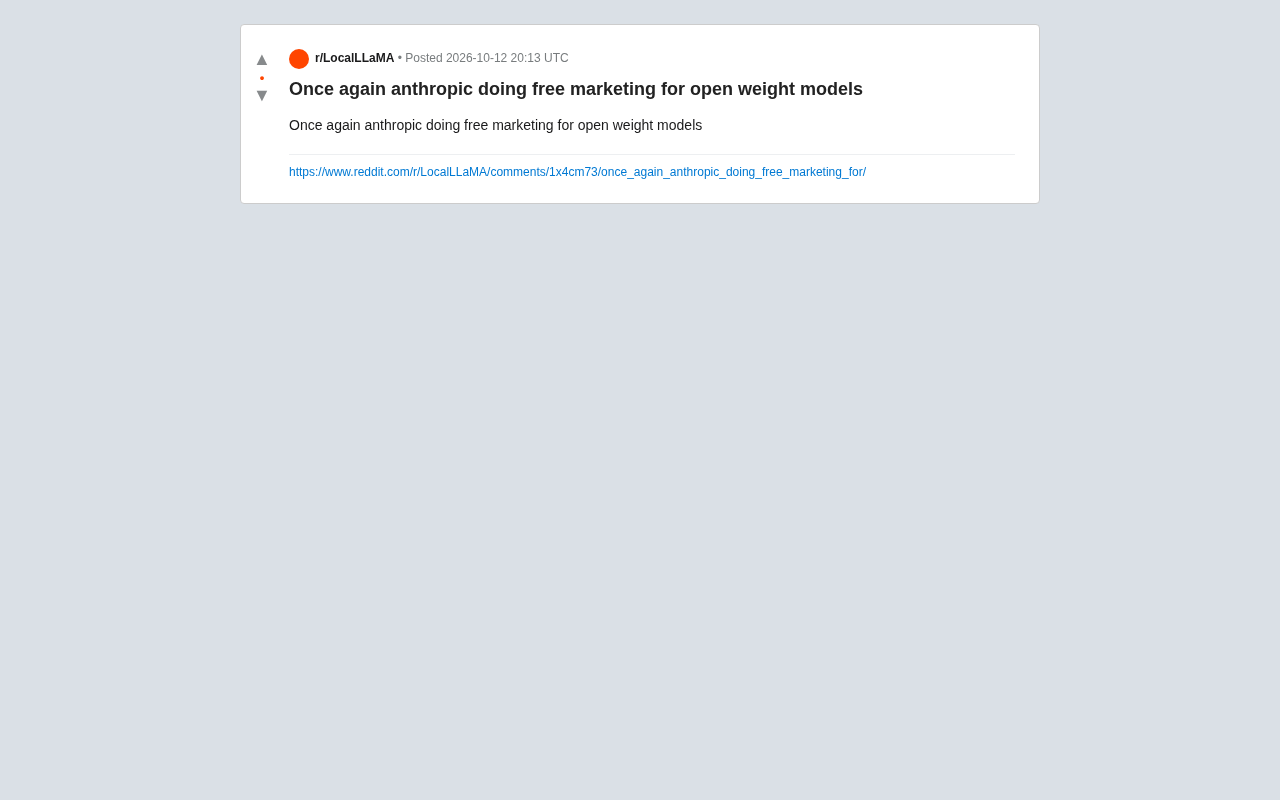
A Discussion That Went "Off-Track"
The origin of this isn't complicated. Every time Anthropic releases a new model or updates its strategy, it sparks a round of debate in the community about the closed-source versus open-source approach. This time, the headline that appeared on Reddit was quite blunt—"Once again anthropic doing free marketing for open weight models."
This statement carries strong community sentiment, pointing to a recurring phenomenon: whenever a closed-source vendor emphasizes certain limitations, pricing, or usage barriers of its models, some developers and researchers turn their attention to open-weight models instead—because the latter can be deployed locally, freely fine-tuned, and kept cost-controllable.
In other words, Anthropic's "promotion" isn't necessarily praising open source, but the buzz objectively pushes open-weight models in front of more people.
Why the "Free Marketing" Claim Holds Up
To understand this meme, you first need to see the fundamental differences between the two types of models.
Closed-source models (like Anthropic's Claude series) provide services through APIs, with weights not publicly available, so users cannot see or modify the model internals. The advantages are out-of-the-box usability, stable performance, and official support. The cost: pay-per-use inference, data passing through a third party, and no deep customization.
Open-weight models release the trained weights so anyone can download them and run them on their own machines or private clouds. For budget-sensitive teams, industries needing data compliance, and researchers who like to tinker, this is a necessity.
So when a closed-source vendor's pricing, rate limits, or terms of use change, some users' first reaction isn't "I'll just put up with it," but "then let me see what the open-source side can do." This is the real basis for the "free marketing" claim.
An Open Weight Model is not the same as an "open-source model." Strictly speaking, it refers to a vendor publicly releasing the trained model parameters (weights), allowing others to download, run, and even fine-tune them, but the training data, training code, or complete training pipeline may not be released together. Typical examples include Meta's Llama series, some of Mistral's models, and Alibaba's Qwen series.
The licenses for these models vary widely: some allow commercial use, some limit monthly active users, and some prohibit specific uses. Therefore, the core emphasis of "open weight" is accessible, locally deployable, and modifiable parameters, rather than the complete open-source definition in the traditional software sense. Understanding this is essential to see why the community treats it as an important alternative to closed-source APIs.
In contrast, closed-source models only expose inference interfaces; users can neither obtain the weights nor know the model's internal structure. The trade-offs between the two in cost, compliance, and controllability are exactly the underlying logic of this discussion.
The Community's Subtext: Not Against Closed Source, but Wanting Choice
Many people participating in the discussion are not opponents of Anthropic. What they really care about is:
- Cost transparency: Token-based billing is hard to predict at large scale, while open-source self-deployment is more like a fixed cost.
- Data sovereignty: Keeping sensitive data local is a core reason many enterprises choose open source.
- Customizability: Fine-tuning, distillation, and adding toolchains—open weights give engineering teams more room.
When closed-source vendors emphasize that they are "stronger and safer," what this group of users often hears is "you need to depend on me more." What the community expresses through jokes is actually a appreciation for having options.
Data Sovereignty here refers to an enterprise's complete control over the storage, processing, and transfer of its own data. When a team calls a closed-source API, the input data must be sent to the vendor's servers; even if the vendor promises not to use it for training, the data still leaves the enterprise boundary. For regulated industries such as finance, healthcare, and law, this may directly touch compliance red lines.
Open-weight models allow the inference process to be placed on local servers or private clouds, keeping data within the internal network and structurally avoiding the risk of third-party hosting. This is also a key reason many enterprises insist on self-deploying open-source models even while acknowledging that closed-source models are more capable—for them, data controllability is not a bonus, but an entry threshold.
What This Means for the Entire Industry
From a broader perspective, this kind of discussion reflects a long-standing tension: closed-source models often lead at the capability frontier, but open-weight models have their own rhythm in ecosystem and implementation.
The two are not a simple substitute relationship. Many teams adopt a hybrid approach—using closed-source APIs for rapid validation of frontier capabilities, and landing open weights for scaled and customized scenarios. Every time Anthropic sparks discussion, it actually reminds practitioners: having choice matters more than picking a side.
As for "free marketing," in the end it's more like community slang. It doesn't need to be treated as a serious accusation, but it does point to a fact—at a time when the capability gap between models is gradually narrowing, the appeal of open-weight models will increasingly come from "freedom" rather than pure "performance."
One-line Summary
Anthropic's new model release sparked Reddit jokes that it objectively gave open-weight models free marketing.
Paragraph Summary
Every time Anthropic releases a new model or adjusts its strategy, it sparks community debate over the closed-source versus open-source approach. This time, Reddit joked that "Anthropic once again gave open-weight models free marketing," pointing to a recurring phenomenon: when closed-source vendors emphasize restrictions, pricing, or barriers, some developers instead turn to open-weight models that can be locally deployed, freely fine-tuned, and kept cost-controllable. The article argues that this claim rests on fundamental differences between the two model types in cost structure, data sovereignty, and customizability. Participants are not opposed to closed source, but value having options. Closed source and open source are more complementary than替代; hybrid use has become the practical strategy for many teams. As the capability gap narrows, the appeal of open weights will increasingly depend on "freedom" rather than pure performance.
Related articles

Gaussian Process Bandit Optimization: Exploration Strategies and Inference Regret Guarantees
Cumulative regret guarantees in Bayesian optimization fail to reflect final recommendation quality. This article examines a new study that provides inference regret guarantees for Gaussian process bandit optimization through exploration query strategies and fill distance analysis, validated on hyperparameter optimization and control tasks.

The Most Detailed Codex Guide on Bilibili: From Installation to Real-World Practice
The most detailed Codex guide on Bilibili: from app store installation to daily work mode configuration, with a real coffee shop project demonstrating file organization, data extraction, dashboard creation, and other practical tasks. Learn to use Plan Mode and desktop pets to leverage Codex efficiently.

Appearance Compensation in Volume Rendering: Why RGB Accuracy Cannot Guarantee Density Correctness
Volume rendering research reveals that volumetric data perfectly reproducing external RGB views may still contain density errors: appearance compensation can double central density and keep external rays unchanged even when L2 error exceeds 14.52%. Density recovery depends on appearance capacity, spatial resolution, and measurement design.