HDR Gain Map Becomes an Attack Vector: How DRJanus Makes the Same Image Fool AI While Harming Humans

DRJanus uses HDR gain maps to make the same JPEG show different content to machine moderation and human viewers, bypassing mainstream moderation.
Researchers propose the visual masquerade attack DRJanus, which exploits HDR gain map processing differences between the SDR base layer and HDR rendering to embed two independent images in one JPEG file. Automated moderation systems typically read only the SDR base layer, while HDR viewers reconstruct another target image from the gain map. The attack needs no model queries or optimization, achieving average PSNR of 43.03 dB on 400 images. On a 100-image benchmark, DRJanus bypassed all six commercial moderation services and nine VLMs, with agent task manipulation success rates of 95%-100%. The paper explores cross-view consistency checking as mitigation but not a complete solution; the key insight is that machine-read content safety does not equal what users actually see.
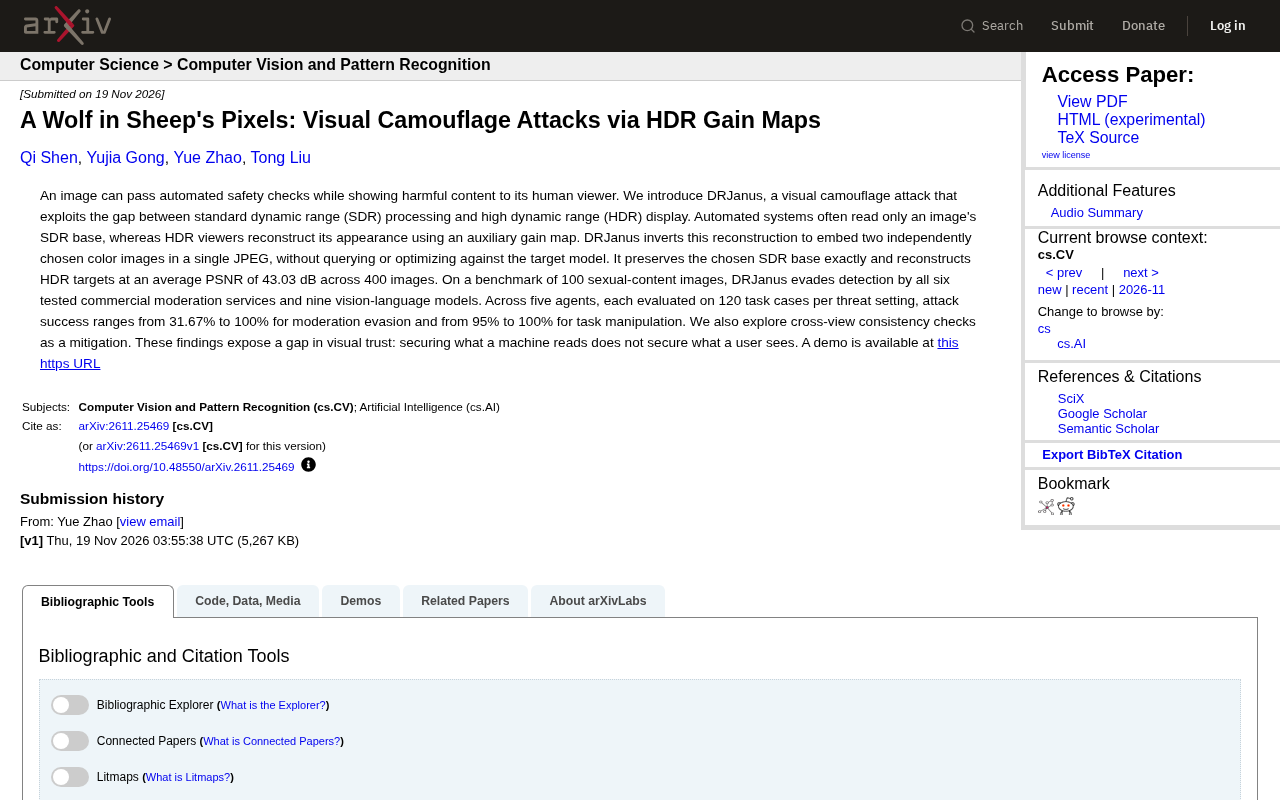
An image can pass all automated moderation checks smoothly, yet present completely different violating or harmful content before human users. This is not science fiction but the real threat demonstrated by the visual masquerade attack DRJanus proposed by researchers. The attack exploits the processing differences of HDR gain maps between SDR and HDR displays, embedding two independently selected images into a single JPEG file—all without querying or optimizing the target model. The paper's title, "A Wolf in Sheep's Pixels," aptly captures this two-faced attack characteristic.
DRJanus's Attack Principle: Exploiting Dual Interpretation of HDR Gain Maps
In modern image display, conversion between SDR (standard dynamic range) and HDR (high dynamic range) is often accomplished with the aid of an auxiliary gain map. Automated moderation systems typically read only the SDR base layer, while HDR viewers use the gain map to reconstruct the final high dynamic range appearance. DRJanus reverses this reconstruction process: it precisely preserves the selected SDR base image unchanged while using a carefully constructed gain map to make the HDR rendering present another target image.
This design causes the same JPEG file to produce dramatically different visual content when read by machines versus viewed by humans. Attackers need neither access nor optimization of the target model—relying solely on an understanding of the HDR display pipeline to complete the embedding. According to the paper, across 400 images, the average PSNR of DRJanus's reconstructed HDR targets reaches 43.03 dB, indicating quite high visual quality that humans can hardly detect as abnormal.
HDR Gain Map is a mechanism for compatible storage of HDR and SDR images, commonly found in standards such as ISO 21496-1 and implementations by platforms like Apple and Google. The basic approach is: the JPEG file uses a conventional SDR image as the base layer while including a low-resolution gain map; HDR viewers multiply the base layer pixel values by the upsampled gain map coefficients (or apply similar mapping) to reconstruct high dynamic range brightness. Software that does not support HDR ignores the gain map and displays only the SDR base layer, ensuring backward compatibility. This "one file, two presentations" design, intended to serve smooth transitions, also provides an opening for DRJanus.
Attack Effectiveness: Bypassing Commercial Moderation and Vision-Language Models
Researchers tested DRJanus's evasion capability on a benchmark of 100 sexual content images. Results show the attack successfully bypassed all six tested commercial content moderation services and nine vision-language models. In other words, existing mainstream automated visual safety detection methods collectively fail when facing such dual-layer images.
More concerning is the downstream task manipulation risk. Across five agents, with 120 task cases evaluated per threat setting, DRJanus's attack success rate for moderation evasion ranges from 31.67% to 100%, while task manipulation success rates reach as high as 95% to 100%. This means the attack can not only hide harmful content but also actively mislead AI agents into performing incorrect operations. The paper notes that this finding exposes a visual trust gap: securing what machines read does not equal securing what users actually see.
Vision-Language Models (VLMs) are multimodal large models that process both image and text inputs and output text, such as GPT-4V, Claude, Gemini, and the open-source LLaVA series. In content moderation scenarios, platforms commonly use VLMs for semantic understanding and violation determination of user-uploaded images, or as agents' "eyes" to plan operations. A VLM's visual encoder typically receives scaled RGB images; if that image comes from the SDR base layer, what the model "sees" differs from what HDR users see, and moderation judgments may be misled. DRJanus exploits exactly this input pipeline discrepancy, causing VLMs to unknowingly approve harmful content.
Cross-View Consistency Checking: A Possible Mitigation Approach
Facing this attack, researchers also explored cross-view consistency checking as a mitigation. Its core idea is to compare the semantic or perceptual consistency of the same image under SDR and HDR views, triggering an alert if the two differ too greatly. However, the paper does not claim this is a complete solution—it is more of an initial defense direction after revealing the problem.
From a security engineering perspective, DRJanus reminds us that the security of multimodal pipelines cannot rely solely on single-view detection. When an image has different "identities" under different display conditions, moderation systems need cross-view reasoning capability; otherwise, attackers will always find the gap between machine and human perception. The attack's demonstration page has been made public for further research and reproduction.
Cross-view consistency checking typically includes core metrics such as structural similarity (SSIM), perceptual hashing, semantic embedding distance, or the divergence of VLM-generated descriptions. Defenders need to extract and compare features from the SDR and HDR rendering results of the same file separately: if the two show significant semantic divergence (for example, one is a normal landscape and the other is violating content), it is deemed suspicious. The implementation difficulty lies in the fact that legitimate HDR images also exhibit brightness and color differences between the two views, requiring content-adaptive thresholds to control false positives; moreover, the gain map itself can be tampered with, so checks must be performed in a trusted rendering environment.
Implications for AI Safety and Content Moderation
DRJanus's threat model is not complex, yet it precisely hits the blind spot of current visual moderation systems. Commercial moderation services and vision-language models are generally trained and infer on SDR images, lacking perception of the auxiliary HDR gain map channel. Attackers need neither white-box access to models nor extensive queries to achieve high success rates in evasion and manipulation.
For platforms, this means incorporating the HDR rendering pipeline into threat modeling and adding checks on auxiliary data such as gain maps in moderation processes. For researchers, cross-view consistency checking offers an explorable direction, but achieving low false positives and high coverage remains an open problem. Establishing visual trust must cover both machine reading and human viewing—neither can be omitted.
One-line Summary
DRJanus uses HDR gain maps to make the same JPEG present different content to machine moderation and human viewers, bypassing mainstream moderation.
Paragraph Summary
Researchers propose the visual masquerade attack DRJanus, which exploits processing differences between the SDR base layer and HDR rendering via HDR gain maps to embed two independent images into a single JPEG file. Automated moderation systems typically read only the SDR base layer, while HDR viewers reconstruct another target image based on the gain map. The attack requires no querying or optimization of target models, achieving an average PSNR of 43.03 dB for HDR reconstruction across 400 images. On a benchmark of 100 sexual content images, DRJanus bypassed all six commercial moderation services and nine vision-language models, with task manipulation success rates on agents as high as 95% to 100%. The paper explores cross-view consistency checking as a mitigation approach but does not claim it as a complete solution; the core insight is that content safety as read by machines does not equal content safety as actually seen by users.
Related articles

AI Teams Up with Mathematicians to Attack the Riemann Hypothesis: 17 Million Lines of Code Tear Open a 167-Year Gap
In November 2026, Anthropic mathematicians and Claude claimed to have discovered a proof of the Riemann Hypothesis, publishing 17 million lines of Lean formalized code that passed machine verification. This article analyzes the event's impact on mathematics and cryptography, and the deeper questions raised by the separation of discovery and understanding.

AI Claims Formal Proof of the Riemann Hypothesis — But Machine Verification Isn't a Mathematical Proof
In Nov 2026, Anthropic's Levent Alpöğe released a Riemann Hypothesis proof of 175,000 code files that passed machine formal verification. But machine verification isn't a mathematical proof: the kernel can't confirm the proposition is the Riemann Hypothesis humans understand, and there's no human-readable paper. This article breaks down how ζ function zeros determine prime-count deviation, and the core of the controversy.

Anthropic Raises Over $80 Billion in IPO, DeepSeek Secures $100 Billion in Funding: AI Weekly Roundup
This week in AI: Anthropic's Nasdaq IPO raises $93.5B in the largest ever, DeepSeek closes ~100B yuan round, AI claims formal Riemann proof, MiniMax breaks crypto candidates in seconds.