He Built a Job-Hunting Engine with Claude Code: Read 10,000 Listings, Landed 2 Offers
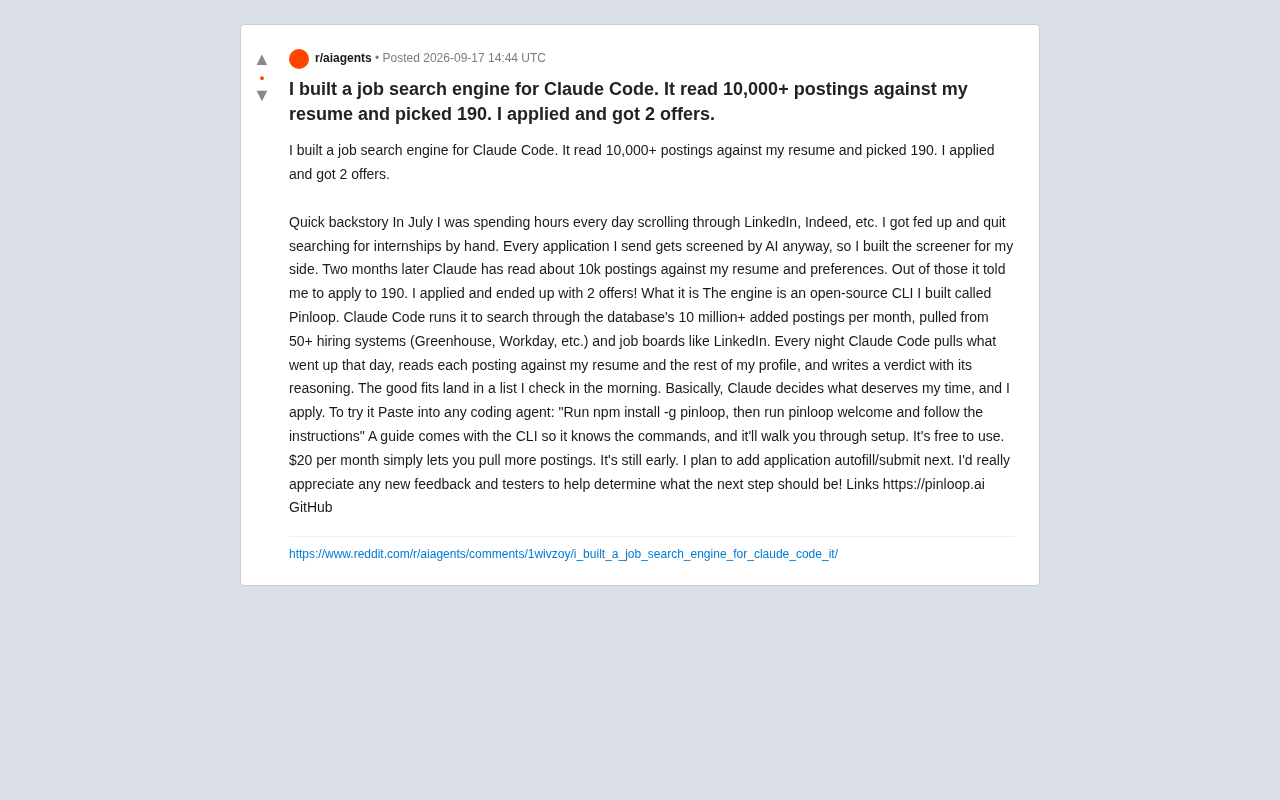
Developer uses Claude Code to build Pinloop, an open-source CLI that reads thousands of job listings nightly and surfaces the best matches.
Facing a hiring landscape dominated by AI resume screening, one developer built a symmetric solution: the open-source CLI tool Pinloop uses Claude Code to nightly fetch new job postings from a database spanning 50+ recruiting systems, compare each against the user's resume and preferences, and produce reasoned apply/skip recommendations with a morning shortlist. Over two months, the system read ~10,000 job descriptions, filtered down to 190 recommended applications, and yielded 2 offers. Free to install via npm with a paid tier for expanded data access, the project plans to eventually automate form-filling and submission — though platform compliance remains a concern.
In an era where AI resume screening has become a standard part of hiring, one developer decided to flip the script — if every application gets filtered by AI, why not build your own AI filter? The open-source project Pinloop does exactly that, using Claude Code to automatically read tens of thousands of job descriptions every night and surface the opportunities actually worth applying to.
From Manual Job Board Scrolling to Automated Filtering
The project's creator shared the full story on Reddit. Back in July, he was spending hours each day manually combing through internship listings on LinkedIn, Indeed, and similar platforms — a tedious and exhausting process. One key insight changed his approach: since every application he submitted would be filtered by the company's AI system, it made perfect sense to build a symmetrical filtering mechanism on the applicant side.
He turned that idea into a tool. Two months later, the results were convincing — Claude read roughly 10,000 job descriptions against his resume and preferences, flagging 190 positions as worth applying to. He applied to those, and ended up with 2 offers.
How Pinloop Works
At its core, Pinloop is an open-source command-line tool (CLI) powered by Claude Code. The scale of its data is the system's key competitive advantage: its underlying database adds over 10 million new job listings per month, sourced from more than 50 applicant tracking systems (ATS platforms like Greenhouse and Workday) as well as mainstream job boards like LinkedIn.
The workflow breaks down into a few stages:
- Nightly data pull: Claude Code fetches that day's newly posted jobs every night;
- Line-by-line matching: Each job description is compared against the user's resume and full profile;
- Verdict with reasoning: For each position, the system produces a judgment on whether it's worth applying to, along with its reasoning;
- Morning shortlist: High-match positions are compiled into a list for the user to review the next morning.
As the author puts it: "Claude decides which jobs are worth my time; I handle the actual applying." This division of labor hands off the most time-consuming part — information triage — to AI, while keeping humans in the loop for the critical decisions and actions.
A note on ATS platforms: Greenhouse, Workday, and similar ATS (Applicant Tracking System) tools are recruitment management platforms widely used by corporate HR departments. They not only collect and manage candidate resumes but typically include built-in keyword matching, automatic scoring, and other AI screening modules — the exact counterpart to the "symmetric filtering" logic the author describes. More than 75% of mid-to-large employers globally use some form of ATS, meaning most resumes pass through an algorithmic filter before any human ever sees them. By tapping into these platforms' public data feeds or aggregated databases, Pinloop effectively operates upstream of the ATS — using equivalent-scale automation to weed out poor-fit roles before a candidate even decides to apply, preventing resumes from being wasted in the ATS funnel.
A Simple Onboarding Experience
The project is designed to have a very low barrier to entry. Users simply paste a single instruction into any coding agent:
"Run npm install -g pinloop, then run pinloop welcome and follow the instructions"
The CLI comes with a built-in guide that helps the AI agent understand available commands and walks users through setup. The tool is free to use, with a paid tier at $20/month — the only difference being access to a larger volume of job data. It's a classic "free for core features, pay for data quota" pricing model.
A Few Things Worth Noting
This project is still in its early stages. The author has openly stated plans to add automatic application form filling and submission, and is actively seeking beta testers and feedback. From a product roadmap perspective, once the full loop of "filter → fill → submit" is connected, it will evolve from an information filter into a complete automated job application assistant.
That said, it's worth keeping the sample size limitations in mind. The 2-offer result comes from a single user's personal experience; conversion rate across 190 applications, the competitiveness of the resume itself, and the supply-demand dynamics of the target industry are all variables that affect outcomes — it's hard to generalize as a universal result. Additionally, delegating large portions of the job search to AI automation may run into the terms of service of certain recruiting platforms — especially the planned auto-submission feature, which warrants careful attention to platform compliance.
A Practical Example of AI Agents in the Real World
Setting aside the success rate of this individual case, what makes Pinloop genuinely interesting is what it demonstrates about the practical value of coding agents like Claude Code in vertical use cases. It's not a flashy demo — it's a combination of large-scale data fetching, LLM semantic matching, and scheduled tasks assembled into a workflow that solves a real problem.
For developers, this also offers a reusable mental model: when you're dealing with an information-overload scenario where you need to repeatedly apply the same set of criteria to a massive volume of items, letting an AI agent handle the "read + evaluate + summarize" heavy lifting is almost always more efficient than doing it manually. Job hunting is just one entry point — the same pattern transfers to bid information, academic literature, investment targets, and many other domains.
A note on Claude Code: Claude Code is a coding agent from Anthropic designed for developers. Its core capability lies in autonomously executing multi-step tasks within a terminal environment — reading files, calling tools, running scripts, and adjusting subsequent actions based on outputs — rather than simply answering questions. Unlike a standard chat-based LLM, a coding agent has a closed-loop "perceive → plan → execute" capability, making it well-suited for embedding into scheduled tasks, data pipelines, and other automated workflows. Pinloop leverages exactly this: Claude Code isn't generating a one-off result — it's triggered nightly as a scheduled process, continuously ingesting new data and producing structured judgments. This "LLM as a workflow node" architectural pattern is becoming one of the key paradigms for deploying AI in real production environments.
Related articles
Cursor Cloud Agent: AI Writes the Code, Then Records a Video to Prove It Works
Cursor Cloud Agent lets AI write code and attach a screen recording as proof — no manual testing needed. Learn how Walkthrough Artifacts and parallel VM isolation work.
Testing 11 WAN 2.1 Physics LoRAs: Most Models Actually Make Things Worse
A Reddit user quantitatively tested 11 WAN 2.1 physics LoRAs using optical flow and frame-differential energy. Most models underperformed the baseline. Here's what the results reveal.
SpawnRipple: An External Social Environment Built for Autonomous AI Agents
SpawnRipple is an external social environment for autonomous AI agents — providing identity, publishing, discovery, interaction, and API without running any agent models.