He Interviewed at 15 AI Product Roles and Got Every Offer—Here's His Project Pitch Framework

After 15 AI product interviews: 80% of interviewers don't understand AI—a working project lets you dominate.
A Bilibili creator interviewed at 15 AI product roles in September and landed 14 offers, then summarized a counterintuitive job-seeking methodology: most interviewers lack deep AI understanding, so a candidate with a truly working hands-on project and clear presentation gains an overwhelming advantage. He recommends a three-step path—foundation (Transformer, Token costs, Prompt), horizons (Agent, RAG, multimodal, Coze), and portfolio (two or three commercial projects). When presenting, build context with company, business line, data scale, and pain points, then cover six segments: solution approach, launch results, and iteration.
Title
He Interviewed at 15 AI Product Roles and Got Every Offer—Here's His Project Pitch Framework
Meta Description
Interviewed at 15 AI product roles and landed 14 offers, negotiating salary from 25K to 45K. This article breaks down the complete framework for presenting projects in interviews: from company background and data scale to a three-layer breakdown of solutions, launch result validation, and iteration planning—helping you form a logical closed loop.
Article Content
When interviewing for AI product roles, the most dreaded question is "tell me about your project." After interviewing at 15 companies, a Bilibili creator discovered a counterintuitive truth: 80% of interviewers themselves only have a half-baked understanding of AI. As long as you can present a real, working hands-on project and explain it with clear logic, you'll dominate the interview on the spot.
First Have a Project, Then Talk Technique
This creator interviewed at 15 AI product roles in September. Except for one that required two-shift rotation (which he declined), he landed all 14 others, negotiating salary from 25K to 45K. His core judgment: most AI product interviewers on the market haven't actually built large model applications hands-on. You don't need to be an algorithm expert, but you must cross the line of "being able to build."
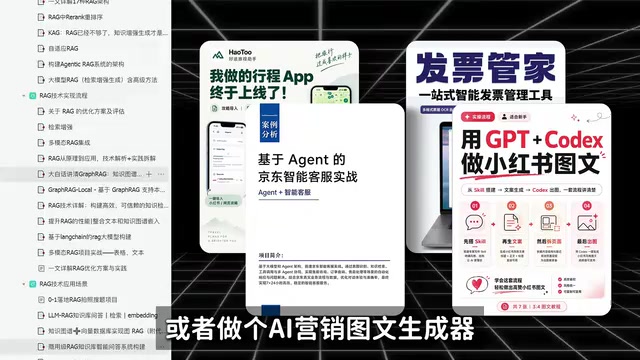
He breaks the preparation path into three steps. Step one is laying the foundation: the ins and outs of Transformer architecture, how to save on Token costs, how to write Prompts, how to close the loop on data processing—these are the prerequisites for all subsequent discussion. Step two is broadening your horizons: dig through hot concepts like Agent intelligent agents, RAG retrieval augmentation, and multimodal fusion, then use zero-code platforms like Coze to get projects running hands-on. Step three is producing work: build two or three commercial projects you can put on your resume, such as using LangChain to build a cross-border e-commerce intelligent customer service, or an AI marketing image-text generator. Once you've practiced to this level, you can confidently apply to 90% of the good roles on the market.
Transformer architecture is a deep learning model structure proposed by Google in the 2017 paper "Attention Is All You Need." Its core is the self-attention mechanism, which allows the model to attend to information at different positions in parallel when processing sequence data, replacing the recurrent structure of RNNs and greatly improving training efficiency. It is the underlying skeleton of almost all modern large language models, including GPT and BERT. For AI product managers, you don't need to derive formulas, but you need to understand three key points: first, input text is split into Tokens and mapped to vectors; second, the attention mechanism allows the model to capture long-distance semantic dependencies; third, the model's parameter count and training data scale determine the capability ceiling. Understanding these lets you align with algorithm colleagues when discussing model selection, context length limits, inference latency, and other issues.
RAG (Retrieval-Augmented Generation) is a technical approach that lets large models first retrieve relevant documents from external knowledge bases before generating answers, then inject the retrieval results as context into the prompt. It solves three major pain points of large models—outdated knowledge, frequent hallucinations, and inability to access private data—and is the most common technical path for enterprises implementing AI applications. The typical process includes: document chunking and vectorization into the database, vectorizing user questions, similarity retrieval to recall Top-K fragments, and concatenating Prompts to call the large model for answer generation. Product managers need to focus on design decisions such as chunking strategy, recall accuracy, re-ranking mechanisms, and citation traceability—these directly determine user experience and answer credibility.
The Big Framework for Presenting Projects: From Company to Pain Points
When interviewers say "first introduce this project," many people immediately dive into feature details—this is a major taboo. The correct approach is to establish context first, following four steps.
Step one, company introduction. What the company is called, what its main business is—explain it in one sentence. Step two, business and product lines. Which business you're responsible for, which product line, and which core data metric you're accountable for. Step three, product data and user scale. How revenue is doing, roughly what magnitude of DAU/MAU. Step four, industry introduction and user pain points. Provide appropriate industry education, explaining the current industry status, user pain points, what problems you solve, and through what methods.
The value of these four steps is letting the interviewer quickly build a coordinate system. Without this coordinate system, no matter how detailed you are later, they won't be able to follow.

Six Segments of Feature Implementation
After covering project background, enter the second layer of the framework: a macro introduction of the specific features you built and the implementation path. The creator breaks it into six segments, with the last three best demonstrating a product manager's capabilities.
Solution Approach: Three-Layer Breakdown
Present the solution in three layers. The product design layer describes pages and interaction logic: what features and rules were designed, how systems interconnect. For example, using a "multi-dimensional tags plus intelligent recommendation" filtering mode, where users can both actively select tags and accept algorithm recommendations; for interaction, swipe left to filter, swipe right to refresh, reducing operation cost. The feature logic layer explains core rules and flows: tag filtering links to user historical behavior data, and the recommendation algorithm adds two weights—scenario and real-time popularity. The cross-team collaboration layer explains how new features integrate with existing systems, how the data flow链路 works, how interface development priorities are set, and how you align with R&D to ensure consistency from design to technical implementation.

Launch Results: Three-Dimensional Validation
On data metrics: what usage rate the core feature achieved, whether it far exceeded expectations, how many percentage points conversion rate increased, how much retention improved among target users. On user feedback: what positive feedback was collected through surveys or customer channels, which secondary issues negative feedback concentrated on, left for subsequent iterations. On business impact: whether the feature directly drove revenue growth for a business line, or how much it increased user active time.

Iteration and New Problems: The Key to Closing the Loop
Internet products always go through multiple rounds of iteration. After running stably for a period, new problems emerge through user interviews and data monitoring: for example, during major promotions, massive product influx caused filtering response to slow down, affecting some high-value users' experience; or college students' usage rate being notably lower than other groups. These new problems are exactly the source of your next round of requirements, and the best material for showing interviewers your product intuition.
Agent (intelligent agent) refers to a system with a large model as its brain that can autonomously plan tasks, call tools, perform multi-step reasoning, and complete goals. Unlike single-turn Q&A, an Agent typically includes a planning module (task decomposition), a memory module (short-term conversation history and long-term knowledge storage), a tool-calling module (search, code execution, API calls), and an execution loop (deciding the next step after observing results). Zero-code platforms like Coze and Dify let product managers build Agent workflows without writing code, configuring prompts, knowledge bases, and plugins through drag-and-drop nodes. Understanding how Agents operate is essential to explaining in interviews why your project chose Agent architecture over simple Prompt calls, and how to design fallback and human takeover mechanisms.
The Underlying Logic of This Presentation Approach
Looking at the six segments together—company background, data scale, requirement sources, analysis process, implementation plan, launch results, iteration planning—all covered, a logical closed loop. What interviewers want to hear is never a feature list, but how you went from problem to solution, from solution to result, from result to the next round of problems.
This creator's observation is worth pondering: when interviewers themselves only half-understand AI, a candidate who can get a project running and explain it clearly is far rarer than imagined. Rather than agonizing over algorithm details, first build something demonstrable, then practice this framework until it's second nature.
If you need job-seeking materials for product managers or hands-on project resources, you can find the creator in the original video's comments section to claim them.
One-line Summary
After interviewing at 15 AI product roles: 80% of interviewers don't understand AI—a real hands-on project lets you dominate.
Paragraph Summary
After interviewing at 15 AI product roles in September and landing 14 offers, a Bilibili creator summarized a counterintuitive job-seeking methodology: most interviewers on the market don't have deep AI understanding, and candidates who have a truly working hands-on project and can present it clearly gain an overwhelming advantage. He recommends a three-step preparation path—laying the foundation (Transformer, Token costs, Prompt), broadening horizons (Agent, RAG, multimodal, Coze hands-on), and producing work (two or three commercial projects for your resume). When presenting projects, first establish context with company, business line, data scale, and industry pain points; then expand across six segments—solution approach (three layers: product design, feature logic, cross-team collaboration), launch results (three dimensions: data, feedback, business impact), and iteration/new problems—forming a complete closed loop from problem to solution to result.
Related articles

WorkBuddy Full Tutorial: Build an AI Office Automation Agent from Scratch
A complete WorkBuddy tutorial: installation, three working modes, multimodal picture book video practice, expert team agent building, and workflow configuration for low-cost AI office automation.

WorkBuddy Agent Complete Guide: From Beginner to Automation in 7 Days
Based on Bilibili's 256-episode WorkBuddy masterclass, this systematically breaks down Tencent's AI office workbench core capabilities: Agent principles, Skill encapsulation, cross-platform connectors, scheduled automation, knowledge bases, and zero-code development, with learning path recommendations.

8 AI Accounts, 7 Failed: An Honest Review of Using AI to Get Work Done
Only 1 of 8 AI-run Bilibili accounts succeeded. We break down the real difference between "performing AI" and "using AI to get work done."