Headron: Building Verifiable Governance Infrastructure for Autonomous AI Agents
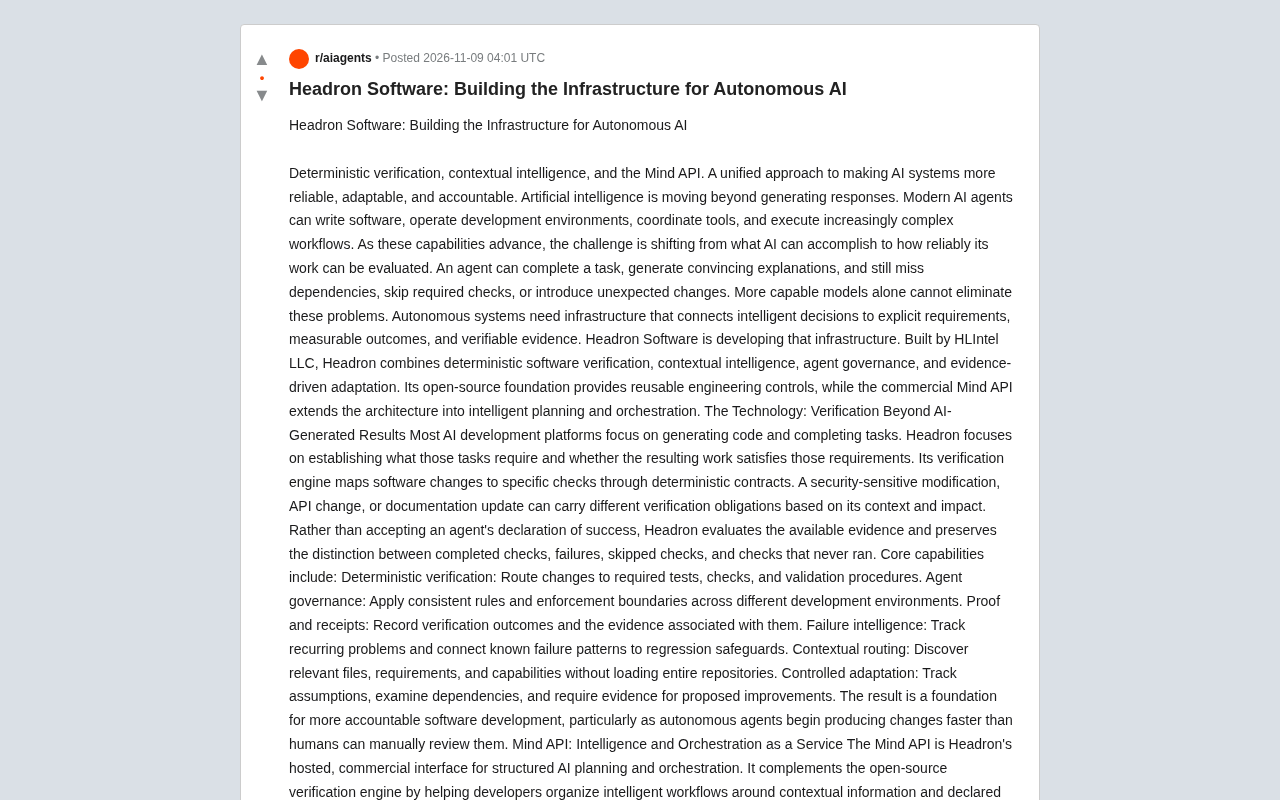
Headron builds accountable verification infrastructure for autonomous AI agents using deterministic contracts and a three-layer architecture.
The article introduces how Headron Software addresses the trustworthiness of autonomous AI agents: when agents can write code and operate environments yet may miss dependencies, skip checks, or introduce unexpected changes, stronger models alone cannot eliminate the risk. Headron maps software changes to specific checks through deterministic contracts, strictly distinguishing passed, failed, skipped, and never-run states, and rejecting agent self-reported success. Its architecture comprises three layers—context and intelligence, contracts and governance, execution and proof—supporting Claude Code, Cursor, OpenHands, and other environments via runtime adapters and MCP. On the commercial side, Mind API offers structured planning and verification-aware orchestration, decoupled from the MIT-licensed open-source CLI and not tied to any model. The controlled adaptation mechanism, based on belief revision, requires correction proposals to carry evidence and does not apply them automatically. Self-reported data include 31/31 implanted breakages rejected and an 89% token reduction in routing experiments, and the project states these do not constitute independent certification.
From "Generating Results" to "Verifying Results"
According to the original Reddit post, Headron is built by HLIntel LLC, and its core approach differs from most AI development platforms: while the latter focus on generating code and completing tasks, Headron focuses on defining what a task requires and whether the resulting work satisfies those requirements.
Its verification engine maps software changes to specific checks through deterministic contracts. A security-sensitive modification, an API change, or a documentation update assumes different verification obligations based on its context and impact scope. The system does not accept an agent's self-reported claims of success; instead, it evaluates the available evidence and strictly distinguishes four states: checks completed, failed, skipped, and never run.
The core capability list includes: deterministic verification, agent governance, proofs and receipts, failure intelligence (tracking recurring issues and feeding known failure patterns into regression guards), context routing (discovering relevant files and capabilities without loading the entire repository), and controlled adaptation (tracking assumptions, checking dependencies, and requiring improvement proposals to carry evidence). Together, these capabilities point toward one goal: when autonomous agents produce changes faster than humans can manually review them, there must still be an accountable engineering foundation.
Deterministic contracts are defined in contrast to "soft verification" that relies on an LLM's free-form judgment. They bind a given software change to a set of pre-declared, mechanically executable checks: given the same change and the same set of contracts, the verification result does not drift with model sampling, prompt wording, or execution order. In implementation, this typically manifests as rule matching over structured inputs such as file paths, interface signatures, dependency graphs, and test inventories, and can therefore reliably distinguish the four states of "check passed," "check failed," "check skipped," and "check never run"—the last two being especially critical, because the most common failure mode of agents is precisely reporting non-execution as a pass. Contract granularity can be tiered by context, with security-sensitive changes bearing more verification obligations than documentation changes, thereby balancing coverage against execution cost.
Mind API: Planning and Orchestration as a Service
Mind API is Headron's managed commercial interface, positioned as structured AI planning and orchestration that complements the open-source verification engine. Developers need not rebuild routing and planning mechanisms for every AI application; instead, they reuse a shared interface that connects task understanding with verification-aware execution.
Architecturally, it emphasizes three responsibilities: contextual intelligence (identifying relevant information, capabilities, and constraints to reduce unnecessary context consumption), structured planning (organizing proposed work into explicit changes with associated requirements), and verification-aware orchestration (connecting planning outputs to the checks and evidence needed to evaluate downstream execution).
The key to this design is decoupling: developers can keep their preferred models and tools and simply introduce a consistent planning and governance layer. Headron does not host models, nor does it replace existing agents. The open-source CLI can run independently without a managed account; Mind API provides a key-based add-on service for developers who need integrated intelligence and orchestration capabilities.
Model Context Protocol (MCP) is an open interface specification connecting AI applications with external tools and data sources, roughly analogous to "USB-C on the tool side": models or agents discover available capabilities, read structured information, and invoke operations through a unified client-server protocol, without having to write adapter code for each tool individually. In Headron's usage, MCP serves as the exposure surface for discovery and verification information—agents can query relevant files, verification obligations, and check results, but execution actions remain gated by a separate permission layer. This design of read-only exposure plus separated authorization allows the same verification contract to take effect across different host environments such as Claude Code, Cursor, and OpenHands, avoiding drift caused by each agent duplicating its own copy of the underlying rules.
Three-Layer Architecture: Context, Governance, and Execution Each Fulfill Their Roles
Headron's overall architecture splits responsibilities into three complementary layers, keeping AI systems flexible while making key operational boundaries explicit:
- System 1 (Context and Intelligence): responsible for task understanding, discovery, context retrieval, and capability routing.
- System 1.5 (Contracts and Governance): responsible for requirements, permissions, verification obligations, and decision boundaries.
- System 2 (Execution and Proof): responsible for task execution oversight, verification results, evidence, and accountable outputs.
The original post explicitly states that these three layers represent an architectural direction rather than three separate products. Their purpose is to connect the decisions made by intelligent systems with the requirements and evidence needed to evaluate those decisions.
In terms of environment integration, Headron supports multiple development environments through runtime adapters and the Model Context Protocol (MCP), including Claude Code, OpenAI Codex, Cursor, OpenHands, Windsurf, Hermes, and other compatible tools. A single shared verification contract can take effect across these environments, without each agent maintaining its own copy of the underlying rules. The MCP interface exposes read-only discovery and verification information, while execution remains subject to separate permission controls.
The naming of System 1 / System 1.5 / System 2 borrows the intuition of dual-process theory from cognitive science: System 1 corresponds to fast, intuitive pattern matching, and System 2 to slow, deliberate reasoning and verification. Headron inserts System 1.5 in between to point to a frequently overlooked middle layer—contracts and governance belong neither to intelligent generation nor to execution proof, but form the rule layer that translates "what to do" into "what conditions must be met for it to count as done." Without this layer, there is no alignable interface between the solutions produced by the fast system and the verification performed by the slow system, and verification easily degenerates into after-the-fact remediation rather than upfront constraint.
Evidence-Driven Controlled Adaptation
One of Headron's more significant recent efforts centers on belief revision and controlled software adaptation. Traditional verification answers the question "does the change satisfy the existing requirements"; Headron attempts to go further: what happens when an underlying assumption itself is wrong?
Its evolving mechanism can identify claims that depend on disproven beliefs and prepare correction proposals—but does not apply them automatically. The adaptation record associates improvement proposals with assumptions, expected benefits, evidence, uncertainties, and rollback conditions. This provides a basis for the system to examine its own assumptions while constraining modification behavior within explicit boundaries. One point emphasized in the original post is worth remembering: an intelligent system should not be considered improved merely because it claims to be improved; improvements must carry evidence. The current implementation focuses on software engineering scenarios rather than general autonomous self-improvement.
Belief revision originates from knowledge representation and logic research; it addresses how a system should consistently retract and revise old beliefs rather than simply stacking new ones when new information conflicts with existing knowledge. In the agent context, it corresponds to a real problem: planning is often built on assumptions such as "a certain dependency exists," "a certain interface is stable," or "a certain test covers this path," and once an assumption is falsified, all conclusions that depend on it should be invalidated and re-evaluated. If the system merely keeps appending new conclusions, it will leave behind contradictory grounds for action. Headron's approach is to explicitly record assumptions, track their downstream dependencies, and, when an assumption is overturned, generate correction proposals accompanied by evidence and rollback conditions—while leaving whether to apply them to controlled boundaries, which is fundamentally different from automated self-rewriting.
Engineering Evidence: Self-Reported Quantitative Metrics
Headron's public repository contains verification records, mandatory tests, recorded failures, and structured engineering metrics. According to the data listed in the original post and reviewed as of November 8, 2026:
- 940 live verifications and 394 recorded landings;
- 17,397 check results, of which 7,357 passed and 1,278 failed;
- 52 hard invariants constraining repository contracts and consistency;
- In a mandatory evaluation covering 20 toolchains, all 31 implanted breakages were rejected (31/31);
- In a routing experiment, prompt tokens were reduced by 89% compared with full-tree context loading.
The original post also states that these are project-self-reported, scope-defined measurements and do not constitute independent certification or a guarantee of general correctness. Their value lies in emphasizing making engineering claims inspectable, retaining failure results, and marking the boundaries of the available evidence—a system should state what it has proven, rather than packaging incomplete verification as definitive conclusions.
The Combination of an Open-Source Foundation and Commercial Intelligence
In terms of product strategy, Headron combines an accessible engineering foundation with optional commercial services. Headron Software provides, under the MIT license, the open-source CLI, deterministic contracts, verification engine, runtime adapters, MCP integration, and supporting development tools, so developers can inspect the implementation and integrate it into existing repositories. Mind API extends the architecture through managed planning and orchestration. HeadronOS and related interfaces represent a broader product direction, but the original post notes that these companion products are at different stages of development and should not be conflated with the availability of the open-source core.
The onboarding path is also relatively straightforward: after installing via uv, run doctor, init, and verify in sequence. The goal is to make it easier for developers to adopt structured verification and governance without replacing their existing tools.
The Next Threshold for Autonomous AI: Accountability
AI systems will continue to become more capable, more interconnected, and more autonomous, coordinating specialized agents, interacting with external environments, and completing complex work with less direct supervision. This is creating infrastructure needs beyond model reasoning: systems must understand their operating environment, comply with constraints, recognize uncertainty, retain evidence, and adapt without introducing runaway changes.
Headron chose to start with software engineering because changes, dependencies, tests, and execution results naturally provide measurable handles. Its greater potential lies in a portable accountability layer that spans models, agents, and development environments, ultimately covering more complex autonomous workflows. The open-source verification engine lays the engineering foundation, Mind API opens a commercial path, and controlled adaptation and shared contracts reserve space for more complex systems. The future of autonomous AI depends not only on what intelligent systems can do, but also on whether their actions can be understood, governed, and verified.
Related articles

Seven Years of Evolution: How Far Has the Foldable Come From the First Generation?
From the first foldable to today's latest models, what has seven years changed? Shallower creases, higher brightness, thinner bodies, and smoother software migration—has the foldable crossed the chasm from enthusiasts to ordinary users? This article discusses the question based on a video comparison.

When Did Humans Start Eating Salt? A 10,000-Year History of Salt
When did humans start eating salt? From salt use at the dawn of agriculture 11,000 years ago to ancient seawater evaporation and rock salt mining, and on to the salt trade, salt taxes, and Gandhi's Salt March, this article traces salt's key role in human civilization.
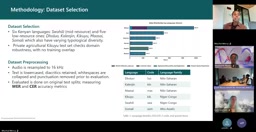
Microsoft Paza Research: How African Language Speech Recognition Breaks Through Architecture and Data Bottlenecks
Microsoft's Paza research evaluates 53 speech models across 39 African languages, revealing architecture choice matters more than pre-training coverage, 200-300 hours is the practical data threshold, and language typology deeply influences recognition performance.