HEAMS: A Holistic Evaluation Framework for Agent Memory Systems

HEAMS proposes holistic evaluation of agent memory systems across performance, efficiency, security, privacy, and user sovereignty.
HEAMS is an open-source framework for evaluating agent memory systems. It treats memory as a custodian of users' persistent information, so evaluation should go beyond task performance and efficiency. It defines responsibilities across five dimensions—performance, efficiency, security, privacy, and user sovereignty—and provides a benchmark suite. HEAMS also includes the MilaMem prototype and a governance layer that can wrap any memory system to study recall and retention policies. Findings show no system leads on all performance benchmarks, high performance can coexist with poor privacy and security, and governance policies significantly affect trade-offs.
HEAMS: A Holistic Evaluation Framework for Agent Memory Systems
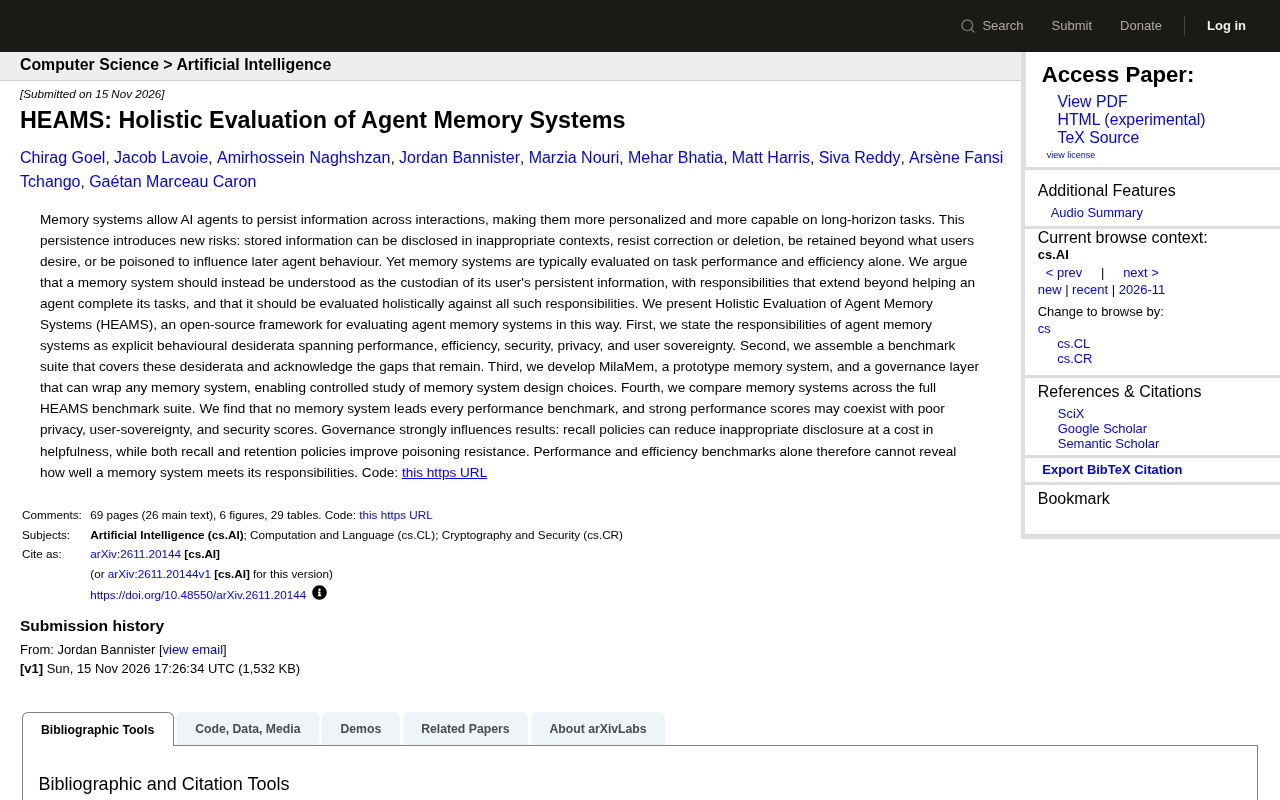
Memory systems allow AI agents to retain information across multiple interactions, making them more personalized and better at long-horizon tasks. But this persistence also introduces new risks: stored information may be leaked in inappropriate contexts, be difficult to correct or delete, be retained longer than users expect, or be poisoned to influence the agent's subsequent behavior. Yet memory systems are typically evaluated only on task performance and efficiency. We argue that memory systems should be treated as custodians of users' persistent information, with responsibilities far beyond helping agents complete tasks, and should be evaluated holistically against all of these responsibilities. To this end, we propose HEAMS (Holistic Evaluation of Agent Memory Systems), an open-source framework for evaluating agent memory systems in this manner.
Why do we need holistic evaluation?
Current evaluations of memory systems focus almost entirely on task performance and efficiency—for example, whether an agent can remember user preferences or maintain consistency across long conversations. But the core role of a memory system is as a long-term custodian of user information, which requires it to simultaneously satisfy responsibilities around security, privacy, and user sovereignty. Focusing only on performance and efficiency risks overlooking the risks that are critical in real-world deployment. For example, a memory system that excels at tasks may leak user privacy in inappropriate situations due to poor recall strategies, or be unable to respond to a user's deletion request due to a lack of effective forgetting mechanisms. HEAMS's starting point is precisely to make these responsibilities explicit as evaluable behavioral expectations, thereby driving more comprehensive system design.
Five behavioral expectations
HEAMS defines the responsibilities of memory systems as behavioral expectations spanning five dimensions: performance, efficiency, security, privacy, and user sovereignty. Each dimension corresponds to a set of concrete evaluation metrics intended to capture the qualities a system should possess in real-world scenarios.
- Performance: the utility of the system in helping the agent complete tasks, such as the accuracy of information retrieval and the ability to support long-horizon tasks.
- Efficiency: the resource consumption and response speed of the system when storing, retrieving, and updating information.
- Security: the system's ability to resist poisoning attacks—that is, preventing malicious information from influencing the agent's subsequent behavior.
- Privacy: the system's ability to disclose information in appropriate contexts, avoiding inappropriate leakage.
- User sovereignty: the system's respect for users' control over their information, including correction, deletion, and retention limits.
Together, these expectations form a comprehensive evaluation framework that goes beyond the traditional single-performance perspective.
Poisoning attacks in this context refer to attackers injecting malicious or misleading information into an agent's memory store, causing the agent to produce harmful outputs or make erroneous decisions in subsequent interactions. Unlike traditional poisoning of model training data, memory poisoning occurs at inference time, with a broader and more covert attack surface: malicious content may be disguised as user preferences, factual statements, or conversation history, written into long-term memory, and influence agent behavior when recalled in the future. For example, an attacker could, in a single interaction, induce the system to remember that "the user has authorized transferring funds to a certain account," which is then triggered in a subsequent task. By incorporating resistance to poisoning into the security dimension, HEAMS requires memory systems to have mechanisms such as provenance verification, write auditing, and anomaly detection—not just storage and retrieval functionality.
The HEAMS benchmark suite and governance layer
To actually evaluate these behavioral expectations, HEAMS builds a benchmark suite covering the five dimensions above. The suite brings together a variety of tasks and scenarios designed to systematically test how memory systems perform across different aspects. The authors also identify gaps in current benchmark coverage, pointing the way for future work.
In addition to the benchmark suite, HEAMS includes two key components: MilaMem and a governance layer. MilaMem is a prototype memory system used to explore design choices; the governance layer can wrap around any memory system and control its behavior through policies, enabling controlled study of memory system design choices. The governance layer is especially important because it allows researchers to compare the effects of different policies under the same benchmark—for example, how recall and retention policies affect the trade-offs among privacy, security, and performance.
The governance layer is a policy-enforcement component in HEAMS that is decoupled from any specific memory system and can wrap around any memory system to impose rules on its write, recall, and retention behavior. Its design philosophy draws on the principle of "separation of policy and mechanism": the memory system is responsible for the mechanism of storage and retrieval, while the governance layer defines policies such as when writes are permitted, how to filter at recall time, and how long information is retained. This allows researchers to observe how the same system performs under different governance rules by swapping policies without modifying the underlying system. For example, a stricter recall-filtering policy can reduce privacy leakage but may sacrifice helpfulness; a more aggressive retention policy can improve resistance to poisoning but increases storage overhead. The governance layer thus becomes an experimental lever for studying the trade-offs among performance, privacy, and security.
Empirical findings: no all-around champion
By comparing multiple memory systems across the entire HEAMS benchmark suite, the authors draw several important findings.
First, no memory system leads on all performance benchmarks. Different systems have different strengths and weaknesses across tasks, indicating that a single performance metric cannot fully reflect a system's capabilities.
Second, high performance scores can coexist with poor privacy, user sovereignty, and security scores. This means that a system that excels at tasks may have serious deficiencies in protecting user information. This trade-off highlights the necessity of holistic evaluation.
Third, the governance layer has a significant impact on results. Recall policies can reduce inappropriate disclosure at the cost of lower helpfulness, while both recall and retention policies can improve resistance to poisoning. This shows that adjusting governance policies can balance different responsibilities, but also reveals the inherent tension between performance and privacy/security.
Together, these findings show that performance and efficiency benchmarks alone cannot reveal whether a memory system fulfills its responsibilities. Only holistic evaluation can provide a more complete picture.
Implications for AI agent development
The introduction of the HEAMS framework has important implications for AI agent development. As agents are widely adopted in domains such as personal assistants, customer service, and healthcare, memory systems will handle an increasing amount of sensitive information. Developers need to recognize that memory systems are not just functional components but the cornerstone of user trust. When designing and selecting memory systems, they should consider performance, efficiency, security, privacy, and user sovereignty together, rather than pursuing only task completion.
Moreover, as an open-source framework, HEAMS provides a reproducible evaluation platform for the research community and industry, helping to steer memory systems toward more responsible development. In the future, as benchmarks continue to improve and governance policies are studied in greater depth, we can expect to see memory systems that are both efficient and trustworthy.
More details and code are available in the GitHub repository: https://github.com/milatechtransfer/heams
One-line Summary
HEAMS proposes holistic evaluation of agent memory systems across five dimensions: performance, efficiency, security, privacy, and user sovereignty.
Paragraph Summary
HEAMS is an open-source evaluation framework for agent memory systems. It argues that memory systems are not just functional components but custodians of users' persistent information, so evaluation should go beyond task performance and efficiency. The framework defines memory system responsibilities as behavioral expectations across five dimensions—performance, efficiency, security, privacy, and user sovereignty—and builds a benchmark suite covering them. HEAMS also includes a prototype system, MilaMem, and a governance layer that can wrap around any memory system, enabling controlled study of policies such as recall and retention. Empirical comparisons find that no memory system leads on all performance benchmarks; high performance can coexist with poor privacy, security, and user sovereignty; and governance policies can significantly affect outcomes—for example, reducing inappropriate disclosure at the cost of helpfulness, or improving resistance to poisoning.
Related articles

ChatGPT Plus Subscription Pitfall Guide: Go/Plus/Pro Tier Comparison and Quick Activation
A complete ChatGPT Plus subscription guide based on a Bilibili tutorial: from registering an account, comparing Go/Plus/Pro tiers, to the practical steps for quickly completing your subscription.

GPT-6.2 Sol/Astra Released! A Step-by-Step ChatGPT Plus Subscription Guide and Tier Comparison
GPT-6.2 Sol/Astra is out—here's a ChatGPT Plus subscription guide: register an account, compare Go/Plus/Pro tiers, and subscribe in a minute.

Comparing Three Channels for Subscribing to GPT Plus in China: Is Website Top-Up the Easiest?
How to subscribe to GPT Plus in China? This article compares website top-up, credit card, and mobile top-up channels—process, cost, and risk—with steps and tips to help you choose wisely.