Heap Code: The Open-Source VS Code AI Coding Assistant That Truly Supports Local Models

Heap Code is a privacy-first, open-source VS Code AI coding assistant with full local model support.
Heap Code is an open-source VS Code extension offering AI coding assistance through Chat, Completions, Inline Edit, and Agent Mode. It supports local inference via Ollama and LM Studio, as well as any OpenAI-compatible cloud service. Key differentiators include per-role provider switching, human-in-the-loop agent controls, hybrid semantic search, zero telemetry, and OS Keychain-based API key storage.
An AI Coding Assistant Built for Local-First Workflows
In an era where GitHub Copilot has become nearly synonymous with AI-assisted coding, many developers find themselves stuck in the same frustrating position: most Copilot alternatives either lock you into a single cloud provider or offer only superficial support for local models. One developer, after trying various solutions, decided to build his own — introducing Heap Code, an open-source VS Code extension designed to tackle this problem at its roots.
As the author shared on Reddit, Heap Code integrates four core capabilities: Chat, Completions, Inline Edit, and Agent Mode. It runs locally on Ollama and LM Studio, and also supports cloud services like OpenAI, Groq, and OpenRouter — or any service that implements an OpenAI-compatible API — using your own API keys.
Background on Local Inference Frameworks: Ollama and LM Studio are the two most prominent frameworks in the local LLM ecosystem today. Ollama is centered around a command-line tool that uses standardized model formats (GGUF) and a REST API, letting developers manage and run local language models much like Docker containers. LM Studio offers a graphical interface, lowering the barrier for users without a technical background. Together, they've pushed the scenario of "running 7B–70B parameter models on consumer hardware" from niche to mainstream — providing the infrastructure foundation that makes Heap Code's "fully local" use case genuinely viable.
It's worth noting an important industry context behind Heap Code's support for "any OpenAI-compatible service": the HTTP interface specification OpenAI defined when launching its GPT API (endpoints like /v1/chat/completions) has effectively become the industry standard for LLM services. Groq, Together AI, and even the local inference framework Ollama all provide interfaces compatible with this spec. This makes a truly model-agnostic architecture possible — developers can switch between providers simply by changing the baseURL and API key, without touching any application logic.
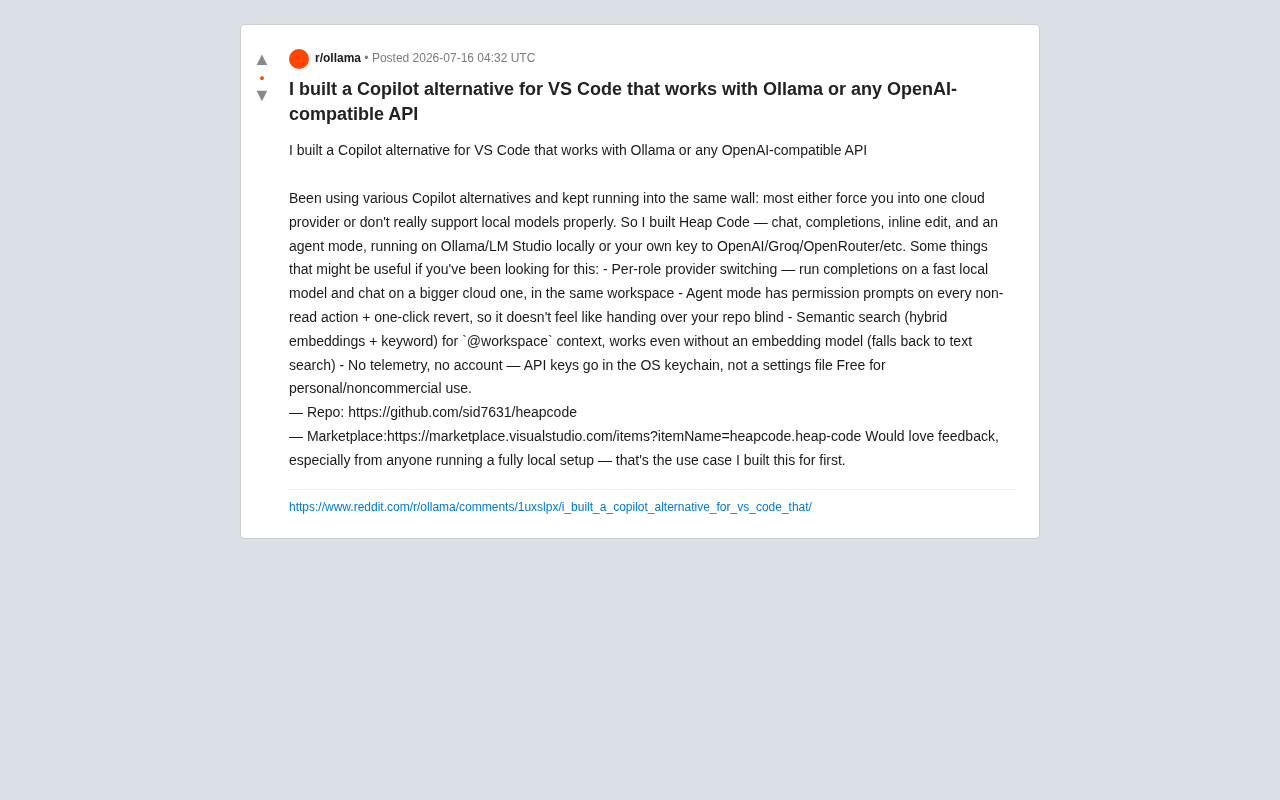
For developers who've been searching for a solution that truly supports full local deployment, this project's positioning is crystal clear — the author openly states that fully local operation was the primary use case he had in mind when building this tool.
Four Differentiating Design Choices Worth Noting
Per-Role Provider Switching
One of Heap Code's most distinctive features is per-role provider switching. Within a single workspace, developers can run code completions on a fast, lightweight local model while routing conversational reasoning to a more capable cloud model.
This reflects pragmatic engineering thinking: code completion is latency-sensitive and called frequently, making it well-suited for lightweight local models; complex conversational reasoning demands more from the model, but occasional cloud calls won't break the bank. This kind of flexible, mixed-provider setup is exactly what single-provider solutions struggle to offer.
An Agent Mode With Guardrails
Agent Mode is a feature every AI coding tool is racing to ship — and also the one developers worry about most. Handing your entire codebase over to an AI for autonomous operation is a real risk.
To understand this concern, consider what Agent Mode actually entails: it's the ability of an AI system to autonomously plan and execute multi-step operations — in a coding context, this typically includes reading and writing files, running terminal commands, and calling external tools. Unlike single-turn code generation, agent actions have a cascading effect — one wrong instruction can trigger a chain of changes that are difficult to undo. The industry has largely split into two camps: the "maximum autonomy" school, represented by Devin, which aims to minimize human intervention; and the "human-in-the-loop" approach, adopted by tools like Cursor and GitHub Copilot Workspace, which introduces user confirmation at critical decision points.
Heap Code takes the restrained route: every non-read-only operation triggers a permission prompt, and one-click revert is supported. As the author puts it, this design means the tool "doesn't feel like handing over your repo blindfolded." Striking the right balance between automation and user control is one of the defining challenges as AI agent tools mature.
Semantic Search and Privacy Trade-offs
Hybrid Semantic Search — No Embedding Model Required
Context comprehension is arguably the most critical factor in AI coding assistant quality. Heap Code provides hybrid semantic search for @workspace context — combining vector embeddings with keyword-based retrieval.
To appreciate this design, it helps to understand the limitations of each approach individually: vector embeddings transform code or text into high-dimensional numerical vectors, placing semantically similar content closer together in vector space. This captures logically similar code snippets but can miss exact API names or variable identifiers. Keyword-based methods like BM25 excel at exact matching but struggle with semantically equivalent but differently phrased expressions. Hybrid retrieval is designed to get the best of both — and it's the prevailing practice in modern RAG (Retrieval-Augmented Generation) systems. In a code completion context, this means the AI can find both "functionally similar reference functions" and "exact-name dependency calls."
Particularly worth highlighting is the graceful degradation strategy: even without an embedding model configured, the tool automatically falls back to plain text search rather than failing entirely. For local deployment scenarios, this "better with, functional without" design significantly lowers the barrier to entry.
A Clear Privacy Commitment: No Telemetry, No Account
As data privacy becomes increasingly important, Heap Code makes its stance explicit: no telemetry data collection, no account required. API keys are stored in the OS Keychain rather than written in plaintext to a config file.
The OS Keychain refers to system-level secure storage mechanisms such as macOS Keychain, Windows Credential Manager, and the Linux Secret Service API. Compared to storing API keys in plaintext in a .env file or settings.json, Keychain storage offers encryption, access isolation, and binding to the user's login state — even if an attacker gains read access to the filesystem, extracting credentials stored this way is non-trivial. This approach is far from universal in the VS Code extension ecosystem; Heap Code making it the default behavior rather than an opt-in reflects a higher standard for developer key security.
This combination of features is particularly appealing to enterprise developers and individuals who care about data sovereignty. Paired with its fully local execution capability, Heap Code can theoretically ensure that code and data never leave the local environment — which is precisely the core requirement for many compliance-constrained teams.
Positioning and Ecosystem Outlook
Heap Code is currently free for personal and non-commercial use. The project is open-sourced on GitHub (sid7631/heapcode) and available on the VS Code Marketplace. The author is especially eager for feedback from users running fully local setups, as that remains the core scenario he originally targeted.
Zooming out, Heap Code represents a trend in the AI coding tools ecosystem that deserves attention: beyond the cloud-dominated mainstream, local-first, privacy-first, model-agnostic open-source solutions are gaining ground. As local inference frameworks like Ollama and LM Studio mature, and as open-source model capabilities continue to improve, an AI coding experience that doesn't depend on any single cloud provider is becoming increasingly feasible.
Of course, whether Heap Code can genuinely challenge Copilot's market position remains to be seen — local models still lag behind top-tier cloud models in completion quality and context length, and the real-world reliability of the Agent mode needs to be tested in actual projects. But for developers who want to embrace AI-assisted coding without being locked into the cloud or sacrificing data sovereignty, having an open-source, flexible, privacy-friendly option in the mix is itself worth watching closely.
Key Takeaways
Related articles

Alibaba Launches Happy Shrimp: AI-Powered One-Click Complete Song Generation
Alibaba launches Happy Shrimp, an AI music generation tool that creates complete songs with lyrics, melody, arrangement, and vocals from natural language descriptions. In-depth analysis of its core features, differentiation from competitors like Suno, and industry impact.

GPT Sol Ultra vs Grok 4.6: Real-World Task Completion Benchmark in Reasoning Mode
Developer benchmark reveals GPT Sol Ultra completes draw.io scientific diagrams in one iteration while Grok 4.6 fails to converge despite maximum reasoning mode, exposing that reasoning depth ≠ task delivery capability.

OpenAI Authorship Dispute: The Battle Over Academic Boundaries in the AI Era
OpenAI disputes authorship with mathematician Tristan Buckmaster over Navier-Stokes research, raising ethical questions about AI involvement in science.