Heat Diffusion Prior: THETA Enhances Cross-Domain Transfer in Graph Foundation Models
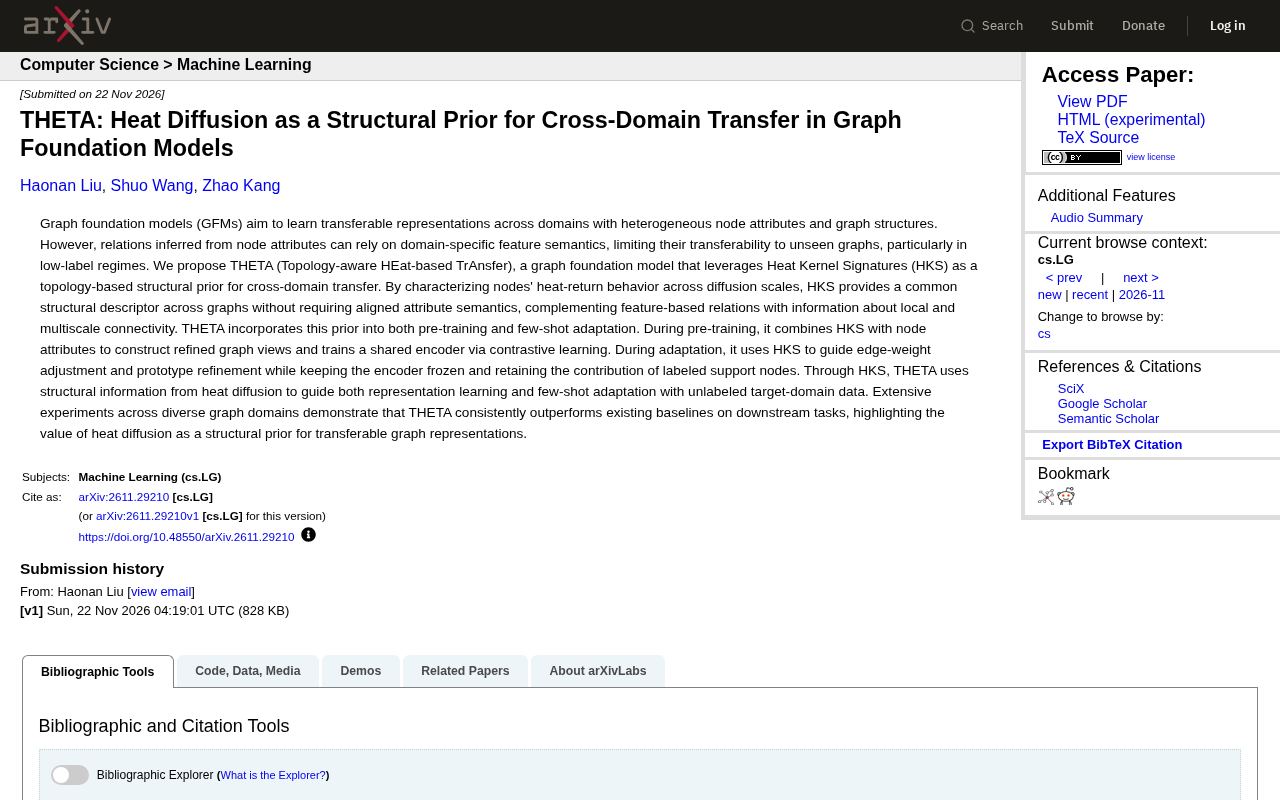
THETA uses heat kernel signatures as a structural prior to boost cross-domain transfer in graph foundation models.
The article presents THETA, a graph foundation model that uses Heat Kernel Signatures (HKS) as a topological structural prior to address poor generalization of attribute-semantic relations and label scarcity in cross-domain transfer. THETA combines HKS with attributes for contrastive pretraining and uses HKS to guide edge-weight adjustment and prototype refinement during few-shot adaptation with a frozen encoder. Experiments across domains show consistent gains over baselines, highlighting the value of structural priors.
Graph Foundation Models (GFMs) aim to learn node representations that can transfer across domains, but node attribute semantics and graph connectivity patterns vary greatly across domains, causing models to underperform on unseen graphs—especially when target-domain labels are scarce. A study titled "THETA: Heat Diffusion as a Structural Prior for Cross-Domain Transfer in Graph Foundation Models" proposes using Heat Kernel Signatures (HKS) as a purely topological structural prior, providing a universal descriptor independent of attribute semantics for cross-domain transfer, and injects this prior into both pretraining and few-shot adaptation stages.
Core Problem: Attribute-Inferred Relations Are Hard to Transfer
Existing graph foundation models often infer relations between nodes from node attributes, but such relations depend on domain-specific feature semantics. Attribute similarities that are effective in the source domain may fail entirely in the target domain. The paper points out that this limits the model's transferability in low-label scenarios. HKS instead characterizes nodes' "heat return" behavior through the heat diffusion process on the graph, reflecting local and multi-scale connectivity across different diffusion scales, thereby providing a structural descriptor decoupled from attribute semantics.
Heat Kernel Signatures (HKS) originate from the heat diffusion equation in spectral graph theory. Treating the graph as a discrete heat conduction system, the probability of heat propagating from node i to node j evolves with diffusion time t, and its analytical form is given by the eigenvalues and eigenvectors of the Laplacian matrix: $H_t = \exp(-tL)$. HKS takes the diagonal elements $h_t(i,i)$ of this heat kernel matrix—i.e., the amount of heat that node i "returns" to itself after time t—as the node's structural fingerprint across multiple scales. At small t, HKS mainly reflects a node's local degree and neighborhood structure; at large t, it captures global connectivity. Since HKS depends only on the Laplacian spectrum and is independent of node attribute semantics, it is naturally suited as a domain-agnostic topological descriptor for cross-domain use; it is also equivariant to graph isomorphism, with theoretical stability guarantees.
The THETA Method: Heat Diffusion-Guided Pretraining and Adaptation
The core of THETA (Topology-aware HEat-based TrAnsfer) is to use HKS in both pretraining and few-shot adaptation. In the pretraining stage, it combines HKS with node attributes to construct finer-grained graph views and trains a shared encoder via contrastive learning. In this way, the encoder learns not only attribute information but also topological patterns characterized by heat diffusion.
In the adaptation stage, the encoder remains frozen, and THETA uses HKS to guide edge-weight adjustment and prototype refinement while preserving the contribution of labeled support nodes. This means the model can effectively adapt on unlabeled target-domain data with the help of the structural prior, without retraining the entire network.
Contrastive Learning in graph pretraining typically adopts InfoNCE-style objectives: pulling closer the representations of the same node under different augmented views (e.g., edge masking or attribute perturbation weighted by different HKS scales) and pushing apart representations of different nodes. THETA incorporates HKS into view construction, making the two augmented views comparable in a topological sense, so that the representations learned by the shared encoder encode both attribute semantics and heat diffusion structure. Prototype Refinement is a common technique in few-shot graph learning: maintaining a prototype for each class obtained by averaging support-set node representations, then iteratively updating the prototype using predictions on query-set or unlabeled nodes to bring it closer to the true class center. After adjusting edge weights with HKS, THETA re-aggregates neighbor representations to refine prototypes, enabling unlabeled target-domain data to participate in adaptation guided by the structural prior without fine-tuning encoder parameters.
Experimental Validation: Consistent Lead on Cross-Domain Downstream Tasks
The paper conducts extensive experiments across multiple graph domains, and THETA consistently outperforms existing baselines on downstream tasks. This validates the value of heat diffusion as a structural prior for transferable graph representations. Although the abstract does not disclose specific datasets and metric values, the conclusion of "consistently outperforming baselines" covers different graph domains, indicating a certain generality of the method.
Implications: Structural Priors Compensate for the Shortcomings of Attribute Semantics
THETA's approach suggests that one bottleneck in cross-domain graph transfer lies in over-reliance on attribute semantics. Introducing domain-agnostic topological descriptors can provide a stable complementary signal in low-label scenarios. As a physical process, heat diffusion's multi-scale nature is naturally suited to characterizing both local and global graph structure. In the future, it may be combined with other structural priors to further improve the generalization capability of graph foundation models.
One-line Summary
THETA uses heat kernel signatures as a topological structural prior to enhance cross-domain transfer in graph foundation models.
Paragraph Summary
This article introduces a graph foundation model study called THETA, addressing the difficulty of generalizing attribute-semantic relations in cross-domain graph transfer and the scarcity of target-domain labels. It proposes using Heat Kernel Signatures (HKS) as a purely topological structural prior decoupled from attribute semantics. In pretraining, THETA combines HKS with node attributes to construct graph views and trains a shared encoder via contrastive learning; in few-shot adaptation, it freezes the encoder and uses HKS to guide edge-weight adjustment and prototype refinement, thereby effectively leveraging unlabeled target-domain data. Multi-domain experiments show that the method consistently outperforms existing baselines on downstream tasks, validating the value of the heat diffusion prior for transferable graph representations and suggesting that structural priors can compensate for the shortcomings of attribute semantics in cross-domain scenarios.
Related articles

Astrophysicist Pokes Fun at Supermoons: The Difference Between a 16-Inch and a 15-Inch Pizza
Astrophysicist Neil deGrasse Tyson criticizes the terms supermoon and micromoon, using a 16-inch vs. 15-inch pizza analogy to show the visual difference is negligible, and calls out exaggerated labels in science communication.

Bypassing the iOS Safari 60fps Limit: Building a Native-Like Web App Experience
A deep dive into bypassing iOS Safari's 60fps limit through compositor animations, frame rate decoupling, and interaction detail optimization to give web apps a near-native feel on iPhone.

Allstate's Multi-Day Technical Outage Before Thanksgiving
Insurance giant Allstate suffered a multi-day technical outage before the Thanksgiving travel peak. This article analyzes the impact of the timing, implications for insurtech, and the importance of system stability for financial institutions.