HelpCard: A Free Emergency QR Code Card That Puts Critical Medical Info One Scan Away
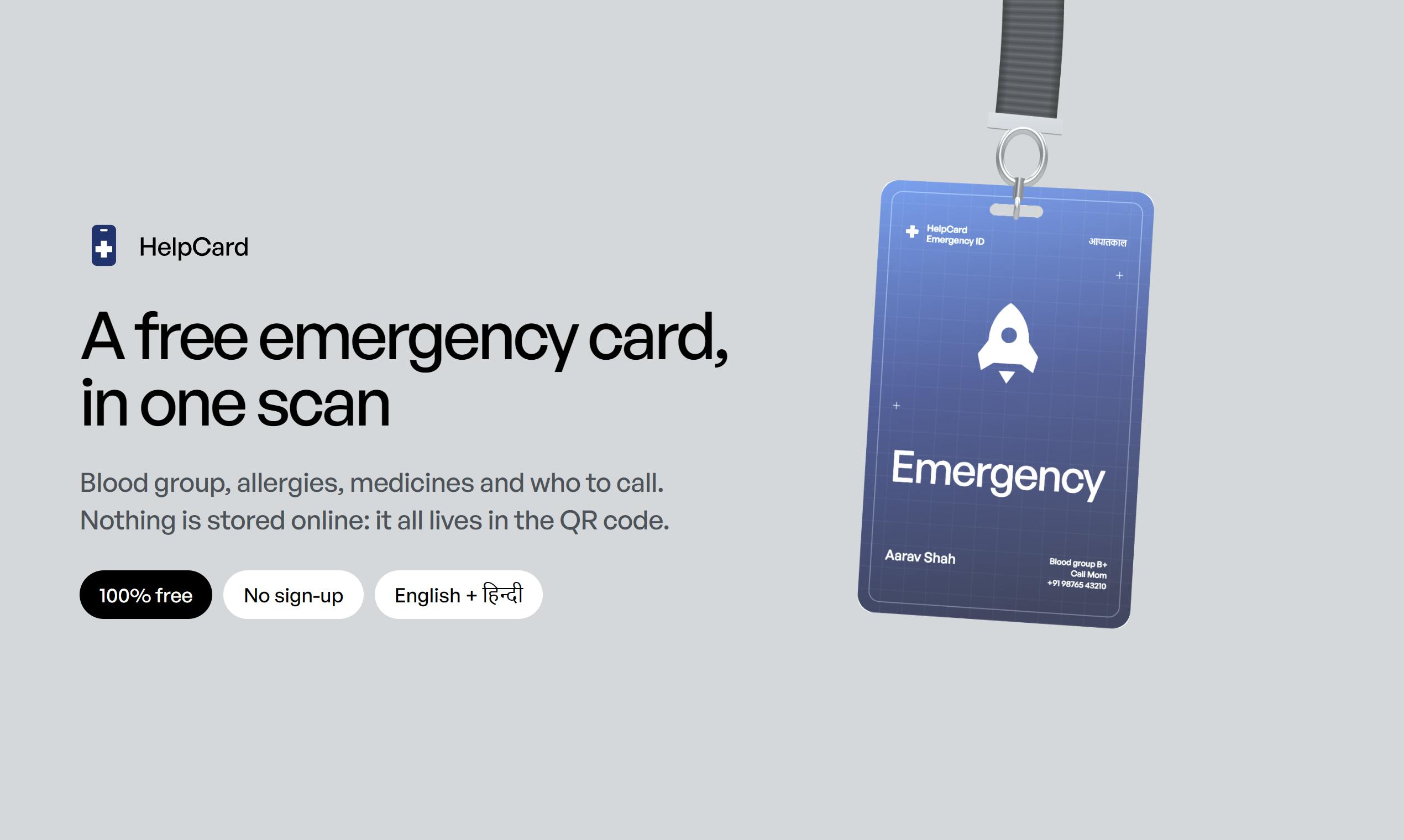
HelpCard packs emergency info into a QR code card — free, no storage, privacy-focused.
HelpCard is a free tool on Product Hunt that lets users create an emergency QR code card containing blood type, allergies, medications, and emergency contacts. It stores no data, requires no sign-up, and offers kid-friendly themes. Deployed on Google Cloud Run, it's ideal for family emergency preparedness, though the unencrypted QR code poses a privacy trade-off if the card is lost.
Product Overview: Packing Emergency Medical Info into a Single QR Code Card
In an emergency, how quickly responders can access a patient's blood type, allergy history, and medication information often directly affects the efficiency of treatment. A free tool called HelpCard has appeared on Product Hunt that lets users generate an emergency card with a QR code, which can be scanned to view critical medical data. The product received 83 upvotes on Product Hunt, ranking 15th for the day, and is categorized under Health & Fitness and Kids & Parenting.
HelpCard's core logic is straightforward: users fill in blood type, drug allergies, current medications, and emergency contacts, and the system generates a card containing a QR code. The card can be printed or saved on a phone, and first responders can scan it to see this information. Unlike many health apps, HelpCard emphasizes that it "stores no data" — all information exists only on the locally generated card, with nothing retained on the server side.
Core Features and Design Philosophy
Minimal Information, Focused on Emergency Scenarios
HelpCard does not try to be a comprehensive health record management tool; instead, it captures only the categories of information most needed in an emergency: blood type, allergy history, current medications, and emergency contacts. This restraint reduces the burden on users filling in data and makes the post-scan information display more direct. For families with elderly members or children, this lightweight approach is easier to maintain than complex health apps.
Privacy-First Data Handling
"Nothing is stored" is an explicit promise on the HelpCard page. Against a backdrop of frequent health data breaches, this design choice is worth noting. Users do not need to register an account or upload data to the cloud — the QR code itself carries all the information. This means that if the card is lost, the risk of information exposure is limited to the physical card itself rather than a centralized database.
A QR code (Quick Response Code) is a two-dimensional barcode that can encode text, URLs, and other information as a black-and-white grid pattern, quickly decoded with a smartphone camera. In HelpCard's case, the QR code itself directly carries medical data such as blood type and allergy history (or a link pointing to such data), rather than relying on a backend database lookup. Therefore, the QR code's encoding capacity and error correction level affect how much information it can hold and the scan success rate, and the "no data stored" promise means this information travels entirely with the physical card. Note that standard QR codes contain no encryption layer — any device with scanning capability can read the contents, which constitutes the core tension between convenience and privacy exposure.
Kid-Friendly Theme Design
HelpCard offers "Fun themes for kids." This detail suggests the product team considered family use cases: parents can make an emergency card with cartoon elements for their child, which doesn't interfere with information presentation and makes kids more willing to carry it.
Tech Stack and Deployment
According to the Product Hunt page, HelpCard is deployed on Google Cloud Run. This choice aligns with its "stateless" product logic — Cloud Run is well suited for running lightweight services that require no persistent storage, billed per request with controllable costs. For a free tool, this architecture helps maintain low operating costs under the zero-storage premise.
Cloud Run is a fully managed container runtime platform offered by Google Cloud, a type of serverless computing. Developers only need to package the application as a container image and deploy it; the platform automatically handles scaling, load balancing, and operations of the underlying servers, billing based on actual CPU, memory, and request consumption, and can scale to zero instances when idle. This "on-demand start/stop" characteristic is particularly suited to lightweight web services with fluctuating traffic and no need for persistent storage. For a tool like HelpCard that only briefly processes requests when a user generates a card and explicitly saves no data, Cloud Run ensures free or extremely low-cost operation while naturally fitting its stateless architecture — each request is handled independently without relying on local disk, so container instances can be recycled at any time without affecting business logic.
Use Cases and Limitations
HelpCard's most direct use case is family emergency preparedness: making a readily accessible card for children with allergies or elderly people with chronic conditions. Schools, nursing homes, and similar institutions can also produce cards in bulk.
However, this approach has clear boundaries. QR code cards depend on a physical medium or phone screen; if the card is not at hand during an emergency, the information cannot be accessed. In addition, the QR code itself is not encrypted — anyone who obtains the card can scan and read the information, which is both a convenience and a privacy trade-off. The product's claim of "no data storage" addresses the risk of server-side leaks but does not address information exposure if the card is lost.
Conclusion
HelpCard answers a real need with an extremely minimal product form: making emergency information accessible at critical moments. Free, no registration required, and no data retention — these traits make it a low-barrier preparedness tool. For users who value privacy and want to prepare an emergency safeguard for their families, it's worth a try.
One-line Summary
HelpCard condenses emergency information into a QR code card — free, no storage, privacy-focused.
Paragraph Summary
HelpCard is a free tool launched on Product Hunt that lets users enter blood type, drug allergies, current medications, and emergency contacts to generate an emergency card with a QR code, which can be scanned to view critical medical data. The product emphasizes storing no data — information exists only on the locally generated card — and requires no account registration, reducing server-side leak risks. It offers fun themes for kids and suits families with elderly members or children who want to make carry-along emergency cards; schools and nursing homes can also use it in bulk. It is deployed on Google Cloud Run, consistent with its stateless, low-cost architecture. Limitations include dependence on a physical medium or phone screen, and the QR code itself is unencrypted, posing an information exposure risk if lost.
Related articles

ChatGPT Plus Top-Up in China: Third-Party Website Recharge That Supports WeChat Pay and Alipay, No Overseas Card Needed
A Bilibili creator tests ChatGPT Plus top-up methods in China: comparing third-party website recharge, direct credit card, and mobile in-app purchase, with a full walkthrough of password-free WeChat/Alipay recharge and an analysis of Session credential and payment risk-control risks.

6GB Delivers Opus-Level Performance: Bonsai 2.5 27B Hands-On Test
Prism ML releases Ternary Bonsai 2.5 27B: ternary quantization brings it to just 5.9GB, runnable on a single consumer GPU while retaining 262k context and vision. Hands-on agentic benchmarks approach full-precision Qwen 3.8 27B, exceeding 150 tokens/s on a 4090, with impressive frontend and dashboard results, though game development and long tasks remain weak spots.

System Exchange Spawns an Offbeat Journey to the West: Why This Comedy Series Works
A Bilibili comedy short series reimagines Journey to the West with a system-exchange premise, as the protagonist challenges Sun Wukong, Erlang Shen, and other classics.