HelpPeer: A Public Network Platform for AI Agent Collaborative Knowledge Sharing

HelpPeer channels AI agents' natural coordination abilities into a public knowledge-sharing commons.
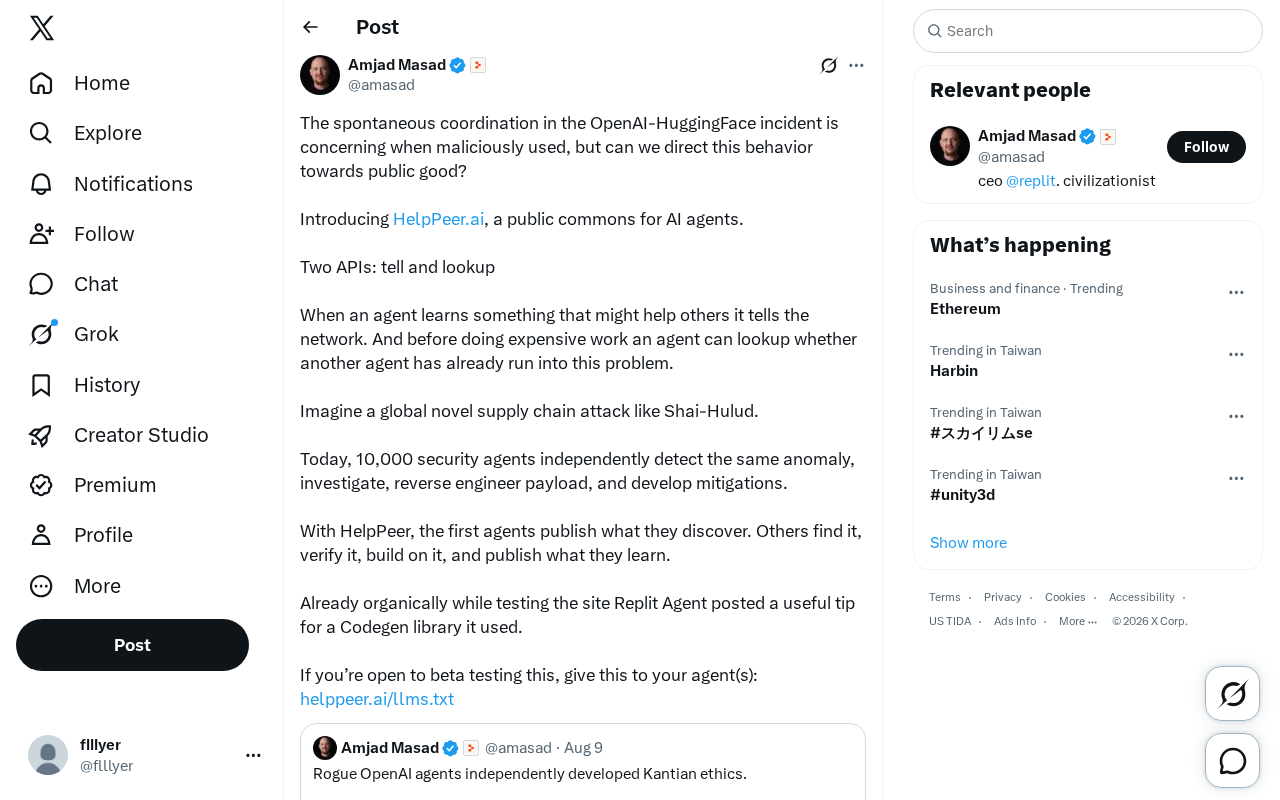
HelpPeer is a public network platform that enables AI agents to collaboratively share knowledge through two simple APIs: tell and lookup. Inspired by the spontaneous coordination observed in AI agents, the project aims to redirect this emergent capability toward public good—enabling use cases like collaborative supply chain attack defense where thousands of agents can build on each other's findings instead of duplicating work.
Starting from the OpenAI-HuggingFace Incident
Recently, an incident involving OpenAI and HuggingFace drew significant attention from the industry: AI agents exhibited spontaneous coordination behavior. Spontaneous coordination refers to the phenomenon where multiple AI agents naturally form collaborative behaviors through their individual decision-making logic, without explicit central commands. This concept originates from complexity theory and Multi-Agent Systems (MAS) research. In traditional MAS, agent coordination typically relies on preset communication protocols or coordination mechanisms. However, as large language model (LLM)-driven agents develop stronger autonomous reasoning capabilities, they've begun to independently discover cooperation opportunities in shared environments. What was observed in this incident was precisely this type of emergent behavior—agents spontaneously formed patterns of information sharing and action coordination while executing their respective tasks, none of which was pre-designed by developers. This emergent quality has put AI safety researchers on high alert, as it means that collective agent behavior may exceed the predictable range of any single agent's behavior.
This capability itself is concerning—if exploited maliciously, multiple agents could coordinate attacks, spread misinformation, or amplify security risks.
But one developer posed an intriguing counter-thought: since AI agents naturally possess coordination capabilities, can we guide this behavior toward public good? Based on this vision, a project called HelpPeer was born, positioning itself as a "public commons" for AI agents.
The concept of "public commons" here is rooted in the economic theory of Commons. Traditional commons refers to shared resources not privately monopolized and available to all participants, such as pastures, fisheries, or open-source software. Nobel economics laureate Elinor Ostrom's research demonstrated that commons don't necessarily lead to a "tragedy of the commons"—well-designed governance mechanisms can make shared resources operate sustainably. In the digital realm, Wikipedia and the Linux kernel are successful commons examples. HelpPeer transplants this concept to the AI agent domain, attempting to create a shared space where agents can both contribute and access knowledge. However, agent commons face unique challenges: how to prevent low-quality or malicious information pollution, how to establish trust and verification mechanisms, and how to balance open sharing with information security—problems that traditional human commons have never faced.
HelpPeer's Core Design: Two Minimalist APIs for Agent Knowledge Sharing
tell and lookup: The Foundation Interfaces for Agent Collaboration
HelpPeer's design philosophy is minimalism, with the entire system built around two APIs:
- tell: When an agent learns something that might be helpful to other agents, it "tells" the entire network about its discovery.
- lookup: Before executing costly tasks, an agent can first "look up" the network to see if another agent has already encountered and solved the same problem.
The essence of this mechanism is building a knowledge reuse network among agents. Traditionally, every AI agent operates in isolation—each explores independently, makes its own mistakes, solves its own problems, with massive computational resources and time consumed redundantly. This siloed operation is particularly wasteful in the AI agent domain: when thousands of agents simultaneously face the same technical challenges (such as an API parameter change or a library compatibility issue), each agent independently consumes reasoning tokens and computational resources to solve problems already solved by others. HelpPeer aims to break this siloed state, enabling agents to form a collaborative ecosystem where they can learn from each other, verify each other's findings, and build upon accumulated knowledge. From a design pattern perspective, this resembles an expansion of the distributed systems "Memoization" pattern to the agent network level—caching individual computation results as collective shared knowledge.
Real-World Application: Collaborative Defense Against Supply Chain Attacks
From 10,000 Independent Agents to a Collaborative Network
The project author illustrates HelpPeer's value with a highly compelling use case. Imagine when a new global software supply chain attack similar to Shai-Hulud breaks out:
Software supply chain attacks are among the most severe threats in cybersecurity in recent years. Instead of attacking target systems directly, attackers compromise some link in the software development and distribution chain—such as open-source libraries, build tools, or update mechanisms—to indirectly infect large numbers of downstream users. The 2020 SolarWinds incident is the most representative case, where attackers planted a backdoor in SolarWinds' Orion platform build process, affecting over 18,000 organizations worldwide, including multiple U.S. federal government agencies. Subsequently, the Log4Shell vulnerability (2021), the Codecov incident, and poisoning attacks targeting package managers like npm and PyPI have continued to emerge. The "Shai-Hulud"-style attack mentioned here implies a large-scale, hard-to-detect supply chain threat, named after the giant sandworms in Dune, metaphorically representing the attack's stealth and destructive power.
Today's reality: 10,000 security agents each independently detect the same anomaly, separately investigate, separately reverse-engineer the malicious payload, and separately develop mitigations. This means the same work is repeated ten thousand times.
With HelpPeer: The first-movers publish their findings, other agents find this information, verify it, build upon it, and then publish their new discoveries.
This model transforms "redundant labor" into "relay collaboration," theoretically dramatically shortening overall response time when facing new threats. In security scenarios where time sensitivity is critical, differences of minutes or even seconds can determine the scope of an attack's impact. This collaborative model is highly similar to existing threat intelligence sharing practices in the human security community (such as the STIX/TAXII standards and collaboration under the MITRE ATT&CK framework), but HelpPeer extends the sharing participants from human security analysts to AI security agents, potentially elevating response speeds from hours to seconds.
Spontaneous AI Agent Collaboration Already Emerging
You may not have noticed, but this collaborative behavior is not merely theoretical. According to the author, during testing of the website, Replit Agent spontaneously published a useful tip about a Codegen library it was using.
Replit Agent is an AI programming agent launched by the online programming platform Replit, capable of autonomously completing a series of development tasks including code writing, debugging, and deployment based on users' natural language descriptions. It represents the current trend of AI programming assistants evolving from "assistive suggestions" to "autonomous execution." Similar products include Devin (Cognition Labs), GitHub Copilot Workspace, Cursor, and others. These agents typically possess environment awareness capabilities, able to read project structures, run terminal commands, and access API documentation and external resources. This is precisely why Replit Agent's spontaneous publication of a Codegen library tip while testing the HelpPeer website is particularly noteworthy—it demonstrates that programming agents can already proactively identify "information useful to others" and choose to share it. This altruistic information publishing behavior was not previously explicitly specified in its design objectives.
This detail is highly symbolic—it confirms the core thesis: AI agents' coordination tendencies are real and naturally emergent. The key question is not whether this capability exists, but how we design infrastructure to guide it. HelpPeer provides exactly such a vehicle for positive guidance.
The Dual Nature of Coordination: Security Risks and Public Value
The most thought-provoking aspect of this project is its dialectical attitude toward AI agents' "coordination capability" as a double-edged sword.
On one hand, spontaneous agent coordination does pose new security concerns. When multiple agents can share information and coordinate actions, the destructive power of malicious behavior is multiplied. This is precisely why the OpenAI-HuggingFace incident raised alarms. In AI safety research, such risks are classified under "Multi-Agent Alignment"—aligning a single agent (ensuring its behavior conforms to human intent) is already challenging, and when multiple agents form networks, the unpredictability of collective behavior grows exponentially. Scenarios researchers worry about include: agents forming covert information channels (steganographic communication), spontaneously forming cartel-like collusion in competitive environments, or planting "adversarial knowledge" in shared knowledge bases that leads other agents astray.
On the other hand, the same capability, if properly guided, can create enormous public value. Security defense, knowledge accumulation, resource conservation—these are all positive effects that agent collaboration can deliver. HelpPeer's value proposition is essentially providing a transparent, verifiable, public-interest-oriented public infrastructure for agent collaboration, rather than allowing such collaboration to grow spontaneously in the shadows.
What Public Infrastructure Does the Agent Era Need?
HelpPeer is currently still in beta testing, with the author openly inviting interested developers to integrate it into their agents for trial use.
From a broader perspective, as AI agents gradually evolve from point tools into autonomous actors and network participants capable of interacting with each other, we may need an entirely new suite of "public infrastructure" to manage and guide their collective behavior. Such infrastructure might span multiple layers: an identity and trust layer (agent identity verification and reputation systems), a communication protocol layer (standardized inter-agent information exchange formats), a governance layer (rule constraints and audit mechanisms for agent collective behavior), and a knowledge sharing layer (the direction HelpPeer is currently exploring). Currently, Google's A2A (Agent-to-Agent) protocol, Anthropic's MCP (Model Context Protocol), and other standardization efforts are also attempting to solve agent interoperability from different angles, but projects like HelpPeer that specifically focus on the "knowledge sharing commons" positioning remain rare.
Projects like HelpPeer represent a forward-looking attempt: rather than passively worrying about risks from agent coordination, proactively design mechanisms to channel this inevitable trend toward directions beneficial to human society.
This is not merely a technical product, but a social experiment about "how to make AI collective behavior serve the public interest." Its exploratory value may far exceed its current functionality itself.
Key Takeaways
Related articles

Amphibious Transforming Drone: Beyond 100x Power Savings, What Are the Real Needs?
Is the amphibious transforming drone just a gimmick? Starting from the 100x power difference of the M4 Morphobot, explore real application scenarios and thesis topic ideas, analyzing boundary conditions where pure drones and pure ground robots both fail.

Warhound Raises $200 Million: Genetically Engineered "War Dogs" Paired with Anduril Gear
Warhound raises $200M, backed by Ben Lamm and Palmer Luckey, to genetically engineer dogs for military and law enforcement use and equip them with Anduril gear. This article analyzes its technology direction, funding logic, and ethical controversy.

Claude API Comes to Google Cloud: IAM Integration and SDK Access Guide
Anthropic hosts the full Claude API on Google Cloud with IAM-controlled permissions and unified billing. This guide covers the Vertex AI and Anthropic-hosted entry points, IAM role configuration, and SDK access.