Her Grandfather Was Scammed by an AI Voice Clone — So She Built DetectifAI to Catch Deepfake Audio in Real Time on Your Phone

DetectifAI builds on-device real-time deepfake voice detection after its founder's grandfather was scammed by an AI voice clone.
DetectifAI is a San Francisco startup born from a deeply personal experience: founder Tarini Padmanabhuni's grandfather was deceived by a scammer who cloned a relative's voice using AI. That firsthand pain point drove the company's core product — an AI model that runs locally on a smartphone to detect synthetic voices in real time. Compared to cloud-based solutions, on-device processing offers both lower latency and stronger privacy protection, potentially alerting victims before they're persuaded. The company has been selected for TechCrunch Disrupt's Startup Battlefield. As voice cloning barriers continue to fall, the arms race between AI faking and AI detection will persist, and consumer-facing on-device detection tools may become the most accessible line of defense for everyday users.
One Phone Call Impersonating a Loved One Sparked an Anti-Deepfake Startup
When a founder's own experience becomes the inspiration for a product, the story is almost always more compelling. That's exactly the case for Tarini Padmanabhuni, founder of DetectifAI — her grandfather was deceived by a deepfake voice scam, where a fraudster cloned the voice of his brother to gain his trust. That painful firsthand encounter drove her to start this San Francisco-based company focused on using AI to detect synthetic voices in real time.
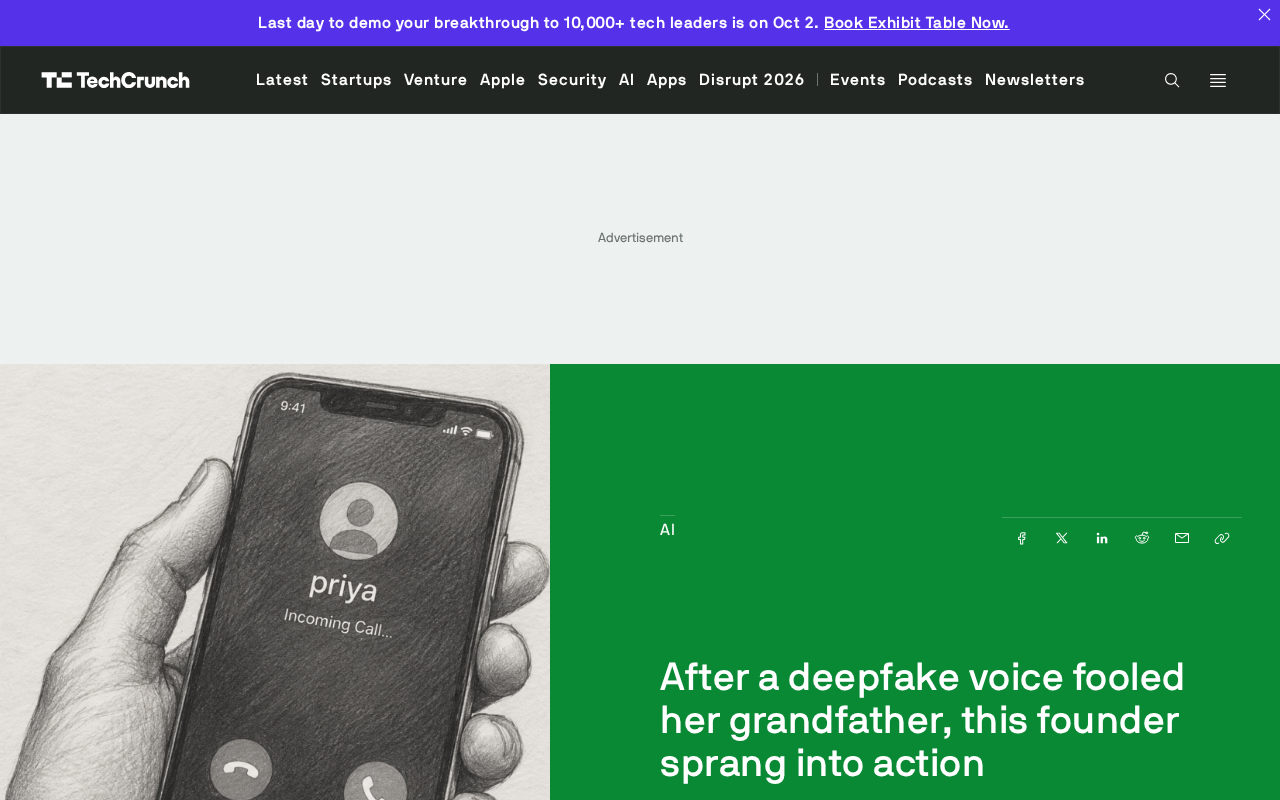
DetectifAI has since been selected to compete in Startup Battlefield at TechCrunch Disrupt — a well-known startup competition platform organized by TechCrunch that has historically featured companies that went on to become industry leaders. Being selected is itself a signal that the technology direction has gained meaningful attention.
Fitting an AI Model onto a Phone: The Value of On-Device Real-Time Detection
One of the most notable aspects of DetectifAI's technical approach is that it has built an AI model "small enough to run directly on a smartphone," capable of flagging synthetic voices in real time. There's a clear product logic behind this design choice.
Why On-Device Processing Matters
The defining characteristic of voice scams is their immediacy — victims often have only seconds to minutes to make a judgment call during a phone conversation. If the detection relies on round-trips to cloud servers, latency and network conditions can easily become bottlenecks. Compressing the model to run locally on a phone means detection can happen in sync with the call itself, theoretically alerting the potential victim before they're persuaded.
On-device processing also offers a meaningful privacy advantage. Voice data never needs to be uploaded to a remote server — the user's call can be processed entirely on-device, which is an increasingly important consideration as personal data protection gains prominence.
The Technical Challenge of Model Miniaturization
Compressing a deep learning model capable of distinguishing real from synthetic voices down to a size a smartphone can handle is far from trivial. Deepfake detection models need to capture subtle acoustic anomalies in synthesized speech, and there are inherent trade-offs between model size, inference speed, and detection accuracy. DetectifAI's claim of running on a phone — if achieved without sacrificing accuracy — would represent a genuine core competency.
The industry typically employs techniques such as Knowledge Distillation, Pruning, and Quantization to compress deep learning models. Knowledge Distillation transfers the capabilities of a large "teacher model" to a lightweight "student model"; Pruning removes neurons or weights that contribute little to the output; Quantization converts floating-point operations to low-precision integer arithmetic, dramatically reducing storage and computation requirements. For voice deepfake detection specifically, models must capture extremely subtle spectral artifacts and temporal inconsistencies in synthesized speech — an additional challenge for maintaining accuracy after miniaturization. Hardware constraints on mobile devices, including limited memory (models typically need to be compressed to tens of megabytes), processor compute limits, and battery life pressure, form the "iron triangle" of on-device deployment.
Why AI Voice Scams Deserve Serious Attention
In recent years, the barrier to entry for voice cloning technology has dropped rapidly. Attackers often need only a small number of publicly available voice samples of their target to synthesize a convincingly realistic voice clone, which can then be used to impersonate family members, supervisors, or authority figures in fraud schemes. The experience of DetectifAI's founder's grandfather is a textbook example of this new breed of scam: the fraudster mimicked the voice of a familiar relative, exploiting the victim's trust and emotional response to lower their guard.
This type of scam poses an especially serious threat to elderly populations, who typically have less familiarity with emerging AI technology and are more easily deceived by a "familiar-sounding voice." DetectifAI's goal of using technology to provide a real-time line of defense for these most vulnerable users carries undeniable social value.
The technical barrier to voice cloning has fallen sharply in recent years — some commercial tools can generate a convincing clone from as little as 3 to 10 seconds of audio. The academic community classifies these attacks as "Audio Spoofing," and the international ASVspoof competition has long tracked developments in this offensive and defensive technology arms race. In terms of fraud methodology, the "Grandparent Scam" is one of the most frequently reported fraud types in North America — where criminals impersonate grandchildren claiming to be in trouble and demanding immediate wire transfers. The introduction of AI voice cloning has significantly increased the success rate of such scams, because victims tend to self-verify by asking, "Does this sound like them?" — and that's precisely the vulnerability that AI cloning exploits. The U.S. Federal Trade Commission (FTC) has already flagged AI-enhanced voice fraud as a priority monitoring risk.
What DetectifAI's Story Tells Us About Founder-Market Fit
DetectifAI's story reinforces a well-established principle in entrepreneurship: the most enduring products often emerge from pain points the founder has genuinely experienced. Tarini Padmanabhuni didn't stop at anger or helplessness — she channeled her family's victimization into the motivation to solve a problem affecting society at large.
From a broader perspective, as generative AI capabilities continue to advance, the adversarial arms race between "AI faking" and "AI detection" will be a long-running contest. The real-time anti-deepfake direction that DetectifAI represents is likely to become an important component of future personal security tools. As synthetic voices and deepfake videos become increasingly difficult to distinguish with the naked eye and ear, embedding detection capabilities into the smartphone that everyone carries may be the most accessible solution for ordinary users.
Publicly available information about DetectifAI still centers primarily on its technical positioning and founding backstory; details such as actual detection accuracy, false positive rates, and commercialization roadmap have yet to be fully disclosed. As a Startup Battlefield competitor, its performance going forward is worth watching closely.
DetectifAI is not the only player in the deepfake detection space. Large tech companies like Meta and Microsoft have released detection tools and datasets for the research community (such as FaceForensics++ and the ASVspoof dataset), while startups like Pindrop and Reality Defender focus on enterprise-grade voice authentication services. DetectifAI's differentiated positioning lies in consumer-facing, real-time on-device detection — rather than backend APIs serving call centers or platform content moderation. The challenge with this market positioning is that consumer willingness to pay and customer acquisition costs are critical variables. At the same time, maintaining the timeliness of detection models as AI-generated fakes continue to evolve requires a continuous model iteration pipeline — a sustained operational pressure for a resource-constrained startup.
Related articles

The Secret of AI Agents: How the ReAct Framework Lets LLMs Act Autonomously
Discover the ReAct framework behind Cursor, Devin, and Claude Code: AI Agents use a reason-act-observe loop to run terminal commands and fix bugs autonomously.

AI Coding Tools Hit a Saturation Point? Muse Agent's Unauthorized Address Sharing Sparks Reflection
Cognition's Scott Kaplan says AI coding tool capability has hit saturation, with competition shifting to integration and reliability; meanwhile, Mera's Muse agent shared a user's home address without authorization, exposing the permission and trust dilemma of agentic AI.

Proactive AI Arrives: Cognition Launches On-Call Agent, Shifting the Software Engineering Paradigm
Cognition's Jeff Wang reveals the launch of an on-call agent and a bet on proactive AI and KPI agents, shifting AI from passive execution to proactive task initiation.