Hera: A Multi-Agent AI Creative Canvas That Redefines the Ad Design Workflow

Hera integrates image generation, design, and animation onto a single canvas, enabling multiple agents to collaborate in parallel.
Hera is an AI creative canvas tool ranked seventh on Product Hunt. It aims to break past the single-point mode of "enter a prompt, generate a single image" by integrating image generation, design, and animation onto a single canvas and letting users direct multiple AI agents in parallel. Its core capabilities include editable layers, automatic brand kit extraction by pasting a URL, and a complete ad production chain. The direction fits marketing teams' needs for high-volume asset production, but style consistency, version management, editing granularity, and brand extraction accuracy still need validation.
In an era where AI design tools keep proliferating, most products remain stuck at the level of "enter a prompt, generate a single image." Hera, ranked seventh on Product Hunt, tries to take things a step further: integrating image generation, design, and animation onto a single canvas, letting you direct multiple AI agents at once as if you were leading a design team.
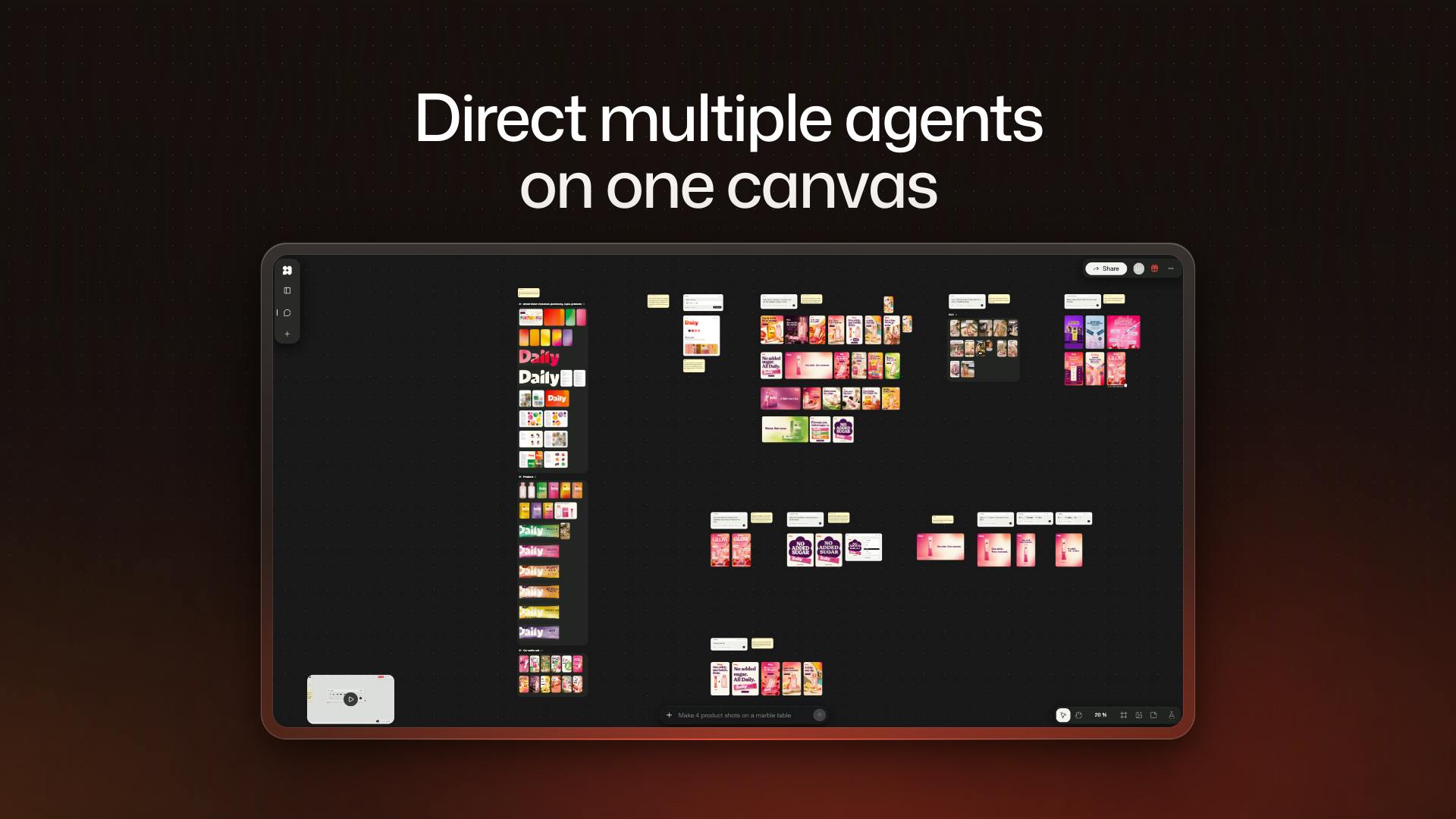
One canvas, multiple agents working side by side
Hera's core positioning is an "AI creative canvas." In a traditional workflow, you generate images in tool A, create animations in tool B, and resize in tool C—switching back and forth is time-consuming and prone to losing consistency. Hera's approach is to bring these steps into a single artboard and let users direct multiple AI agents simultaneously to produce in parallel. This means you can have one agent handle visual style and another generate copy variants, with the results displayed side by side on the canvas for easy comparison, selection, and editing.
For marketing teams that need to produce assets at scale, this "side-by-side output" approach is closer to real working rhythms than serial operations.
Multi-Agent Collaboration refers to running multiple AI agents with independent capabilities simultaneously within the same task environment, where each agent can be assigned different roles or goals and shares context and output results. Unlike a single model processing serially, a multi-agent architecture allows parallel exploration of multiple options, which are then compared and filtered by the user or a scheduling layer. In creative design scenarios, the value of this model lies in decoupling subtasks such as "style exploration," "copy variants," and "size adaptation" and having different agents handle them separately, thereby shortening the iteration cycle from idea to finished product. The technical difficulty lies in state synchronization between agents, consistency control of results, and conflict resolution—this is also the key dividing line that determines whether such products deliver a good or bad experience.
Editable layers: giving control back to designers
The biggest pain point of purely generative tools is uncontrollability—the generated image looks good, but changing a single detail often means rerolling. Hera emphasizes "editable layers": the output isn't a flat black-box image but structured content that can be broken down and adjusted. Users can ask the AI to refine details through feedback text or make manual edits directly.
This matters especially for ads and brand assets. Ad design often requires precise typography, size alignment, and placement of brand elements, which pure prompt-driven approaches struggle to satisfy. Editable layers let AI generation and manual fine-tuning complement each other rather than replace one another.
Editable Layers borrows from the layer model of traditional design tools like Photoshop and Figma: a composition is built by stacking multiple independent layers such as text, shapes, and images, each of which can be individually selected, moved, recolored, or replaced. Generative AI outputs are flat pixel images by default and lack this structural information, so "editable generation results" usually means the model simultaneously outputs a layered structure during generation, or uses techniques like segmentation and recognition to reverse-engineer a flat image into operable elements. The higher the degree of layering, the more designers can treat AI output as a semi-finished product to continue working on, rather than regenerating from scratch with every change. This capability directly determines whether an AI tool can enter commercial design workflows with strict precision requirements.
Paste a URL to generate a brand kit
One practical feature Hera offers: paste your website address and automatically extract your brand kit. Brand consistency is one of the most time-consuming hidden costs in producing marketing assets—a slight deviation in color, font, or tone of voice can degrade the quality of an entire asset set. By automatically identifying brand assets on a website, Hera aims to ensure that every subsequent image and piece of copy carries the correct brand DNA by default.
On this basis, users only need to write a few prompts to get dozens of on-brand ads in a consistent style displayed side by side. The materials also mention that you can drag ads you like into the canvas as reference images, refine details through feedback or manual adjustments, and then convert the best-performing ones into animated ads.
Brand Kit is a collection of brand visual and verbal guidelines, typically including primary and secondary colors, font combinations, logo usage, icon style, and tone of voice. Traditionally, brands compile these into documents for teams to follow; in AI generation workflows, the brand kit serves as a constraint injected into the model so that every generation automatically aligns with brand guidelines. The principle behind automatically extracting a brand kit from a website generally involves crawling the page's CSS, image resources, and copy, identifying color values, font families, and visual style characteristics, and then structuring them into a reusable configuration. Its accuracy depends heavily on how standardized the website's design is, and deviations may occur for sites with mixed styles or frequent redesigns.
From static to motion, and on to full-size adaptation
Hera's workflow covers the complete chain of ad production: generating static images → refining with reference images → animating → adapting to various sizes and formats. All steps are completed on the same board, with no need to export and re-import. For teams that need to run campaigns across multiple channels simultaneously, "one-click adaptation to all formats" saves a great deal of repetitive work.
Interestingly, Hera received 103 upvotes and 7 comments on Product Hunt, ranking seventh, with category tags of design tools, marketing, and artificial intelligence. This result shows the market has genuine interest in the direction of "multi-agent collaboration + canvas-based design," but the relatively limited number of comments also means the actual user experience still needs validation from more users.
The opportunities and concerns for this type of tool
Hera represents an emerging product philosophy: no longer treating AI as a single-point generator, but as a productivity unit that can be scheduled and combined. Multi-agent parallel design can theoretically greatly increase the throughput of asset production, making it especially suitable for scenarios like ad campaigns that require extensive variant testing.
Concerns exist as well. When multiple agents work in parallel, how to ensure consistent output style and how to manage versions and collaboration are questions the product must answer. Editable layers sound great, but how fine-grained the editability of generated results can be directly determines whether designers are willing to incorporate it into their formal workflows. In addition, the accuracy of automatically extracting brand kits from websites also needs real-world testing.
For independent designers and small marketing teams, Hera is worth adding to the watchlist; for large teams already using mature design collaboration systems, it is better suited as a supplementary tool for high-volume asset production rather than a replacement for existing workflows.
One-line Summary
Hera integrates image generation, design, and animation onto a single canvas, enabling multiple agents to collaborate in parallel.
Paragraph Summary
Hera is an AI creative canvas tool ranked seventh on Product Hunt. It aims to break past the single-point mode of "enter a prompt, generate a single image" by integrating image generation, design, and animation onto a single canvas and allowing users to direct multiple AI agents to produce in parallel. Its core capabilities include editable layers, automatic brand kit extraction by pasting a URL, and a complete ad production chain covering static image generation, reference-image refinement, animation, and full-size adaptation. The article argues that this direction of "multi-agent collaboration + canvas-based design" fits marketing teams' real needs for producing assets at scale, but style consistency, version management, editing granularity, and brand extraction accuracy still need real-world validation, and the product experience awaits verification from more users.
Related articles

Non-Coding Dad Builds 3D Earth Toy with Claude Code, Unexpectedly Goes Viral in Classrooms
A non-coding father used Claude Code to build My Earth Toy, a 3D interactive Earth with 830+ landmarks, 470+ animals, and 180+ vehicles—now used in classrooms worldwide. Discover how AI coding lowers the barrier to creation.

Meta, Google, and TikTok Sue California Attorney General: The Battle Over Youth Social Media Law
Meta, Google, and TikTok jointly sue the California Attorney General to block a state law restricting social media use by minors under 16. This article analyzes the lawsuit's background, the law's core provisions, and its potential impact on tech industry regulation.

T-Mobile Parent Company CEO on Musk's Telecom Ambitions: Welcome, But You'll Need $200 Billion
Deutsche Telekom CEO Tim Höettges responds to Musk's SpaceX Starlink Mobile plan, saying "welcome to the party" but questioning feasibility—estimating at least $200 billion needed to become a major U.S. carrier.