Hermes Agent for Kubernetes Cluster Management: AIOps Tool Selection and Cost Analysis

How to manage K8S clusters with Hermes Agent, and the real Token costs behind AIOps.
A practical review of managing Kubernetes clusters with Hermes Agent. Covers the evolution from MCP to OpenClaude to Hermes, the Skill consolidation mechanism, the truth about Token costs (million-level consumption for a simple status check), cluster deployment considerations, and a three-level framework for AI operations capability.
From Manual Operations to Intelligent Operations: A Paradigm Shift
The way Kubernetes (K8S) clusters are managed is undergoing a profound technical evolution. From early days of pure manual operations and script-based automation, to today's management with large model agents, operations work has officially entered the new stage of "Intelligent Operations (AIOps)."
AIOps (Artificial Intelligence for IT Operations) was first proposed by Gartner in 2016. Its core is the deep integration of machine learning, big data analytics, and traditional IT operations processes. A complete AIOps system typically encompasses four dimensions: data collection and aggregation (logs, metrics, tracing), anomaly detection and root cause analysis, automated decision-making and execution, and a continuous learning and optimization feedback loop. The current industry practice of equating "deploying an Agent tool" with AIOps actually touches only one dimension—"automated execution"—while lacking data infrastructure, an anomaly awareness system, and feedback optimization mechanisms. Truly landing AIOps requires embedding large model capabilities within a complete observability stack, rather than using an isolated chat-based operations Agent.
In a live-streamed course focused on cloud-native technology, the instructor systematically laid out this evolutionary path and focused on how to use Hermes Agent to manage K8S clusters. This was not just a tool demonstration, but a sober review of the current state of AI operations.
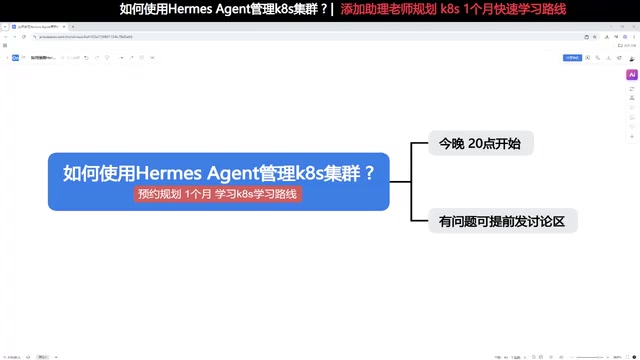
You may not have noticed that the instructor explicitly pointed out: using large model tools to manage K8S is essentially a practical implementation of AIOps intelligent operations, but there is a common misconception in the industry—"setting up an Agent for you equals a complete AIOps." True intelligent operations requires operations personnel to deeply understand the working principles, deployment methods, and usage logic of large models, rather than simply applying an off-the-shelf tool.
The Evolution of K8S Intelligent Management Tools
The instructor reviewed several mainstream approaches to intelligent K8S management, helping to understand the technical background behind the emergence of Hermes Agent.
From MCP to OpenClaude
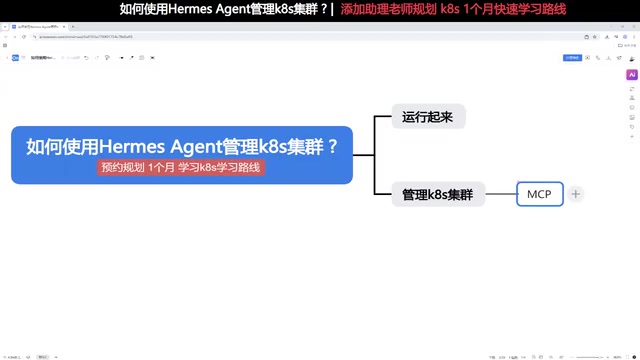
The earliest solutions were based on MCP (Model Context Protocol) to connect large models for cluster management. Tools like kubectl-ai essentially also make calls through MCP. MCP is a standardized protocol promoted by AI companies such as Anthropic, aimed at standardizing how large models interact with external tools and data sources. Its core idea is to provide AI models with a unified "context window," enabling models to perceive and operate external systems—such as file systems, databases, and API interfaces. However, MCP's working mechanism means it needs to inject large amounts of context information (including cluster state, historical operation records, tool descriptions, etc.) into the model's input all at once. This is precisely the root cause of its notable pain point—excessive Token consumption: every interaction must carry a complete context payload.
To solve efficiency problems, tools like OpenClaude subsequently emerged and demonstrated capabilities such as managing K8S clusters and cross-host access in early demos. However, the instructor candidly admitted that OpenClaude iterates extremely fast and "quickly became outdated," so in practice they had already switched to more stable tools.
The Core Positioning of Hermes Agent
Hermes Agent belongs to the same Agent-type tool category as OpenClaude, but it excels in performance, functionality, and overall user experience. The most core difference between the two lies in memory capability:
OpenClaude has no memory, whereas Hermes Agent will consolidate operations you repeatedly execute over time into a Skill, thereby continuously enhancing subsequent efficiency.
From a technical principle perspective, the memory systems of modern AI Agents typically fall into four types: working memory (current conversation context), short-term memory (session-level storage), long-term memory (vector database persistence), and procedural memory (skill/procedural knowledge). Hermes Agent's Skill consolidation mechanism is essentially an engineering implementation of "procedural memory"—the system identifies patterns of operations the user repeatedly executes, abstracts them into reusable structured skill units (similar to function encapsulation), and directly invokes the skill in subsequent executions rather than reasoning from scratch, thereby reducing both Token consumption and response latency. This skill consolidation mechanism is the key value that distinguishes Agent-type tools from simple API calls—it is closer to the essence of an agent that "does work on your behalf," rather than a one-off question-and-answer tool. From an engineering standpoint, the quality and coverage of the Skill library will gradually become a core differentiation barrier among different Agent products.
The Truth About "Saving Tokens": A Misconception to Be Wary Of
This is the most practically valuable part of this sharing session. The industry widely advertises that Agent-type tools save more Tokens than Cloud Code, but the instructor gave a starkly different frontline conclusion.
The Gap Between Ideal and Reality
Although in theory Hermes Agent should save more Tokens than OpenClaude, the instructor explicitly stated:
"I found during use that it actually doesn't save either, and Token waste is quite severe. Sometimes I just simply say 'help me check the K8S status,' and consumption can reach the millions."
This phenomenon has deep engineering causes. Token is the basic unit of measurement by which large language models process text. In the cloud API call model, Token consumption maps directly to monetary cost—using mainstream model pricing as a reference, the cost of input Tokens is roughly between $1-15 per million Tokens, with output Tokens costing more. The reason K8S cluster status queries trigger million-level Token consumption is that: the cluster's complete state description (Pod list, node information, event logs, config items, etc.) is inherently a huge amount of data, and the Agent's multi-round reasoning (the Thought-Action-Observation loop in the ReAct framework) injects this information into context multiple times. This "context inflation" phenomenon amplifies exponentially in complex operations scenarios and is one of the core engineering challenges facing the productization of current AI operations tools. This data is critical—it reveals the real cost problem of current large model operations tools: what appears to be a simple query operation may involve enormous Token costs behind the scenes.
Token Costs Have Become a Real Pain Point for Enterprises
The instructor made the point vivid with an intuitive analogy: "Checking K8S status once costs 30 cents, deploying an application costs 35 cents." As AI is deployed at scale in enterprises, the accumulation of these costs has left many teams "with a headache."
He also mentioned a real interview data point: in production-grade operations scenarios, Token consumption is "basically in the hundreds of millions." Magnitudes of tens of thousands or hundreds of thousands appear conservative in real scenarios. This reminds practitioners that when evaluating AI operations solutions, cost accounting must be placed at the core, rather than focusing only on the flashiness of feature demos.
Regarding cost control, a viewer in the live chat proposed a mitigation approach of scheduled triggering + cache hits. The engineering principle of this solution is: converting instant queries originally triggered by user natural language into periodic collection automatically executed at fixed time intervals, and caching the results in memory or KV storage (such as Redis). When a user or Agent initiates a status query, it reads from the cache first rather than re-invoking the large model reasoning chain, thereby greatly compressing Token consumption. The instructor endorsed this direction: "With scheduled triggering, the cache hit rate is still quite high," but also noted that in highly dynamic scenarios such as fault troubleshooting and change releases, data timeliness requirements cause frequent cache invalidation. An event-driven invalidation mechanism needs to be introduced, combined with Kubernetes' Watch API to achieve incremental updates rather than full pulls. Overall, the effectiveness of caching needs to be weighed against actual business characteristics.
Practical Prerequisites: Get It Running First, Then Talk About Management
The instructor broke down the entire practice into two levels, especially useful for beginners.
Level One: Get Hermes Running
Many students' problems are not about how to manage clusters, but that they can't even get the tool itself to run properly. Therefore, the first step is to complete environment setup and ensure Hermes Agent can start normally.
Level Two: Connect and Manage K8S Clusters
The second step is to use the Agent to connect to an existing K8S cluster. Here there is an easily overlooked key point—the cluster's deployment method directly affects the Agent's connection logic.
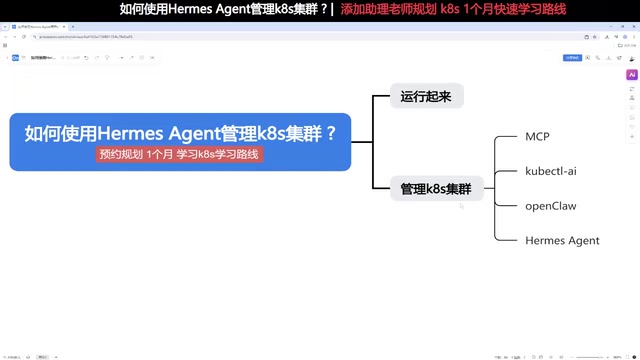
The instructor particularly emphasized: clusters deployed through different tools such as KubeADM, KubeKey, and RKE2 differ in access and management methods. KubeKey is a K8S cluster full-lifecycle management tool open-sourced by QingCloud (the KubeSphere team). Its 4.x version introduced a modular architecture that significantly reduces the deployment complexity of multi-node clusters. KubeADM is the official K8S cluster bootstrapping tool with relatively basic functionality, suitable for standardized scenarios. RKE2 is led by SUSE/Rancher, emphasizing security and compliance, suitable for heavily regulated industries such as government and finance. The kubeconfig file paths, cluster component configurations, and network plugin choices generated by different deployment tools each vary, and these differences directly affect the authentication methods and permission configurations when the Agent interacts with the cluster's API Server via kubectl. This demonstration is based on a K8S 1.34.3 cluster deployed with KubeKey 4.0.5. If you don't yet have an available cluster, you need to complete cluster deployment as a prerequisite step.
The Three Levels of AI Operations Capability
At the end of the sharing session, the instructor summarized, from a career development perspective, the three levels of capability that operations personnel should possess in the AI large model direction, offering reference value for both job seekers and working practitioners.
- Level One (Entry): Whether you can use Agent tools such as Hermes and OpenClaude to perform basic management of K8S clusters.
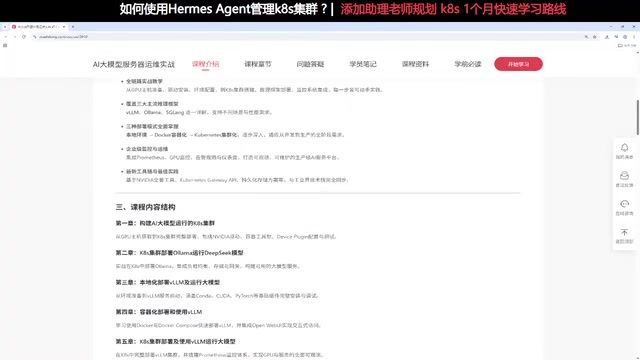
- Level Two (Intermediate): Whether you have experience with the deployment, operations, and usage of large model inference frameworks, covering localized inference frameworks, Docker containerization, and running inference frameworks based on K8S.
- Level Three (Advanced): Building on deployment and operations experience, whether you can perform large model tuning and application development.
The instructor pointed out that these three levels are frequently asked about in actual interviews, and clarifying them helps to systematically plan one's personal technical growth path.
Conclusion: Intelligent Operations Is Infrastructure, Not the Endpoint
The most important takeaway from this sharing session is that large model tools are merely the infrastructure of intelligent operations, not the entirety of intelligent operations.
Hermes Agent provides a better user experience through its Skill consolidation mechanism, but it cannot automatically solve the real-world challenge of Token costs. For enterprises and individuals, true AI operations capability must be built on a deep understanding of large model principles, deployment methods, and cost control. Tools will continuously iterate (from MCP to OpenClaude to Hermes), but the underlying operations mindset and cost awareness are the long-term competitiveness that transcends technology cycles.
Key Takeaways
Related articles
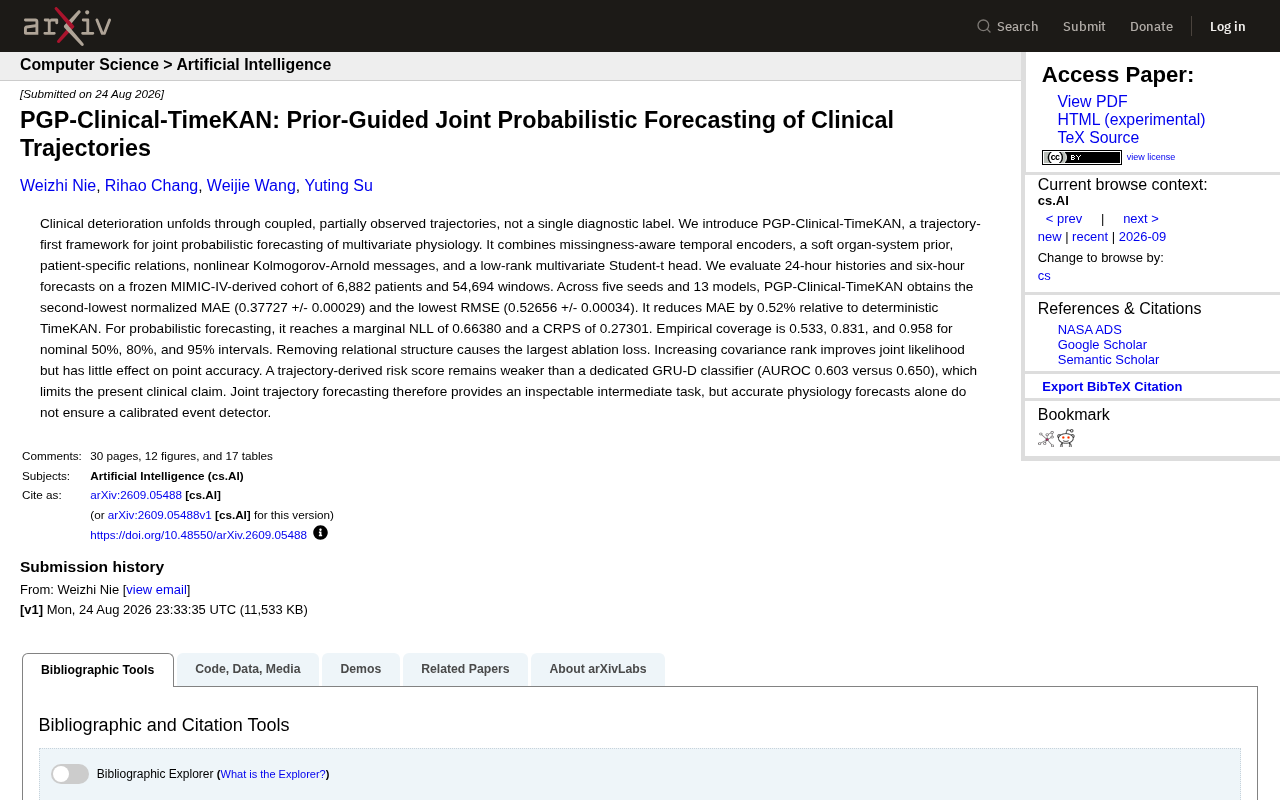
PGP-Clinical-TimeKAN: A Detailed Guide to the Multivariate Physiological Indicator Joint Prediction Framework
An in-depth analysis of the PGP-Clinical-TimeKAN framework for joint probabilistic prediction of multivariate physiological indicators, covering trajectory-first paradigm, KAN message passing, MIMIC-IV validation, and ablation studies.
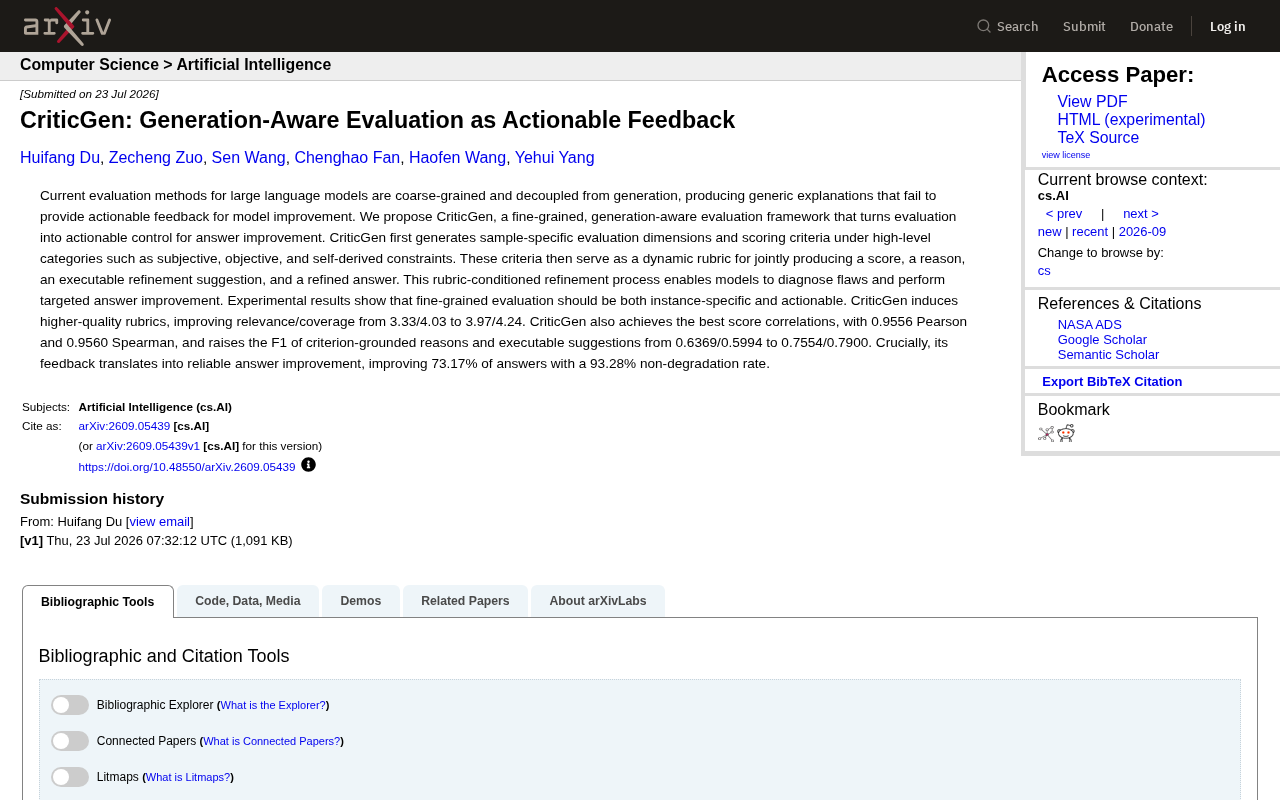
CriticGen: A New Framework That Transforms AI Evaluation into Actionable Improvement Feedback
CriticGen proposes a generation-aware evaluation framework that transforms AI assessment from passive scoring to an active optimization loop, achieving 73.17% answer improvement and 93.28% non-degradation rate.
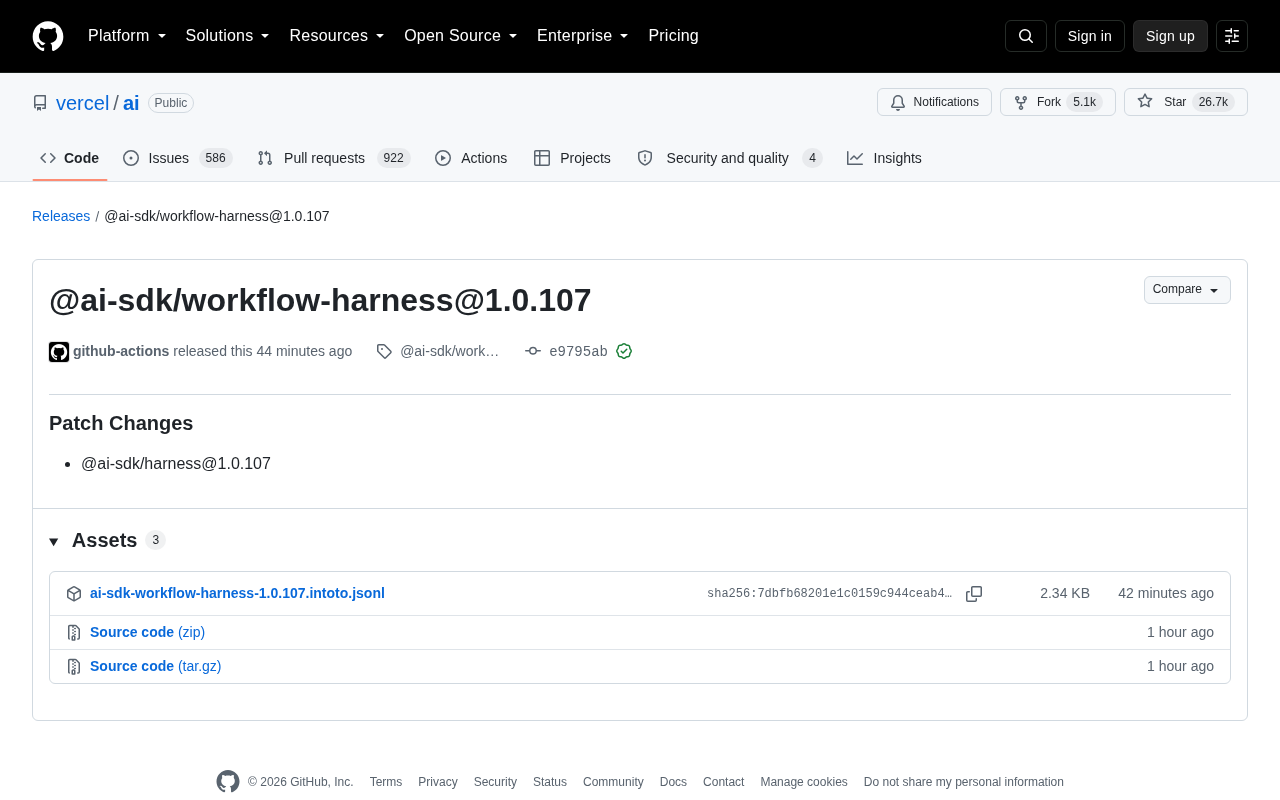
Vercel AI SDK workflow-harness Update Analysis
Deep analysis of Vercel AI SDK workflow-harness 1.0.107 update: architecture design, engineering practices, and developer value for building reliable AI apps.