Hermes Agent Goes Viral: A Deep Dive into the Self-Evolving AI Agent

Hermes Agent is a self-evolving AI agent with long-term memory that gets smarter the more you use it.
Hermes Agent is an open-source AI Agent framework that has rapidly gained over 120K GitHub stars. It differentiates itself from tools like OpenCloud through two key advantages: significantly lower Token consumption and persistent long-term memory with self-evolution capabilities. Its built-in Self-Learning Loop automatically generates and refines reusable skills from user interactions, enabling personalized adaptation across sessions while keeping all data stored locally for privacy.
What Is Hermes Agent
Recently, an open-source project called Hermes Agent has taken the AI community by storm. According to a Bilibili content creator's introduction, this is an open-source, autonomous AI Agent framework that surpassed 120,000 GitHub stars in less than two months since launch—a truly staggering growth rate.
In terms of positioning, Hermes Agent's core message is simple: "An Agent that shares the burden with you." It's not a simple chatbot or a code completion tool, but rather "an intelligent agent that lives on your machine and gets smarter every day." This "self-evolution" capability is its biggest differentiator from other similar AI Agent tools.
For readers not yet familiar with the AI Agent concept, here's an analogy: AI tools like Doubao or DeepSeekAd that we commonly use are more like a "brain"—they help you brainstorm and plan, but can't actually take action. Agent-type tools (like the previously viral OpenCloud, colloquially known as "the lobster") are powerful because they can actually execute tasks for you: organizing documents, creating files, sending and receiving emails, scraping information from browsers, and more.
From a technical perspective, an AI Agent refers to an AI system capable of perceiving its environment, making autonomous decisions, and executing actions. Unlike traditional conversational AI, Agents possess tool-use capabilities and can interact with the external world through APIs, browsers, file systems, and other interfaces. This concept originates from the Agent-Environment paradigm in reinforcement learning, and in recent years, LLM-based Agent architectures have become the mainstream direction as large language models' reasoning capabilities have improved. A typical Agent workflow includes four stages: "Perceive → Plan → Act → Feedback," each of which may involve calling external tools and evaluating execution results.
Hermes Agent vs OpenCloud: Two Core Advantages
Since the functionality is similar to OpenCloud, why should we pay attention to Hermes Agent? Based on hands-on experience with both tools, here are two key differences.
Advantage 1: Lower Token Consumption
One common criticism of OpenCloud is its massive Token consumption—some joke that "checking the weather burns through 10,000 Tokens." Through actual testing, Hermes Agent consumes noticeably fewer Tokens than OpenCloud. For users who need to use AI Agents frequently over the long term, this directly impacts usage costs and is a practical advantage that cannot be ignored.
To understand why Token consumption matters so much, you need to understand the underlying mechanism: Tokens are the basic units that large language models use to process text, with Chinese text averaging about 1.5-2 characters per Token. Agent-type tools often generate massive intermediate Token consumption due to multi-round reasoning, tool calls, and result parsing—these reasoning processes are invisible to users but count toward API call costs. For example, a seemingly simple "check the weather for me" instruction may require the Agent to go through task understanding, tool selection, parameter construction, API calling, result parsing, and formatted output—each step consuming Tokens. Reducing Token consumption typically relies on more efficient Prompt Engineering, more streamlined task planning strategies, and context compression techniques. Hermes Agent's optimization in this area indicates more refined design in its internal reasoning pipeline.
Advantage 2: Long-Term Memory and Self-Evolution
This is the most fundamental difference with Hermes Agent. When you close or restart OpenCloud's dialog, it essentially becomes a "brand new tool"—all previous context and accumulated knowledge is lost. "Every restart is like amnesia."
Hermes Agent, on the other hand, possesses persistent long-term memory capabilities. It "learns your preferences over time, accumulates more memories and skills, and becomes increasingly intuitive to use." In other words, other AI tools are short-term assistants "based on memory," while Hermes Agent is "a partner that evolves."
This touches on an important technical challenge in AI: a large language model's Context Window is limited—even the most advanced models cannot "remember" all historical conversations indefinitely. Mainstream solutions include Retrieval-Augmented Generation (RAG) with vector databases, summary compression, and external memory storage. Hermes Agent clearly employs some form of persistent storage mechanism, writing user preferences and interaction history to a local database and selectively loading relevant memories when new sessions begin, thereby achieving continuity across sessions.
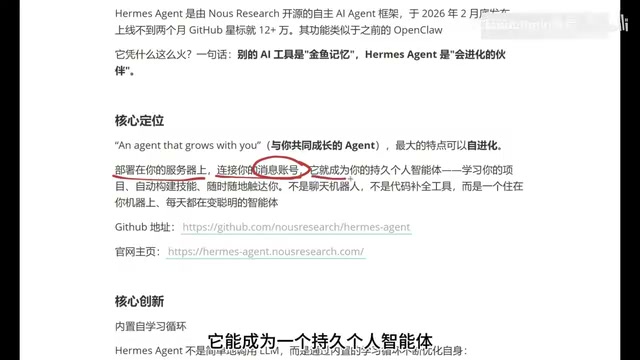
Core Innovation: Built-in Self-Learning Loop
Hermes Agent's self-evolution capability comes from its built-in "Self-Learning Loop." Rather than simply calling a large model, it continuously optimizes itself through ongoing learning.
The core idea of the self-learning loop draws from Meta-Learning and Experience Replay. In traditional AI Agent architectures, each task execution is independent—the model receives instructions, calls tools, returns results, and then everything resets. The self-learning loop adds an "experience consolidation" phase to this workflow: the system abstracts successful interaction patterns into reusable skill templates, stores them in a local knowledge base, and can directly invoke them when encountering similar tasks later, avoiding reasoning from scratch. This mechanism is similar to human procedural memory—like learning to ride a bicycle, where repeated practice forms muscle memory, execution efficiency gradually improves, and you no longer need to consciously think about each movement.
This manifests in four specific ways:
- Automatically generating Skills from interactions: During conversations with users, the system automatically distills reusable skills without requiring manual configuration. Here, a "skill" can be understood as a verified workflow template containing task decomposition methods, tool call sequences, and parameter configurations.
- Continuously iterating skills through use: As usage frequency increases, existing skills are constantly updated and refined, becoming increasingly polished. The system likely compares the effectiveness of different execution paths, automatically selects the optimal approach, and updates skill definitions.
- Automatically persisting knowledge and user preferences: The system gradually "learns" user states during use, achieving personalized adaptation. For example, remembering preferred document formats, commonly used project paths, habitual communication styles, etc.
- Building deep user understanding across sessions: Regardless of which channel is used, accumulated knowledge converges to form an increasingly deep understanding of the user. This means the system backend has unified user profile storage, with different entry points (WeChat, QQ, Feishu) sharing the same memory.
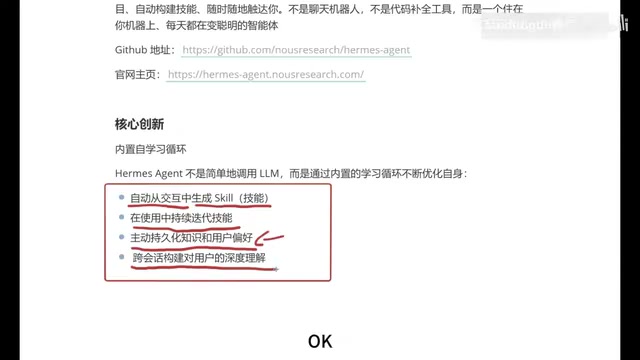
It's worth mentioning Hermes Agent's deployment and integration approach. It can be deployed on your own server and connected to your commonly used messaging accounts—such as WeChat, QQ, Feishu, etc. This local deployment approach also means all data—including conversation records, user preferences, and generated skills—is stored on the user's own server, offering inherent advantages in privacy and security. This means you can directly command it to work within your chat window, accessible anytime and anywhere, truly becoming a "persistent personal agent."
Practical Demo: Generating an AI Agent Project Document with a Single Instruction
The following is a complete practical demonstration of a conversation with Hermes Agent via QQ. The instruction given was: Search online for recently popular Agent projects, summarize them into a document with important links to official websites, blogs, and GitHub repos, then generate a tech-styled static webpage to display the document, and finally run it locally.
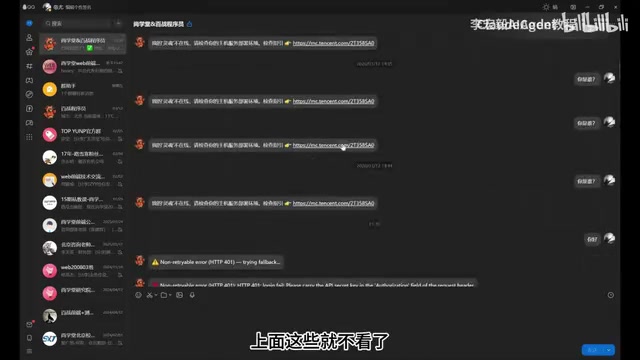
This instruction seems simple but actually involves chaining multiple complex steps: web searching and information filtering, structured document generation, HTML/CSS/JavaScript frontend development, and local HTTP server startup. In a traditional workflow, this would require a person to separately use a search engine, document editor, and code editor to complete.
The most impressive aspect of the entire process was that there was no rework at all—from information retrieval, document generation, to webpage generation, everything was completed autonomously by the Agent. It accurately listed recently popular AI Agent products, including Cursor, Claude Code, OpenCloud, etc., with official websites, GitHub links, and descriptions—all quite accurate. The generated webpage was accessible locally at localhost:8080.
An even more critical detail appeared after generation was complete: the system displayed skill created, meaning it automatically created a new skill and simultaneously updated user information. Interestingly, no one explicitly asked it to generate a skill during the process—the system completed this action automatically during the interaction. This is a direct demonstration of "automatically generating Skills from interactions" and confirms Hermes Agent's self-evolution characteristic of "getting smarter with use." This means that next time it's asked to perform a similar "search + organize + build website" task, it can directly reuse this skill, with further improvements in execution speed and accuracy.
Final Thoughts
From publicly available information, Hermes Agent's viral success is no accident. It addresses two major pain points of current AI Agent products—high Token costs and lack of long-term memory—and provides a differentiated answer through "self-evolution." For developers and practitioners interested in autonomous AI agent development, this is an open-source project worth hands-on exploration.
From a broader perspective, Hermes Agent represents an important trend in AI Agent development: moving from "stateless tools" to "stateful partners." This aligns with the long-term vision of "personalized AI assistants" in the AI field—future AI will no longer be general-purpose tools that start from scratch every time, but dedicated agents that understand you, adapt to you, and grow with you.
Of course, current demonstrations primarily showcase the upper limits of capability. How its self-evolution mechanism performs in real, complex, long-term usage scenarios still requires further validation. For example, whether skill library expansion leads to conflicts, whether long-term memory retrieval accuracy can be maintained, and how isolation works in multi-user scenarios are all questions worth attention. Interested readers can visit the official GitHub repository (stars already at 121K) to explore firsthand and experience this AI agent that "lives on your machine and gets smarter every day."
Related articles

Gaussian Process Bandit Optimization: Exploration Strategies and Inference Regret Guarantees
Cumulative regret guarantees in Bayesian optimization fail to reflect final recommendation quality. This article examines a new study that provides inference regret guarantees for Gaussian process bandit optimization through exploration query strategies and fill distance analysis, validated on hyperparameter optimization and control tasks.
The Most Detailed Codex Guide on Bilibili: From Installation to Real-World Practice
The most detailed Codex guide on Bilibili: from app store installation to daily work mode configuration, with a real coffee shop project demonstrating file organization, data extraction, dashboard creation, and other practical tasks. Learn to use Plan Mode and desktop pets to leverage Codex efficiently.

Appearance Compensation in Volume Rendering: Why RGB Accuracy Cannot Guarantee Density Correctness
Volume rendering research reveals that volumetric data perfectly reproducing external RGB views may still contain density errors: appearance compensation can double central density and keep external rays unchanged even when L2 error exceeds 14.52%. Density recovery depends on appearance capacity, spatial resolution, and measurement design.