Hermes Agent in Practice: A Self-Evolving AI Agent Framework

Hermes Agent: a mature, self-evolving AI Agent framework with built-in code, layered memory, and low Token cost.
Hermes Agent is a comprehensive AI Agent framework integrating Claude Code and Codex for coding, a rich built-in toolset, and an open skill ecosystem. Its standout features—layered memory and self-evolution—plus 200+ model support, multi-platform deployment, easy chat integration, and low Token consumption make it a strong contender for mainstream Agent development.
What Is Hermes Agent
Recently, a framework called Hermes Agent has been gaining attention in the field of AI Agent development. According to the Bilibili content creator "马士兵-AI大模型" (Mashibing AI Large Models), Hermes Agent is essentially an AI Agent framework. Its positioning is similar to existing tools on the market such as OpenClaude (colloquially known as "the little crayfish"), but it offers noticeable improvements in actual user experience.
To understand the value of Hermes Agent, it's helpful to first understand the background of the AI Agent framework as a technical form. AI Agent frameworks have rapidly emerged over the past two years alongside the leap in large language model capabilities. Unlike traditional single-turn question-answering AI, Agent frameworks endow models with a closed-loop capability of "plan-execute-reflect," enabling them to autonomously break down tasks, call external tools, and dynamically adjust strategies based on execution results. The core of such frameworks typically includes a Planning module, Tool Use interfaces, a Memory system, and an execution engine. Representative projects in the industry include Claude Code from Anthropic, OpenAI's related Agent solutions, and open-source community projects like AutoGPT, LangChain, and CrewAI. Understanding the positioning of Hermes Agent requires placing it within this overall evolutionary context—it doesn't invent new concepts from scratch, but rather integrates and refines engineering implementation, performance optimization, and user experience on top of existing frameworks.
The English word "Hermes" also refers to the luxury brand, which is why some jokingly call it the "Hermès Agent." Setting aside these naming quirks, what we should focus on more is its core capabilities: as an AI Agent framework, once set up, it can help users complete various automated tasks, from writing code to calling tools—covering almost everything.
Some view Hermes Agent as an integration of Claude Code and OpenClaude. While this analogy isn't entirely precise, it vividly illustrates its capability boundaries—it possesses both powerful coding abilities and the tool-calling capabilities of a general-purpose Agent. From the underlying level, its model tuning and framework engineering are more mature, resulting in better performance in response speed and execution accuracy.
Hermes Agent Core Capabilities: Code, Tools, and Skills
The most intuitive capabilities of Hermes Agent are reflected in three areas: code writing, tool calling, and skill extension.
Built-in Coding Capabilities of Claude Code and Codex
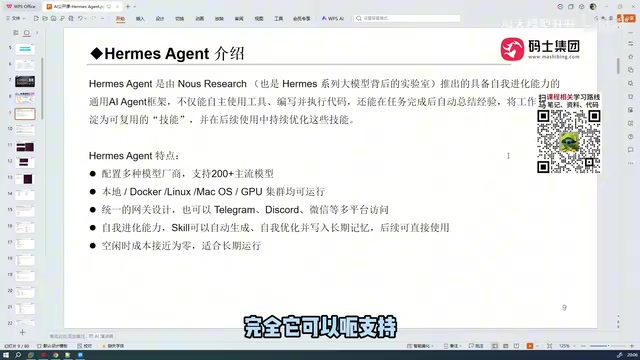
When it comes to code writing, many Agent frameworks perform poorly. One of the highlights of Hermes Agent is that it has built-in Claude Code and Codex, meaning it has virtually no weaknesses when handling coding tasks. Compared to some frameworks with limited code support, this is a substantial advantage.
Here it's worth elaborating on the technical positioning of Claude Code and Codex. Claude Code is a programming assistance tool launched by Anthropic based on the Claude series of models, excelling at multi-file understanding, refactoring, and debugging within real codebases, with an emphasis on grasping project context. Codex, originating from OpenAI, was one of the earliest representative technologies to apply large models to code generation, and also served as the predecessor to the underlying engine of GitHub Copilot. These two represent the two mainstream technical routes of current AI programming capabilities. Hermes Agent's built-in integration of both means that for coding tasks it can call upon programming capabilities that have been specially trained and optimized, rather than relying on a general-purpose model's "improvisation." This also explains why it has a clear advantage over purely general-purpose Agent frameworks in coding scenarios—dedicated programming models typically perform more consistently in syntax accuracy, adherence to engineering standards, and cross-file reasoning.
A Rich Set of Built-in Tools
Beyond coding, Hermes Agent also comes with a large set of built-in tools. Take browser operations as an example: it doesn't need to actually open a browser window like some frameworks do. Instead, it directly accesses web pages, scrapes content, and reads data through its internal browser toolset. This design improves efficiency while also reducing resource consumption.
It can be said that whatever OpenClaude can do, Hermes Agent can basically cover as well, including the calling of various web tools.
Downloadable and Customizable Skills (SQL)
Users can also write their own "skills" (represented in the framework in SQL form), or directly download ready-made skill packages from the internet to use. This open skill ecosystem greatly lowers the barrier to entry, allowing users to quickly reuse capabilities accumulated by the community.

Two Key Differentiating Highlights: Layered Memory and Self-Evolution
If the capabilities above are "standard features," then the following two points are Hermes Agent's true differentiating advantages.
Excellent Layered Memory Mechanism
According to feedback from actual users, Hermes Agent's layered memory is done exceptionally well. Good memory management means the Agent can maintain contextual coherence across long conversations and multi-turn tasks, which is crucial for executing complex tasks.
From a technical standpoint, Memory Hierarchy is a key technology for solving the Agent's "context forgetting" problem. Since large models have a physical limit on their context window, early information in long conversations or multi-step tasks is easily truncated and lost. Layered memory typically divides memory into short-term memory (the immediate context of the current conversation), working memory (key information relevant to the current task), and long-term memory (knowledge and preferences persisted across sessions), and leverages vector databases and Retrieval-Augmented Generation (RAG) technology to precisely recall relevant memory fragments when needed. Good layered memory can significantly enhance an Agent's coherence and stability in complex, long-cycle tasks, which is also one of the important indicators distinguishing mature frameworks from toy-level demos.
Self-Evolution Capability
Even more noteworthy is Hermes Agent's self-evolution capability. During continuous interaction with users, if the framework discovers that certain work is repetitive and follows a regular pattern—such as a fixed process of "do this in step one, do that in step two, do this in step three"—it will automatically generate a corresponding skill (SQL), and directly call the self-generated skill in subsequent tasks.
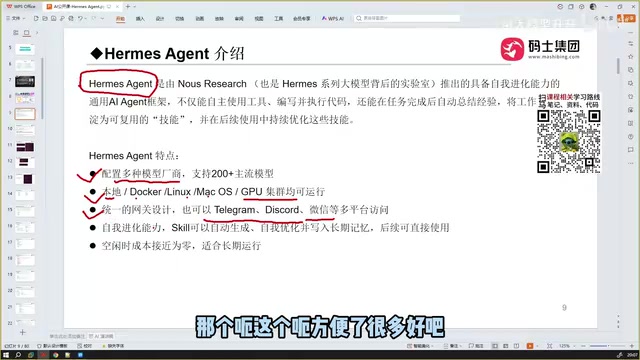
The value of this mechanism lies in the fact that the Agent is no longer a static tool, but continuously optimizes its own execution path with use. The more you use it, the more it "understands" your work habits, and the higher its execution efficiency becomes. This is an important direction in the current development of AI Agent frameworks.
Broad Compatibility and Deployment Flexibility
In terms of compatibility, Hermes Agent's performance is equally impressive.
Support for Over 200 Models
Hermes Agent claims to support over 200 models, covering almost all the various model providers commonly found online. This means users can freely choose the underlying model based on cost, performance, and other requirements, without being locked into a single vendor.
Multi-Platform Deployment
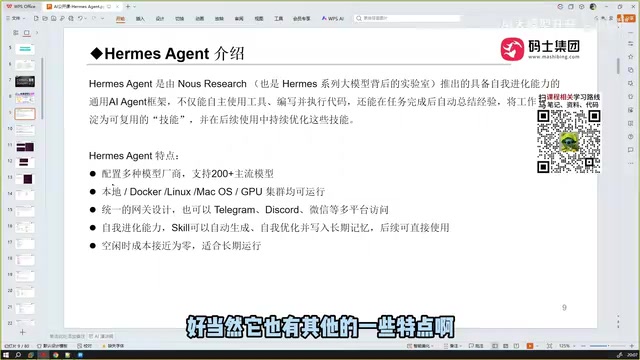
In terms of deployment, Hermes Agent supports local operation and is compatible with Windows, Linux, macOS, and Docker environments. It can even be deployed on clusters, offering extremely high flexibility.
Convenient Chat Platform Integration
Similar to OpenClaude, Hermes Agent can integrate with various chat software platforms, including Telegram and Discord abroad, as well as WeChat, WeCom, and DingTalk domestically. More importantly, its configuration process is very simple—often completed by just scanning a QR code—eliminating tedious manual configuration steps.
This leads to an interesting use case: once you bind Hermes Agent to WeChat, the Agent can run silently on your local computer (such as a Windows machine), while you can converse and issue commands at any time through WeChat on your phone, achieving a remote control experience of "operating your computer to complete tasks via WeChat."
Token Consumption: Far Lower Than Comparable Frameworks
For Agent frameworks, Token consumption is an unavoidable cost issue, especially in scenarios involving multi-turn conversations and complex tasks.
Here it's necessary to explain the relationship between Tokens and cost. A Token is the basic unit of measurement by which large models process text, and almost all commercial model APIs charge based on the number of input and output Tokens. Because Agent frameworks involve operations such as multi-turn reasoning, backfilling tool-call results, and memory retrieval injection, they tend to consume far more Tokens than ordinary conversations, and costs can grow exponentially. Therefore, optimizing Token efficiency is a core issue in Agent engineering. Common approaches include context compression, memory summarization, streamlined prompt template design, and avoiding repeated model calls during idle time.
Hermes Agent performs quite well in this regard. According to reports, it consumes almost no Tokens when not in use. Some testers compared Hermes Agent with OpenClaude across multiple rounds of conversation, and the results showed that Hermes Agent's overall Token consumption was far lower than OpenClaude's. This essentially reflects its engineering optimizations in scheduling strategy and context management.
For execution scenarios like DeepAgent that require large amounts of multi-turn conversation and consume enormous numbers of Tokens, this advantage is particularly critical. It means users can confidently engage in long, high-frequency interactions without worrying too much about runaway costs.
Summary
Overall, Hermes Agent is a comprehensive and mature AI Agent framework. It integrates coding capabilities (Claude Code, Codex), a rich set of built-in tools, and an open skill ecosystem, while forming differentiated competitiveness through the two key features of layered memory and self-evolution. Combined with support for 200+ models, multi-platform deployment, convenient chat software integration, and low Token consumption, it does indeed have the potential to become a mainstream Agent development framework.
For developers looking to get started with AI Agent development, Hermes Agent offers a practice platform with a relatively low barrier to entry and strong capabilities. Of course, this article is compiled based on a single source, so readers are still advised to verify the actual results hands-on in their own scenarios.
Key Takeaways
Related articles

Alibaba Launches Happy Shrimp: AI-Powered One-Click Complete Song Generation
Alibaba launches Happy Shrimp, an AI music generation tool that creates complete songs with lyrics, melody, arrangement, and vocals from natural language descriptions. In-depth analysis of its core features, differentiation from competitors like Suno, and industry impact.
GPT Sol Ultra vs Grok 4.6: Real-World Task Completion Benchmark in Reasoning Mode
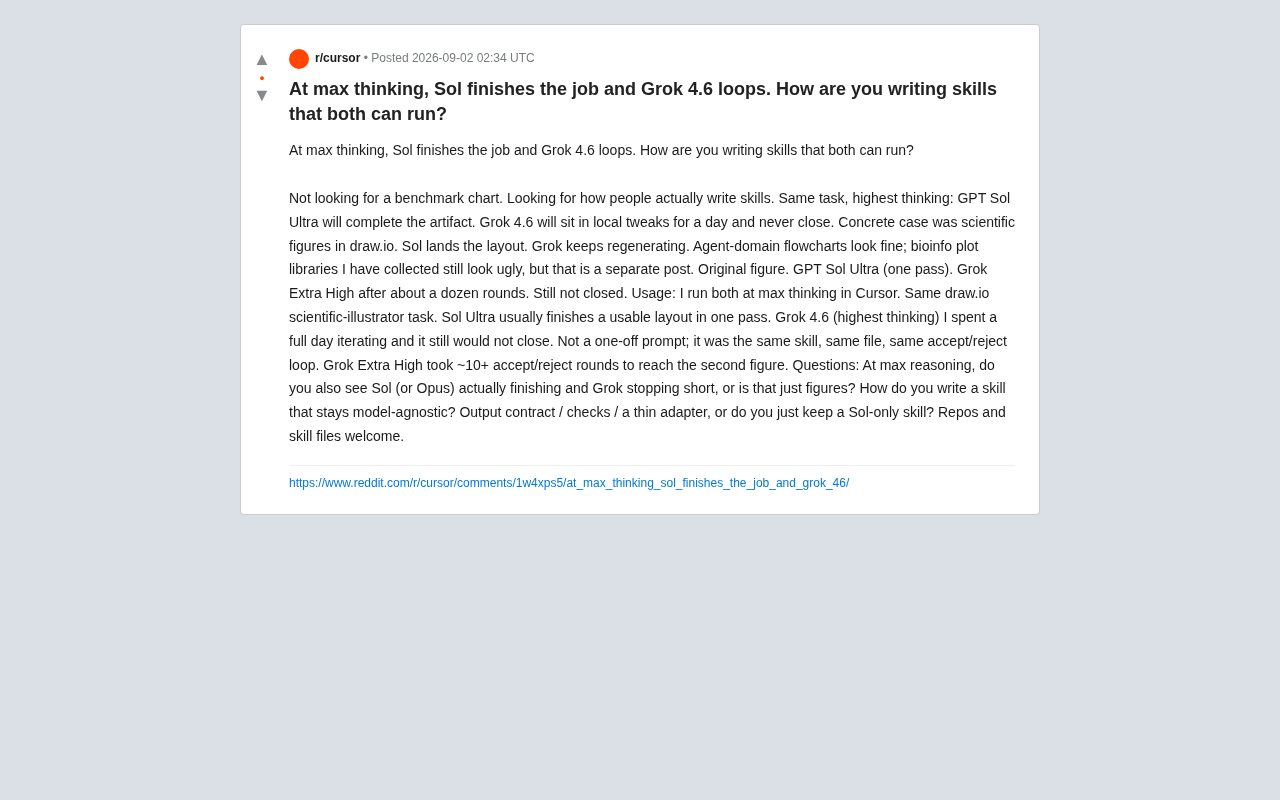
Developer benchmark reveals GPT Sol Ultra completes draw.io scientific diagrams in one iteration while Grok 4.6 fails to converge despite maximum reasoning mode, exposing that reasoning depth ≠ task delivery capability.
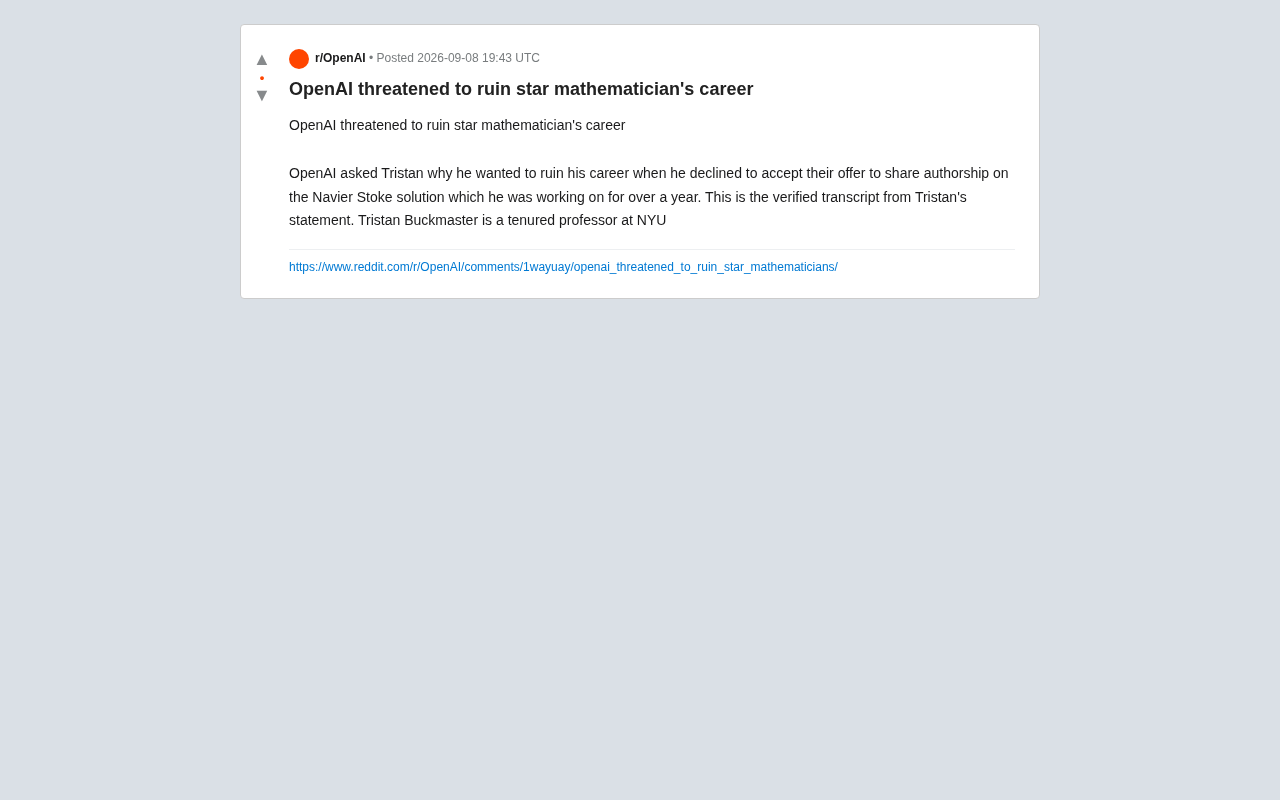
OpenAI Authorship Dispute: The Battle Over Academic Boundaries in the AI Era
OpenAI disputes authorship with mathematician Tristan Buckmaster over Navier-Stokes research, raising ethical questions about AI involvement in science.