Hermes Agent Self-Evolving Framework: A New Open-Source AI Agent Option
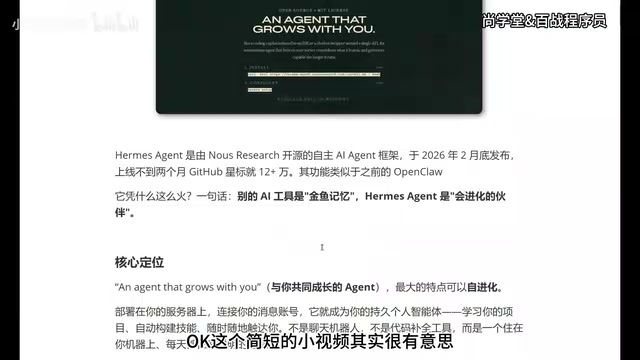
The open-source AI Agent framework Hermes Agent achieves lower Token consumption and continuous evolution through its self-learning loop and long-term memory.
Based on a Bilibili creator's hands-on demo, this article introduces the open-source autonomous AI Agent framework Hermes Agent, released in late February 2026 and reaching 120,000 GitHub stars in under two months. It compares Hermes Agent with Open Cloud: lower Token consumption and stronger long-term memory that survives restarts. Its core innovation is a built-in self-learning loop that automatically generates and iterates skills, persists knowledge and preferences, and builds cross-session understanding. In the demo, the Agent autonomously completed the full workflow from information gathering to document and webpage generation and local execution, creating new skills. Hermes Agent suits developers wanting an agent that lives on their machine and gets smarter daily, though the performance comparison is only personal experience and needs verification.
Title
Hermes Agent Self-Evolving Framework: A New Open-Source AI Agent Option
Meta Description
Based on a Bilibili creator's hands-on demo, this article analyzes the self-evolution mechanism of the open-source AI Agent framework Hermes Agent, its differences from Open Cloud in Token consumption and long-term memory, and the real-world results of automatically generating skills.
Article Content
AI Agents are moving from "can chat" to "can actually do things," and the open-source newcomer Hermes Agent has quickly gained popularity thanks to its self-evolution capabilities. Based on a Bilibili creator's hands-on demo, this article breaks down its core mechanisms, its differences from Open Cloud, and why developers should pay attention.
What Is Hermes Agent?
According to the Bilibili creator, Hermes Agent is an open-source autonomous AI Agent framework released in late February 2026, and its GitHub star count has already reached 120,000 in less than two months since launch. Its functional positioning is similar to the previously popular Open Cloud (commonly known as "Little Lobster"), but the creator emphasized in the video that Hermes Agent performs better in Token consumption and long-term memory.
Unlike AI tools such as Doubao and DeepSeekAd that "give advice," Open Cloud and Hermes Agent can actually execute operations: organizing documents, creating files, sending and receiving emails, and scraping web information. Hermes Agent's differentiation lies in "self-evolution"—it does not merely call large models, but continuously optimizes itself through a built-in learning loop.
AI Agent refers to a software system capable of perceiving the environment, making autonomous decisions, and executing actions to achieve goals. Unlike traditional chatbots that only generate text responses, AI Agents typically have tool-calling capabilities (such as accessing web pages, operating file systems, and sending emails) and can break complex tasks into multiple steps executed in sequence. Their core components include a planning module, a memory module, and a toolset. Both Hermes Agent and Open Cloud fall into this category; they are driven by large language models but emphasize "hands-on operation" rather than "just giving advice," thereby completing end-to-end automated tasks.
Key Differences from Open Cloud
The creator cited a comparison video in the video and pointed out two core differences:
- Lower Token consumption: Based on their own experience, the creator stated that Hermes Agent's Token consumption is absolutely lower than that of Open Cloud.
- Stronger long-term memory: Open Cloud behaves as if it has "amnesia" after closing the dialog box or restarting, while Hermes Agent retains historical memory and can self-evolve based on it.
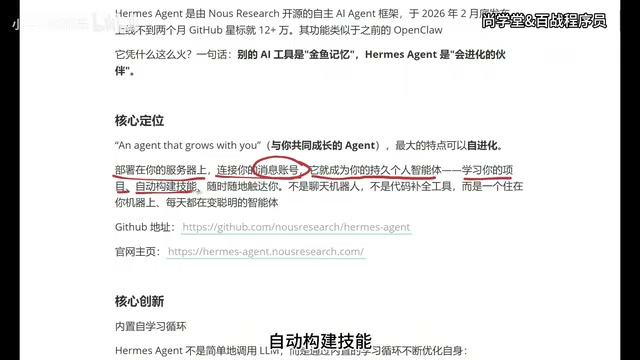
In the creator's words, other AI tools are "gene-based on memory" (short-term memory), while Hermes Agent is an "evolving partner"—the longer you use it, the more it understands your preferences, the more skills it has, and the more handy it becomes.
Long-term memory is the foundation for AI Agents to achieve personalization and continuous evolution. Short-term memory usually refers to the context window within a single session, while long-term memory persists information across sessions through external storage (such as vector databases and key-value stores), including user preferences, historical tasks, and skill libraries. Hermes Agent can retain this memory after restarting and use it to optimize subsequent decisions; Open Cloud's default design relies more on in-session context, and memory is lost after closing. The implementation of long-term memory involves strategies for writing, retrieving, and updating memory, and is one of the current hot topics in Agent research.
Core Innovation: Built-in Self-Learning Loop
Hermes Agent's core innovation lies in its built-in self-learning loop, specifically reflected in four aspects:
- Automatically generating skills from interactions: Skills are automatically created during conversations without the user needing to trigger them actively.
- Continuously iterating skills during use: Skills are continuously updated and optimized with use, becoming increasingly proficient.
- Automatically persisting knowledge and user preferences: A user profile is gradually built based on personal usage.
- Building deep understanding across sessions: It supports access across multiple platforms such as QQ, WeChat, and Feishu, continuously accumulating understanding of you.
In the demo, the creator asked Hermes Agent to "search the internet for recently popular Agent projects, summarize them into a document with important links such as official websites and blogs attached, then generate a tech-styled display webpage, and run it locally after completion." Throughout the process, the creator did not repeat instructions; the Agent autonomously completed the entire workflow from message acquisition to document generation and webpage generation, and automatically created a skill named "skillcritic."
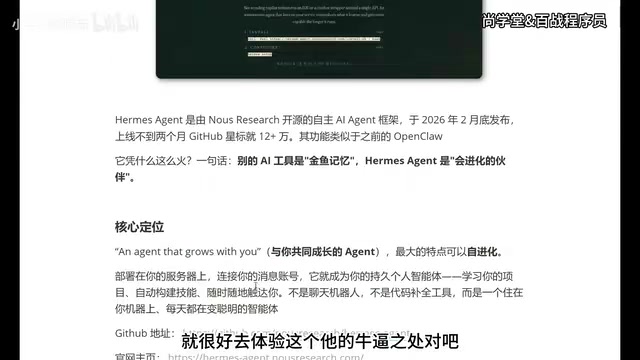
Skill in the context of AI Agents usually refers to a reusable piece of code or instruction set that encapsulates a specific capability, such as "web scraping," "document summarization," or "generating HTML pages." An Agent can dynamically create new skills during operation based on task requirements, or adjust parameters and optimize the logic of existing skills. Hermes Agent's breakthrough lies in automating skill generation and iteration: it extracts reusable patterns from each interaction, solidifies them into skills, and continuously improves them in subsequent use, thereby reducing repetitive reasoning overhead and improving execution efficiency. This mechanism also lowers the threshold for users to manually write skills.
Hands-On Demo: A Single Autonomous Task Execution
After connecting Hermes Agent on QQ, the creator first asked "Hello, who are you," and the Agent replied, "I am Hermes, an AI assistant running on QQ," and listed capabilities such as writing code, debugging, running scripts, web searching, browsing web pages, file management, scheduled tasks, and content generation.
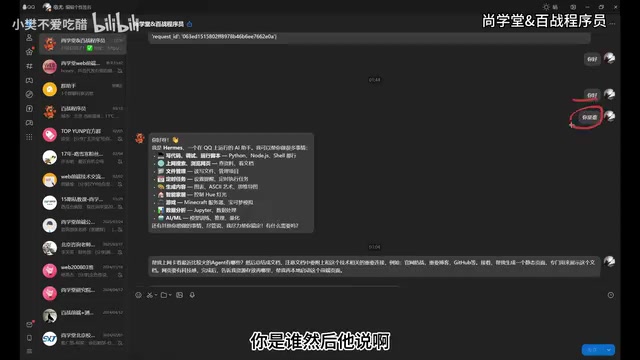
Then the creator issued the above task, and the Agent generated results step by step. After completion, it informed the creator of the browser access address (local localhost). Opening it revealed a display page containing mainstream AI Agent projects from the past two years (such as Cursor, Claude Code, and Open Cloud), and the information was fairly accurate.
Who Should Pay Attention to Hermes Agent?
For developers who want an intelligent agent that "lives on their own machine and gets smarter every day," Hermes Agent provides an open-source, deployable option. At the end of the video, the creator said they would subsequently guide everyone through installing and deploying Hermes Agent from start to finish, which is suitable for developers who want to try it out.
It should be noted that the information in this article mainly comes from a single Bilibili creator's sharing, and the performance comparison is based on personal experience. Readers can further verify it by combining official documentation and the GitHub repository.
One-line Summary
With its self-learning loop and long-term memory, the open-source AI Agent framework Hermes Agent achieves lower Token consumption and continuous evolution.
Paragraph Summary
Based on a Bilibili creator's hands-on demo, this article introduces the open-source autonomous AI Agent framework Hermes Agent. The framework was released in late February 2026, and its GitHub star count reached 120,000 in less than two months since launch. The article compares the core differences between Hermes Agent and Open Cloud: lower Token consumption and stronger long-term memory, with context not lost after restarting. Its core innovation lies in the built-in self-learning loop, which can automatically generate skills from interactions and continuously iterate them, while persisting knowledge and user preferences and building deep understanding across sessions. In the hands-on demo, the Agent autonomously completed the entire workflow from information gathering and document generation to webpage generation and local execution, and automatically created new skills. The article concludes that Hermes Agent is suitable for developers who want an intelligent agent that "lives on their own machine and gets smarter every day," but the performance comparison is only the creator's personal experience and requires further verification.
Related articles

Mistral Large 4 Open-Sources a Trillion Parameters, Microsoft Offers Voluntary Severance to 60,000 Employees
Mistral Large 4 open-sources a trillion-parameter multimodal model with a coding agent score of 48; SanDisk earnings show AI inference reshaping NAND demand; Google Gemini adds in-app file editing, OpenAI raises Codex quotas, and Microsoft offers voluntary severance to 60,000 employees.
Mistral Large 4 Opens Its Weights: AI Morning Brief Roundup of Models and Ecosystem Trends
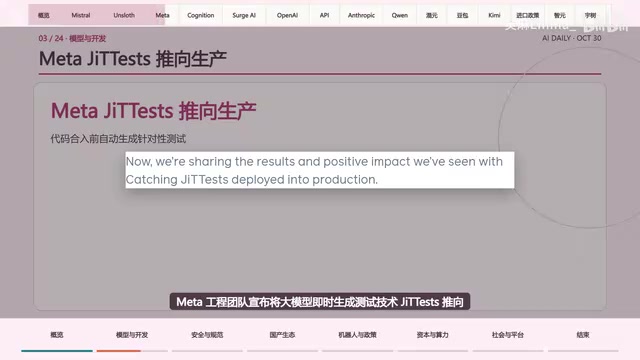
Mistral Large 4 opens its weights, a 1-trillion-parameter MoE architecture that can run locally on MacStudio; Meta's test-generation technology enters production; top tax benchmark pass rate only 10.8%; Canadian government takes a stake in Cohere; Doubao Work opens third-party model calls. This AI Morning Brief rounds up model, ecosystem, capital, and policy developments.
Mistral Large 4 Goes Open Source: A 1T-Parameter European Qwen Challenging DeepSeek
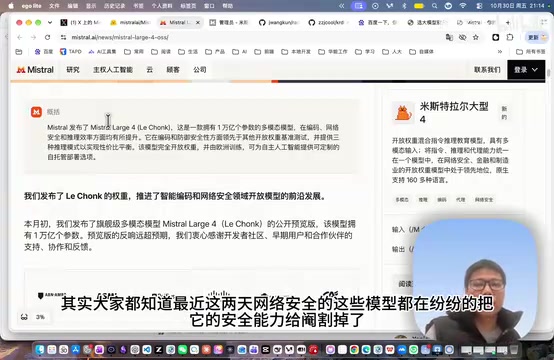
Mistral Large 4 is now open source: 1T total parameters, 52B activated, focused on coding and cybersecurity, with ~610G NVFP4 weights. We analyze its comparison with DeepSeek V4 Flash, API pricing, demo realism, and local deployment value.