HF Trending Breakdown: DeepSeek-V4.1-Flash Tops the Charts as On-Device and Local Deployment Surge
HF trending charts reveal 3 trends: flagship MoE cost cuts, edge AI Agent capability, and local video generation going mainstream.
Based on real Hugging Face API trending data, this article breaks down the open-source models drawing the most developer attention. DeepSeek-V4.1-Flash tops the chart with a 552B MoE architecture featuring just 8B active parameters, MIT licensing, and 1M token context. MiniCPM5 2B and Qwen3.8 27B claim the on-device market from two angles — small-model capability ceiling and local deployment value — while Qwen3.8's GGUF quantized version leads with tens of millions of daily downloads. NextN 2.5 represents a new computer-control Agent track, and LTX 2.5 marks open-source video generation crossing from novelty to necessity.
The competitive pace of open-source models is accelerating. Hugging Face now hosts over 3.01 million models — crossing the 3 million mark in early August — with another million-plus models added in a short span. That number alone speaks to community momentum. This trending list, derived from real API calls rather than hand-picked selections, better reflects what frontline developers are actually choosing. The top ten is dominated by Chinese-developed models, spanning flagship MoE architectures, compact on-device models, and locally quantized versions — covering virtually every hardware tier imaginable.
This article draws on a trending breakdown by Bilibili creator "硬核AI实战派" to summarize the most-watched open-source models currently on Hugging Face and analyze three clear emerging trends.
Flagship Returns: DeepSeek-V4.1-Flash Takes the Top Spot
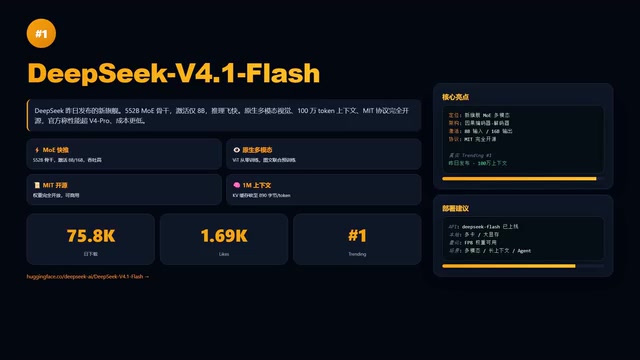
Topping the chart is the newly released DeepSeek-V4.1-Flash, which shot to number one with 75.8K daily downloads and 1.69K likes. Its technical profile is sharp: a 552B-parameter MoE backbone, yet with only 8B active parameters during inference (16B during generation), meaning fast inference and manageable deployment costs.
Critically, it's fully open-sourced under the MIT license, natively supports multimodal vision, and extends context length to 1 million tokens. Officially, it's claimed to outperform V4 Pro while costing just 70% as much per output token. The cost efficiency comes largely from KV cache compression down to 890 bytes per token — just one-quarter of V4 Flash — which is a decisive factor for local deployment and long-context scenarios where VRAM is the bottleneck.
Simultaneously maxing out performance, cost, and speed, then pairing it with a permissive open-source license, is why it reached the top so quickly. For local deployment enthusiasts, an 8B-activation, MIT-licensed multimodal flagship is close to the ideal configuration.
MoE (Mixture of Experts) is key to understanding the parameter counts in these models. Traditional dense models activate all parameters on every forward pass, while MoE models split parameters into multiple "expert" sub-networks, with a routing layer dynamically selecting a small subset for each input. DeepSeek-V4.1-Flash has 552B total parameters but activates only ~8B per inference (16B during generation), meaning its compute load is comparable to an 8B dense model while drawing on the knowledge capacity stored across 552B parameters. KV Cache (Key-Value Cache) is the core acceleration mechanism in Transformer inference: during long text generation, the model caches attention key-value pairs from each layer to avoid redundant computation, with cache size scaling proportionally with context length and layer count. Compressing KV cache to 890 bytes/token means that a 1-million-token ultra-long context occupies an acceptable amount of VRAM rather than tens of gigabytes — a decisive advantage for local multi-GPU deployment or cloud-based long-context applications.
On-Device Surge: MiniCPM5 and Qwen3.8 Compete for Real-World Deployment
Second on the chart is MiniMind's MiniCPM5 2B from ModelBest (面壁智能), with 67.6K daily downloads and 1.17K likes. As the second-generation dense model in the MiniCPM5 series, it targets edge and on-device deployment, featuring a 128K context window, support for Think/No-Think dual reasoning modes, native tool calling, and the standard Llama architecture — making it natively loadable by vLLM and runnable on a single GPU with TP=1.
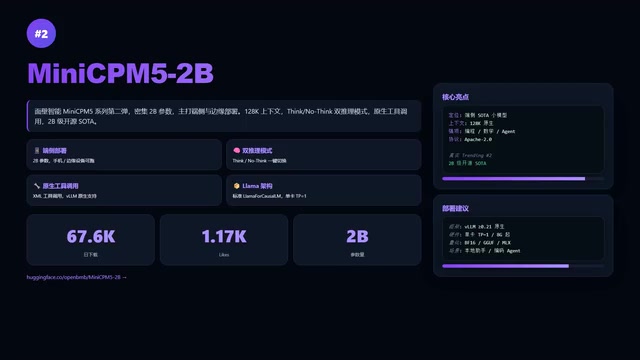
A 2B model achieving SOTA performance on coding, math, long-context, and Agent tasks is itself a signal: small on-device models are no longer toys. Even 2B can handle Agent workloads, and the barrier to local deployment is dropping fast.
Leading in total downloads is Qwen3.8 27B, with 7.56 million daily downloads and 14.7K likes — the highest download count in the entire field. It supports image-text-to-text multimodality and Chinese-English bilingualism, with reliable tool calling and structured output. The 27B tier, once quantized, runs comfortably on a 16GB GPU — earning it the label of "sweet spot" for local deployment. Qwen3.8's use of a unified architecture from Flash to 27B covering all hardware tiers is key to its massive download scale.
Local Deployment Champion: Qwen3.8 27B GGUF Quantized
If the original Qwen3.8 is the sweet spot, then Unsloth's Qwen3.8 27B GGUF quantized version is the undisputed champion for local deployment — 11.33 million daily downloads and 3.88K likes, the highest download count among all quantized models.
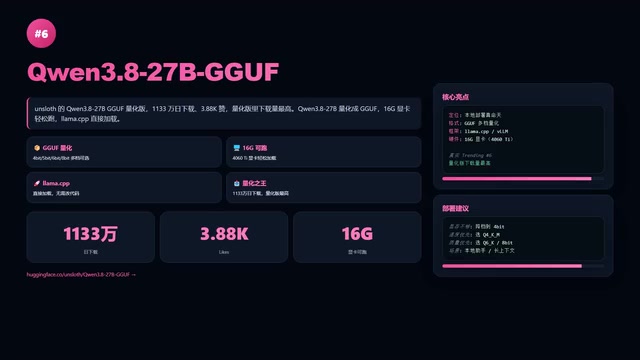
Once quantized to GGUF, it runs smoothly on a 16GB GPU. llama.cpp can load it directly, with options ranging from 4-bit to 8-bit — drop to a lower bit depth if VRAM is tight. This kind of "grab-and-run" executable version resonates far more with hands-on deployers than theoretical benchmarks. With both the original and quantized versions ranking high simultaneously, the community's demand for Qwen3.8 clearly spans both cloud and local use cases.
GGUF (GPT-Generated Unified Format) is a model file format introduced by the llama.cpp project, designed specifically for local CPU/GPU hybrid inference. It evolved from the GGML format, with systematic improvements in metadata management, quantization scheme descriptions, and cross-platform compatibility. Quantization refers to compressing model weights from FP16/BF16 floating-point formats into lower-precision integer representations such as INT8, INT4, or even INT2, trading a small accuracy loss for significantly reduced VRAM usage and computation. 4-bit quantization typically compresses model size to roughly one-quarter of the original; a 27B model at 4-bit quantization comes in around 14–16 GB, right at the limit of a consumer-grade 16GB GPU. llama.cpp also supports automatic offloading of layers to system RAM or even disk when VRAM is insufficient, further lowering the hardware barrier — and that is the fundamental reason GGUF quantized versions dominate local deployment download counts.
Agent and Video Generation: Two Emerging Tracks
Fourth on the chart is NextAGI from Shanghai Innovation Institute's NextN 2.5 — a 397B MoE model with 17B active parameters, purpose-built for computer operation Agent tasks: reading screens, clicking browsers, observing results, and self-correcting. It offers a 262K context window, uses the Apache 2.0 license, and reportedly scores 56.4 on OS World (per official claims).
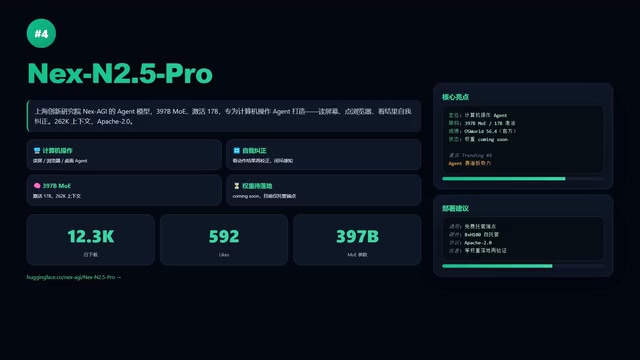
A word of caution: the model weights are still marked as "Coming soon," with only a free hosted endpoint currently available. Real-world validation will need to wait until the weights are actually released — this is a single-source claim and actual performance remains to be independently verified.
On the video generation side, Lightricks' LTX 2.5 appears on the chart with 1.67 million daily downloads and 3.44K likes, making it one of the most stable open-source image-to-video options available. It integrates directly into ComfyUI workflows and is well-suited for product demos, knowledge-sharing videos, and other creative assets. Its appearance alongside MiniMax H3 on the trending chart signals that the open-source video generation track has fully taken off, and local video generation is becoming a genuine necessity.
OS World is an authoritative benchmark for evaluating how well Agent models can operate real operating systems. Tasks include completing compound instructions in Windows/Linux environments — file management, web browsing, software usage — where the model must perceive the current state via screenshots and output mouse/keyboard action sequences. What makes this benchmark difficult is the long action chains, dynamically changing environment states, and error accumulation — fundamentally different from traditional QA or code generation tasks. A score of 56.4 on OS World is relatively high among currently public models, but since NextN 2.5's weights have not been released and only a hosted endpoint is available, external researchers cannot independently reproduce the results, meaning this figure remains an unverified official disclosure. ComfyUI is a visual workflow orchestration tool for local deployment, allowing users to connect processing nodes for image/video generation models as a directed graph. LTX 2.5's native ComfyUI support means it can be seamlessly embedded into existing local creative pipelines.
Three Key Trends
Drawing on this trending list, three clear directions emerge:
- Flagship MoE multimodal models return: DeepSeek-V4.1-Flash uses a MIT license and 8B active parameters to simultaneously maximize performance, cost efficiency, and speed — redefining the standard for open-source flagships.
- On-device small models surge: MiniCPM5 2B proves that compact models can handle Agent workloads, and the barrier to local deployment keeps falling.
- Open-source video generation becomes standard: High download counts for models like LTX 2.5 signal that local video generation has moved from novelty to necessity.
From flagship to edge to local quantized deployment, this trending list captures almost the full landscape of today's open-source model ecosystem — and makes "local deployment" more accessible than ever before.
Related articles
Letting AI Build AI Tools: A 7-Day, 31-Commit Bootstrapping Post-Mortem
An engineer ran a fully autonomous AI-builds-AI pipeline for 7 days, 31 commits, with a 1-in-6 success rate. This post-mortem covers 5 failure types, 11 structural rules, and how every mistake became a permanent immunity gate.
Building an AI-Powered E-Commerce Business from Scratch: A Real-World Account of Multi-Agent Architecture for Print-on-Demand
A blogger builds a print-on-demand e-commerce company from scratch using AI agents — documenting specialized Agent profiles, GPT-5.6 vs Claude Fable multi-model orchestration, and reusable skill accumulation.

AI Agent Earns $10K in One Week: 3 Key Upgrades Explained
A blogger shares how he earned $10K in a week with an AI Agent — not by adding more skills, but through verification, approval gates, and subagents to raise trust and enable true automation.