Hira: A Free AI Job-Hunting Agent That Auto-Applies via Text Message
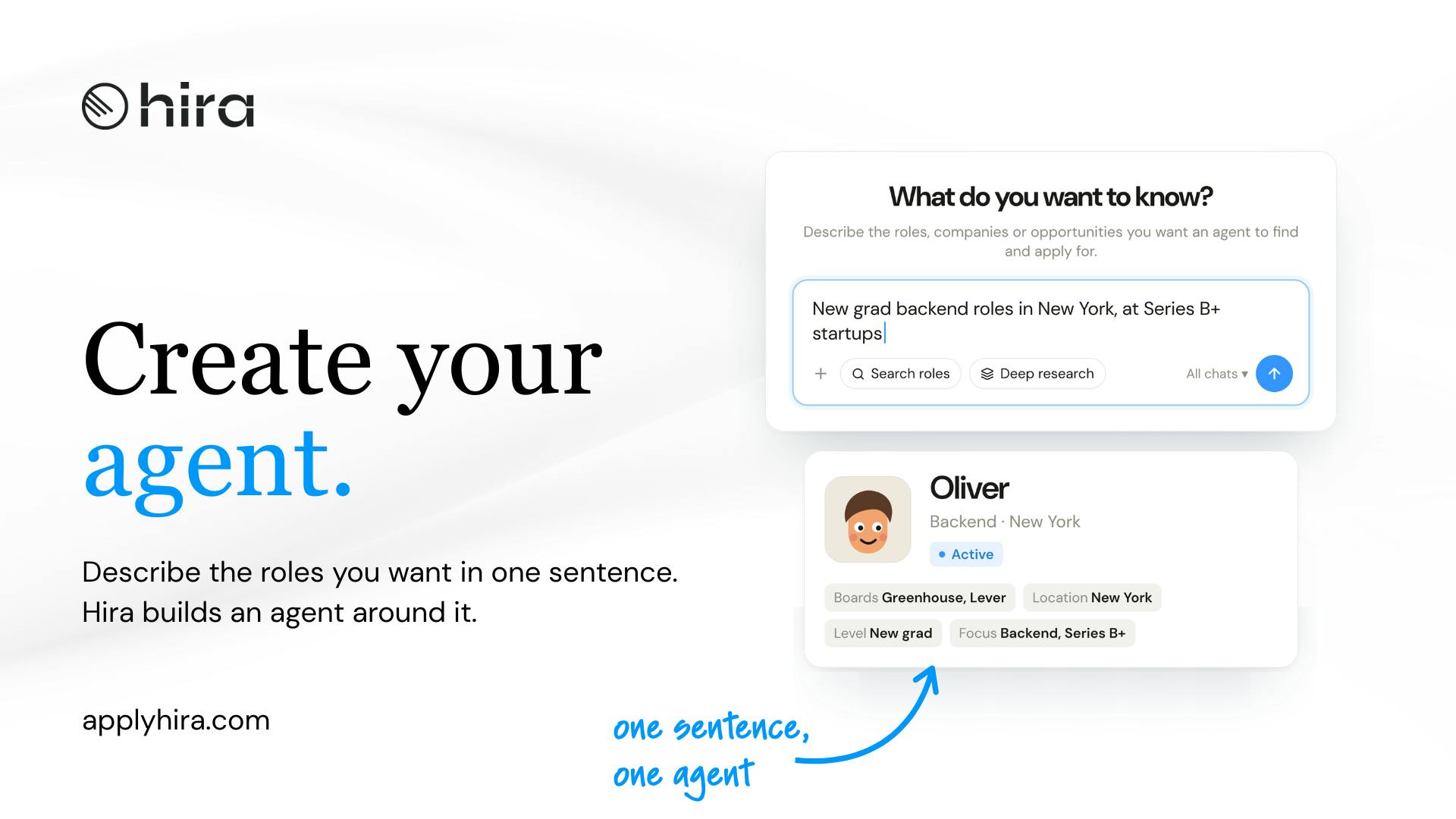
Hira, a free AI job-hunting Agent on Product Hunt, auto-applies to jobs on users' behalf.
Hira is a free personal job-hunting AI Agent launched on Product Hunt that completes job applications for users rather than just giving advice. It offers three entry points—text message, connecting to Muse, and the official website—with texting lowering the barrier by letting users make progress during fragmented time. At launch it received 72 upvotes and ranked 16th that day. The article notes that AI in recruiting was previously mostly used for enterprise screening and resume optimization, while Hira goes further by directly executing applications. Its free strategy may point to early user growth or data monetization, but application quality, job sources, and sensitive data handling are undisclosed and need user verification.
Anyone who has job-hunted knows the pain: filling out the same forms over and over, tweaking your resume for each position, tracking application status... These repetitive tasks eat up huge amounts of time. A product called Hira has appeared on Product Hunt, aiming to take over this entire process with an AI Agent—and it's completely free.
What Hira Is: Hand Job-Hunting to an Agent
Hira positions itself as "your free personal job-hunting Agent." According to the official description, users don't need to apply manually—instead, this personalized AI Agent does everything on their behalf. It offers three ways to interact: text it, connect it to Muse, or use it directly through the official website.
This multi-entry design is worth noting. Agent products are usually confined to a web page or app, but Hira treats text messaging as a first-class citizen—meaning users can make progress on their job search during fragmented moments like commuting or waiting in line, in the most natural way, without having to open a specific app.
At launch, Hira received 72 upvotes and ranked 16th on that day's Product Hunt leaderboard, categorized under Productivity, Artificial Intelligence, and Career. For a vertical-scenario Agent tool, these numbers suggest it has hit a real pain point for job seekers.
The key difference between an AI Agent and an ordinary chatbot lies in "autonomous execution": it can break down goals, call tools, and complete multi-step operations in sequence, rather than just passively answering a single question. In the job-hunting scenario, an Agent typically needs capabilities such as job search, form filling, material matching, and status tracking, and must be able to make judgments or fall back when encountering anomalies (such as website redesigns or CAPTCHAs). This also explains why Agent products tend to emphasize "taking over" rather than "assisting"—their value comes from packaging a series of actions that originally required manual chaining into a single delegation. At the same time, an Agent's execution quality depends heavily on the underlying job data sources and web automation capabilities, which are the most important hidden metrics to watch when evaluating such products.
The Product Logic of Job-Hunting Agents and Industry Context
Hira didn't appear out of nowhere. Over the past while, AI's penetration into recruiting has roughly split into two lines: one facing enterprises—resume screening and candidate matching; the other facing job seekers—resume optimization and job recommendations. Hira takes the more aggressive path—not just giving advice, but directly executing the application actions on the user's behalf.
Behind this is a product judgment: information gathering and repetitive operations in job hunting can be standardized, and are therefore suitable for an Agent; while career choices, interview communication, and other links requiring judgment should still be left to humans. Hira puts "free" in its tagline, also hinting that it may hope to accumulate users through the high-frequency job-hunting scenario and then find other monetization paths.
However, the materials don't explain how Hira ensures application quality, whether it customizes application materials for different positions, or the scope of job sources it connects to. These are precisely the keys to whether a job-hunting Agent is truly usable, and also what users need to examine themselves when choosing such tools.
Muse is a platform/app for job hunting and career development. Hira's support for "connecting to Muse" means users can directly sync context such as their career profile and target job preferences from Muse to the Agent, saving the step of re-entering information. For Agent products, such integration is equivalent to providing structured user profile input: the more complete the information, the stronger the targeting of job matching and applications. Conversely, if users don't have an existing career profile, the Agent's first-round results often suffer. Therefore, "connecting to an existing career platform" is both a means of lowering the onboarding cost and a precondition for improving the quality of automated output—worth examining together when evaluating any job-hunting Agent.
The Considerations Behind the Free Strategy
"All for free" is Hira's most prominent label. At a time when AI Agents generally charge by call volume or subscription, being completely free means the cost is borne in other ways. One possibility is that the product is still in an early growth stage, prioritizing user scale; another is that the job-hunting scenario itself has data value, and the platform can gain commercial returns by aggregating job-seeking behavior.
For users, free lowers the barrier to trying it, but also warrants attention: job hunting involves sensitive personal information such as resumes and contact details, and before handing them to a third-party Agent, you should confirm how the data is stored and used. The materials also don't disclose details in this regard, which is information that should be proactively verified before use.
In AI products, "charging by call volume" means billing based on the number of times the model is called or the number of tokens consumed. Agent applications often need to call large models multiple times per task execution (understanding job descriptions, generating application text, judging page states, etc.), and a single job application process may generate dozens of calls, with costs rising linearly with usage frequency. This is precisely the technical reason why job-hunting Agents are hard to keep free long-term: the more active the users, the greater the vendor's inference costs. Understanding this makes it clear that "All for free" usually corresponds to some kind of subsidy period or alternative revenue source, and users enjoying the free service should also maintain reasonable expectations about the service's sustainability.
Who Should Try Hira
If your job search is in the "casting a wide net" stage—your target job types are relatively clear, you need to apply in bulk, and you don't want to spend time on repetitive form filling—then an Agent tool like Hira is worth a try. Its text-message entry is especially suitable for users who don't want the burden of adding another app.
But if you're precisely targeting a few goal positions and need highly customized application materials, automated applications may instead dilute your competitiveness. The Agent handles efficiency; strategy still needs to be set by humans.
Hira's emergence shows that job-hunting automation is moving from "assistive tool" to "agent execution." Whether it can keep running under the free model and ensure the actual effectiveness of applications will determine whether such products are a flash in the pan or become a permanent fixture in the job-hunting process.
One-line Summary
Hira, a free AI job-hunting Agent on Product Hunt, automatically applies to positions on users' behalf.
Paragraph Summary
Hira is a free personal job-hunting AI Agent launched on Product Hunt, focused on completing job applications for users rather than merely offering advice. It offers three entry points: text message, connecting to Muse, and the official website—the text-message option lets users make progress on their job search during fragmented time, lowering the barrier to use. At launch it received 72 upvotes and ranked 16th that day, categorized under Productivity, AI, and Career. The article notes that AI in recruiting was previously mostly used for enterprise-side screening and job-seeker-side resume optimization, while Hira goes further by directly executing applications—handing standardized operations to the Agent and leaving career judgment to humans. Its completely free strategy may point to early user growth or data-value monetization, but guarantees of application quality, the scope of job sources, and how sensitive data such as resumes are handled are all undisclosed and require users to verify themselves.
Related articles

OpenAI to Shut Down Agent Builder and Two Other Services on November 30, Developers Must Migrate Urgently
OpenAI will shut down Agent Builder, the evals dashboard, and reusable prompts on November 30; evals is already read-only. Here's the scope, OpenAI's migration paths (Agent SDK, PromptFu, your own code), and what developers should export and rebuild this week.
RankSpot: A Pay-Per-Use SEO & AI Search Execution Layer That Lets Agents Write, Publish, and Build Backlinks for You
RankSpot is an SEO & AI search execution layer for AI Agents. Connect via MCP to Claude or ChatGPT to write, publish & build backlinks. Pay-per-use, $3/article.

Appxiom: Giving AI Coding Assistants Production Context
Appxiom gives AI coding agents production context—crashes, jank, memory leaks, failed network calls—across Android, iOS, Flutter, KMP, and Web, ranking bugs by Goal Friction Impact.