Hiwonder miniAuto Pro Open-Source Robot Car: Testing AI Large Models and Voice Agent Integration
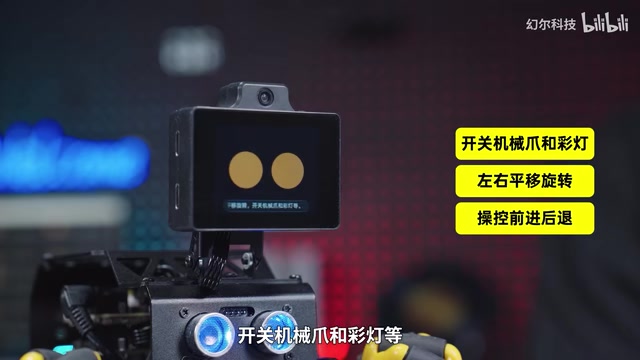
miniAuto Pro bridges LLMs, vision AI, and embedded hardware for full-pipeline natural language robot control.
Hiwonder's miniAuto Pro is an open-source robot platform for embedded developers and AI enthusiasts that integrates LLMs, vision-language models, and mechanical control into a complete closed loop. Users can issue complex multi-step instructions in natural language; the system parses them into sequences of movement and gripper actions, applies if-else conditional logic using real-time ultrasonic sensor data, and uses a vision model for scene description and object recognition to drive gripper-based pick-and-place operations. As an open-source platform, it provides an extensible foundation for practicing the full voice + vision + control pipeline.
For embedded developers and AI enthusiasts, an open-source platform that genuinely bridges large language models, voice interaction, and mechanical control is far more compelling than a simple educational kit. Hiwonder's miniAuto Pro is exactly that kind of product — it combines the ESP-Claw intelligent agent, the AI voice assistant "Xiaohuan," and the robot body itself, demonstrating a complete closed loop from natural language commands to physical actions.
One Instruction, Multi-Step Action Orchestration
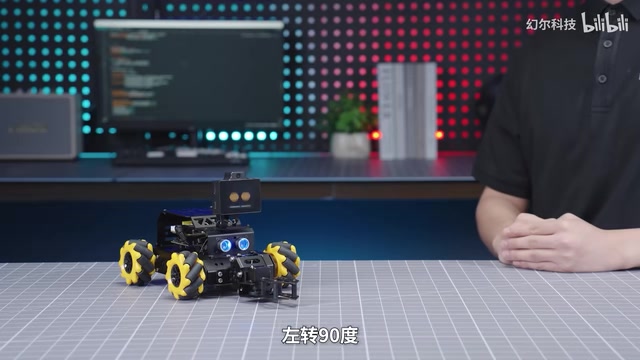
The most immediately impressive feature of the miniAuto Pro is its ability to parse continuous, complex natural language instructions and translate them into a precise sequence of mechanical actions. In hands-on testing, a user simply says something like "Move forward 20 centimeters, then back up 15 centimeters, turn left 90 degrees, turn right 100 degrees, then raise the robotic arm and lower it, and finally open and close the gripper twice" — and the car executes the entire sequence step by step.
This demonstrates a large model's ability to decompose multi-step tasks. Traditional robot control typically requires pre-programmed logic or graphical drag-and-drop instruction building, whereas this interaction style is much closer to natural human conversation. Distances, angles, and action sequences are all accurately mapped to the underlying motor and servo controls.
The technical foundation for this capability is the Function Calling mechanism in large language models (LLMs). Developers pre-define low-level control functions (such as move forward, turn, servo angle, etc.) and inform the model of the available tool list in a structured format. When the model receives a natural language instruction, it decomposes it into an ordered sequence of function calls, which the embedded controller (such as the ESP32 series) then executes in order. This architecture positions the LLM as the "task planning layer" rather than a direct generator of low-level control signals — preserving the flexibility of natural language interaction while ensuring deterministic and safe hardware execution. The ESP-Claw agent is the core module responsible for this "language understanding to hardware instruction translation" role.
Perception and Conditional Logic: Making the Robot "Think"
Going a step further than action execution is the handling of conditional logic. In one demonstration, the instruction given was: "Detect the distance to the obstacle ahead — if it's greater than 30 centimeters, spin in place and turn the ultrasonic sensor light green; if it's less than 30 centimeters, turn the light red." After detecting a distance of 52 centimeters ahead, the car correctly determined "greater than 30 centimeters," spun in place, and switched the light to green.
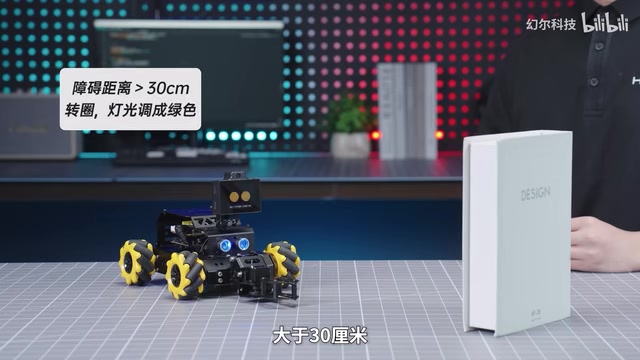
This implementation of if-else conditional branching shows that the system doesn't treat voice input as simple remote-control commands — it actually makes decisions based on real-time data from the ultrasonic sensor. For learners, this is an excellent case study in understanding the classic robot control paradigm of "Perception — Decision — Action."
The Perception-Action Loop is a cornerstone of robotics. In traditional implementations, the perception layer (sensor data acquisition), decision layer (conditional logic or planning algorithms), and execution layer (motor drivers) are all manually wired together by engineers. The innovation in miniAuto Pro lies in delegating the conditional decision-making to the large model at runtime — the model reads the real-time values returned by the ultrasonic sensor, combines them with the threshold described in the instruction, and outputs the corresponding execution plan. This means developers no longer need to manually enumerate every possible conditional branch in advance; they simply describe the rules in natural language and the LLM converts them into executable logic, dramatically reducing the cost of writing conditional control logic.
Combining Visual Understanding with Physical Manipulation
The miniAuto Pro is connected to a vision large model, giving it scene description and object recognition capabilities. When asked to "describe what you see," it can identify a panda, zebra, small tree, and Eiffel Tower model on a tabletop, and note that the background includes a whiteboard and lighting.
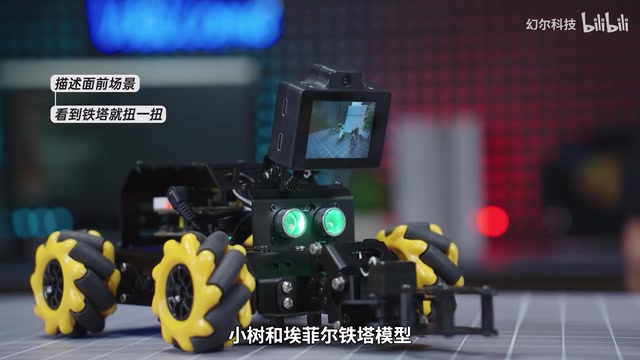
Even more interesting is the combination of vision and action. After receiving the conditional instruction "if there's a tower, do a little wiggle," the car identified the Eiffel Tower model and executed a swaying motion. In the task "turn left 60 degrees, and if you see a rubber duck, grab it and move it to the right," the car completed the full pipeline of recognition, grasping, and transport. This "visual recognition + gripper control" combination brings the large model's perceptual capabilities into genuine physical-world operation.
Vision-Language Models (VLMs) are multimodal models capable of processing both image and text input simultaneously — prominent examples include GPT-4o, LLaVA, and Qwen-VL. Compared to traditional computer vision approaches (such as YOLO object detection), VLMs have the advantage of not requiring purpose-trained models for specific objects; open-vocabulary object recognition and scene understanding can be achieved through natural language descriptions alone. In the miniAuto Pro's use case, image frames captured by the camera are fed into the vision large model, which outputs recognition results that are then passed to the LLM to decide the next action based on the current instruction. This three-tier architecture of "VLM perception + LLM decision-making + embedded execution" is one of the mainstream technical approaches in the current field of Embodied AI.
Open-Source Value for Developers
From a product positioning perspective, the core value of the miniAuto Pro lies in being open source. It integrates an AI voice assistant, the ESP-Claw intelligent agent, a vision large model, and mechanical control modules into a single expandable experimental platform for embedded and AI enthusiasts.
Developers can study how voice commands are parsed into control signals, explore the collaborative logic between vision models and hardware actions, or even build entirely new intelligent application scenarios on top of the existing framework. Compared to closed, finished-product toys, this openness makes it far better suited as a learning vehicle for those studying the fusion of robotics and AI.
Summary
Through a hands-on demonstration, the miniAuto Pro showcases four categories of capability: natural language control, conditional logic, visual understanding, and physical object manipulation. It bridges today's popular large model capabilities with traditional embedded hardware, lowering the barrier for everyday enthusiasts to get started with AI robotics development. For developers looking to get hands-on experience with the full "voice + vision + control" pipeline, this open-source platform offers a solid starting point. It should be noted that this article is based on official demonstration content; actual development experience and expandability will need to be verified in real-world environments.
Related articles
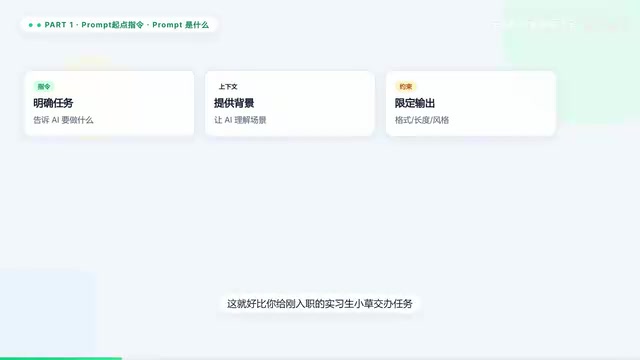
Prompt → MCP → Agent → Skill: The AI Terminology Evolution Chain Explained in 5 Minutes
A clear guide to five core AI concepts — Prompt, MCP, Agent, Skill, and Cowork — and how they connect in a layered evolution chain from simple instructions to multi-agent teamwork.
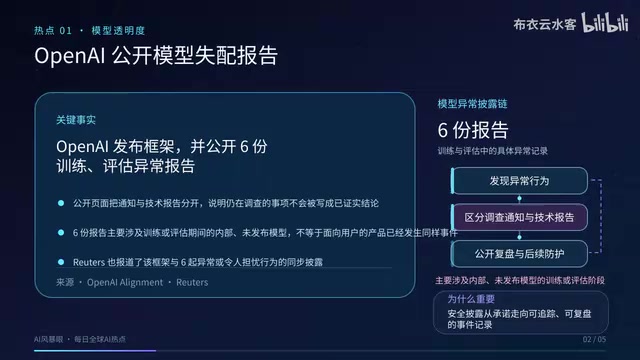
OpenAI Discloses Model Anomalies, DeepMind Launches AGI Forum, NVIDIA Partners on Grid Power Management
Sept 17 AI roundup: OpenAI publishes model anomaly disclosure framework with 6 reports, Google DeepMind launches AGI public forum, NVIDIA leads AI energy management alliance with 18 partners.
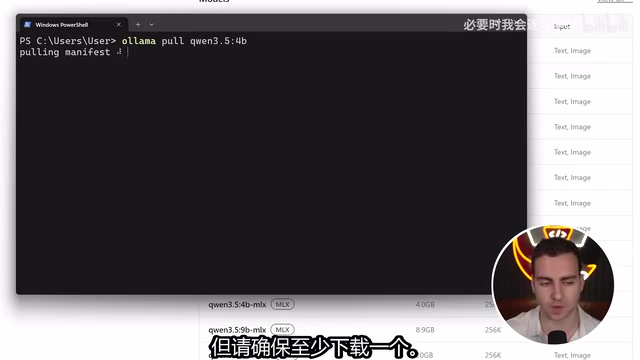
Build a Local AI Agent with Python in 10 Minutes: Ollama + PydanticAI in Action
A hands-on guide to building a fully local AI agent with Python, Ollama, and PydanticAI in 10 minutes — covering model selection, tool functions, and conversation loops.