HN Discussion: What Are the Most Worthwhile AI Skills to Learn Independently?

From an HN question, this distills that AI self-learning should focus on concrete, verifiable skills like prompt engineering, API calls, RAG, and evaluation.
Inspired by a Hacker News question about "the most useful, concrete AI skills to self-learn," the article notes that the question's value lies in shifting self-learners from "should I learn AI" to "what and how to learn." It emphasizes that "concrete" matters more than "trendy" and outlines four actionable directions: prompt engineering and task decomposition, calling model APIs with code, retrieval augmentation and knowledge base construction, and evaluation and debugging. It also analyzes self-learning constraints—information overload and lack of feedback—and recommends active verification and project-driven learning. It concludes that mastering one direction to produce real results beats broad familiarity with many.
A Discussion About Self-Learning AI Skills
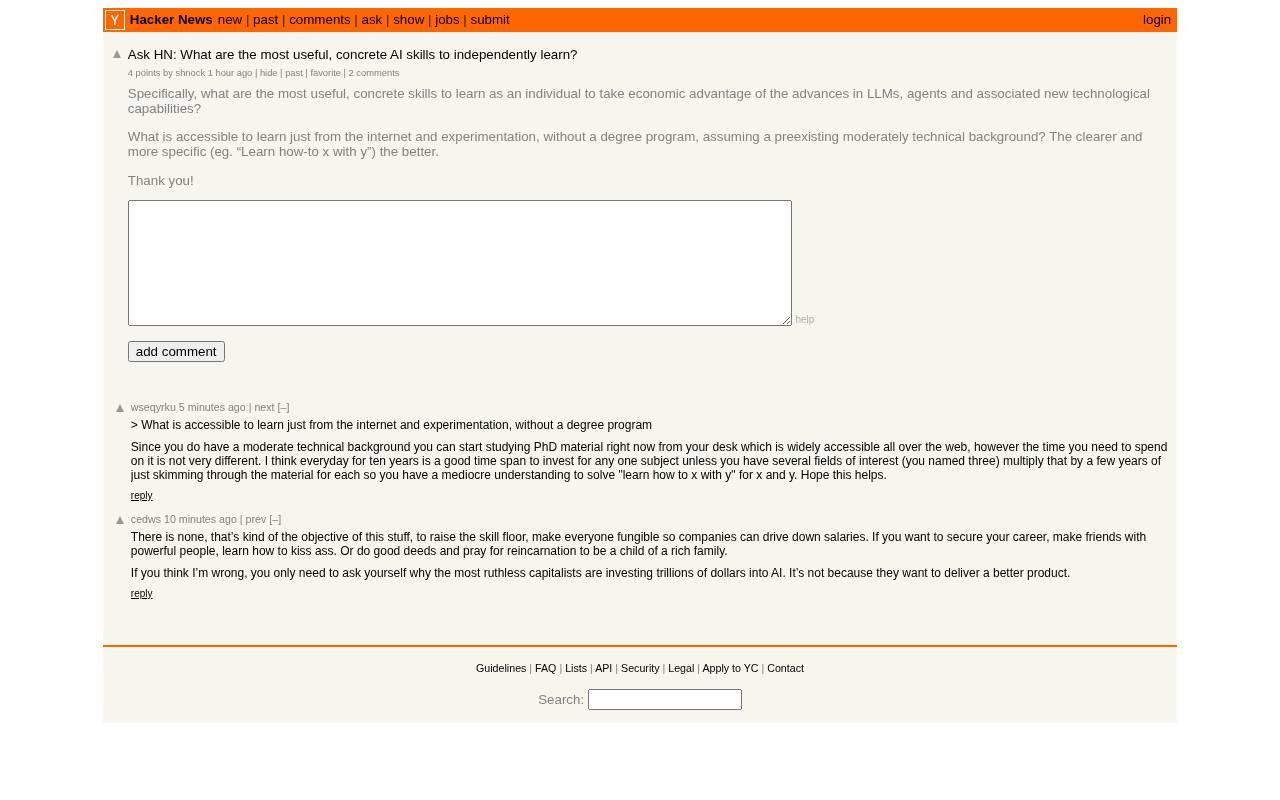
A question appeared on Hacker News: "Ask HN: What are the most useful, concrete AI skills to independently learn?" The post itself only had 4 points and 2 comments—a small discussion—yet it raises a practical question many technical professionals are currently facing: when AI tools are everywhere, which capabilities are truly worth investing time to master?
The value of this question isn't in a unique answer, but in how it pushes self-learners from "should I learn AI" to "what should I learn, and how." In an environment of information overload, the time cost of choosing the wrong direction often exceeds the cost of learning itself.
Why "Concrete" Matters More Than "Trendy"
The asker specifically emphasized the qualifiers "useful" and "concrete," which is itself a valuable filtering framework. Concepts in AI update extremely quickly—new frameworks, models, and terminology emerge every year—but few skills truly settle into personal capability.
From the general patterns of technical self-learning, concrete skills usually have three characteristics: a clear practice path, verifiable output results, and a connection to real work scenarios. By contrast, goals like "understanding the principles of large models" are important but difficult to translate directly into actionable daily practice.
It should be noted that the comment section of the original post was limited, so a complete consensus list cannot be extracted from it. This also means any discussion of "the most worthwhile AI skills to learn" needs to be judged in light of broader community practice rather than relying on a single source.
Learning Directions That Can Be Distilled from the Discussion
Although the post itself generated little discussion, the question it points to appears repeatedly in developer communities. Combined with actual usage scenarios of AI tools, several commonly mentioned self-learning directions can be summarized.
Prompt Engineering and Task Decomposition
Breaking complex tasks into steps a model can execute is a foundational skill for using AI tools. This skill doesn't require a deep mathematical background, yet it directly determines output quality. Practice methods include designing different prompts for the same task, comparing result differences, and recording effective patterns.
Prompt Engineering refers to the practice of designing input text (prompts) to guide large language models toward desired outputs. Its core isn't finding "magic spells," but clearly communicating task goals, context, output format, and constraints to the model. Common techniques include zero-shot prompting, few-shot prompting (providing examples), Chain-of-Thought (letting the model show reasoning steps), and self-consistency (sampling multiple times and voting). Task decomposition is an upstream part of prompt engineering: breaking a complex goal into subtasks the model can complete step by step, then designing prompts for each subtask. These two skills usually don't require programming or math backgrounds, but they do require repeated experimentation and documentation to build a reusable pattern library.
Calling Model APIs with Code
There's a clear dividing line between staying in a chat interface and truly integrating a model into a workflow. Learning to call APIs, handle returned results, and implement simple error retries is a key step in turning AI from a "toy" into a "tool."
Model API calls refer to sending requests to model services programmatically and processing responses. Major providers (such as OpenAI, Anthropic, and Google) all offer HTTP APIs. Developers need to handle authentication (API Key), request parameters (such as temperature and max tokens), response parsing, and error handling (such as rate limiting, timeouts, and content filtering). Unlike chat interfaces, API calls allow models to be embedded in automated processes—for example, batch processing documents, building conversational agents, or integrating with other services. When self-learning, it's recommended to start with the official documentation's quickstart, first completing a single call with a script, then gradually adding retry logic, logging, and cost control. This skill is the key threshold distinguishing "AI users" from "AI developers."
Retrieval Augmentation and Knowledge Base Construction
Making models answer questions based on one's own materials is a very common requirement in real projects. This involves document chunking, vectorization, retrieval, and reranking, and each stage has concrete operations that can be practiced independently.
Retrieval-Augmented Generation (RAG) is an architecture that lets models answer questions based on external knowledge bases. A typical pipeline includes: splitting documents into chunks, converting chunks into vectors with an embedding model and storing them in a vector database, retrieving the most relevant chunks at query time, and feeding the chunks as context along with the question into the model to generate an answer. Key stages include chunking strategy (by paragraph, fixed length, or semantics), embedding model selection, similarity retrieval, and reranking. RAG can mitigate model hallucinations and outdated knowledge, and is one of the most common implementation patterns in enterprise AI applications. When self-learning, you can start by building a small question-answering system based on personal notes or public documents, then gradually optimize retrieval quality.
Evaluation and Debugging
Most self-learning paths overlook the evaluation stage. Being able to design test cases, judge whether model outputs are reliable, and locate failure causes is the dividing line between "can use" and "uses well." This skill is often mentioned in community discussions but is rarely practiced systematically.
Evaluation in AI engineering refers to the process of systematically measuring the quality of model outputs. Unlike traditional software testing, AI outputs are probabilistic and open-ended, so evaluation methods combining subjective and objective approaches are needed. Common methods include: building test sets with standard answers, using LLMs as judges (LLM-as-a-Judge), human rating scales, and A/B testing. Debugging involves locating failure causes—whether the prompt is unclear, retrieval is missing, model capability is insufficient, or parameter settings are inappropriate. Effective evaluation requires clear metrics (such as accuracy, relevance, and faithfulness) and repeatable processes. Many teams neglect evaluation early on, leading to blind iteration; incorporating evaluation into the daily development loop is a key step from "works" to "reliable."
Practical Constraints of Self-Learning Paths
The main obstacle to independently learning AI skills isn't a lack of materials, but an excess of them. Tutorials, videos, and open-source projects are numerous, but quality varies widely and there are no unified quality standards.
Another constraint is the lack of feedback. Programming learning can verify correctness by running results, but many AI-related skills lack immediate, clear judgment signals. This requires self-learners to actively design verification mechanisms rather than relying on standard answers given by tutorials.
From historical discussions in technical communities like HN, one repeatedly validated experience is: learning around concrete projects is more effective than learning around concepts. Choosing a real, small problem, using AI tools to solve it, and filling in the needed skills during the process is often closer to the goal of being "useful" than methodically completing courses.
Conclusion
This question post itself is small in scale, but the question it raises deserves serious attention. The key to self-learning AI skills isn't chasing the latest tools, but finding those concrete capabilities that can be practiced, verified, and transferred. For self-learners, practicing one direction until it can produce actual results is more valuable than broadly understanding ten directions.
One-line Summary
Starting from an HN question, this article distills that AI self-learning should focus on concrete, verifiable skills such as prompt engineering, API calls, RAG, and evaluation.
Paragraph Summary
The article is prompted by a Hacker News question post about "the most useful, concrete AI skills to self-learn," noting that the value of the question lies in pushing self-learners from "should I learn AI" to "what to learn and how." The author emphasizes that "concrete" matters more than "trendy" and summarizes four actionable learning directions: prompt engineering and task decomposition, calling model APIs with code, retrieval augmentation and knowledge base construction, and evaluation and debugging. The article also analyzes the practical constraints of self-learning—information overload and lack of feedback—and suggests that self-learners actively design verification mechanisms and learn around concrete projects rather than methodically completing courses. Finally, it points out that practicing one direction until it can produce actual results is more valuable than broadly understanding multiple directions.
Related articles

Snapchat Opens AI Assistant Lens Building: Supports Claude Code and Cursor
Snapchat lets Lens creators describe AR filters in natural language, with AI assistants like Claude Code and Cursor handling the full build process, greatly lowering the AR creation barrier.

Is the Planck Length the Smallest Distance? Why Physicists Are Skeptical
The Planck length is often called the smallest distance in the universe, but science videos point out this claim has never been experimentally confirmed. This article explains the origins of the Planck length, the obstacles of microscope thought experiments, and what it really tells us—the scale at which quantum gravity becomes unavoidable, not spacetime pixels.

AI Agents Drive Spend Management: Payhawk Raises $280M
Payhawk raises $280M at a $2B valuation. The 2018-founded enterprise finance platform uses AI agents to track and manage expenses and procurement. This article analyzes its product evolution, valuation signals, and impact on the spend management space.