Hole Punch: A Physics Puzzle Game Where You Pilot Spaceships with Gravitational Slingshots

Hole Punch is an indie space game that turns real-world gravity slingshot mechanics into orbital puzzles, earning 200+ upvotes on Hacker News.
Hole Punch is an indie space game that translates the gravity slingshot technique — widely used in real spaceflight — into interactive gameplay. Players maneuver spacecraft around gravitational fields by anticipating orbital curves and choosing optimal approach angles, shifting the focus from reaction-based control to strategic planning. This approach to making real physics visual and playable resonated strongly with Hacker News's developer-heavy audience, earning 208 upvotes and 50+ comments. The project reflects sustained community interest in physics-driven game design and carries genuine educational value for orbital mechanics.
A Space Game Built Around Gravity as a Core Mechanic
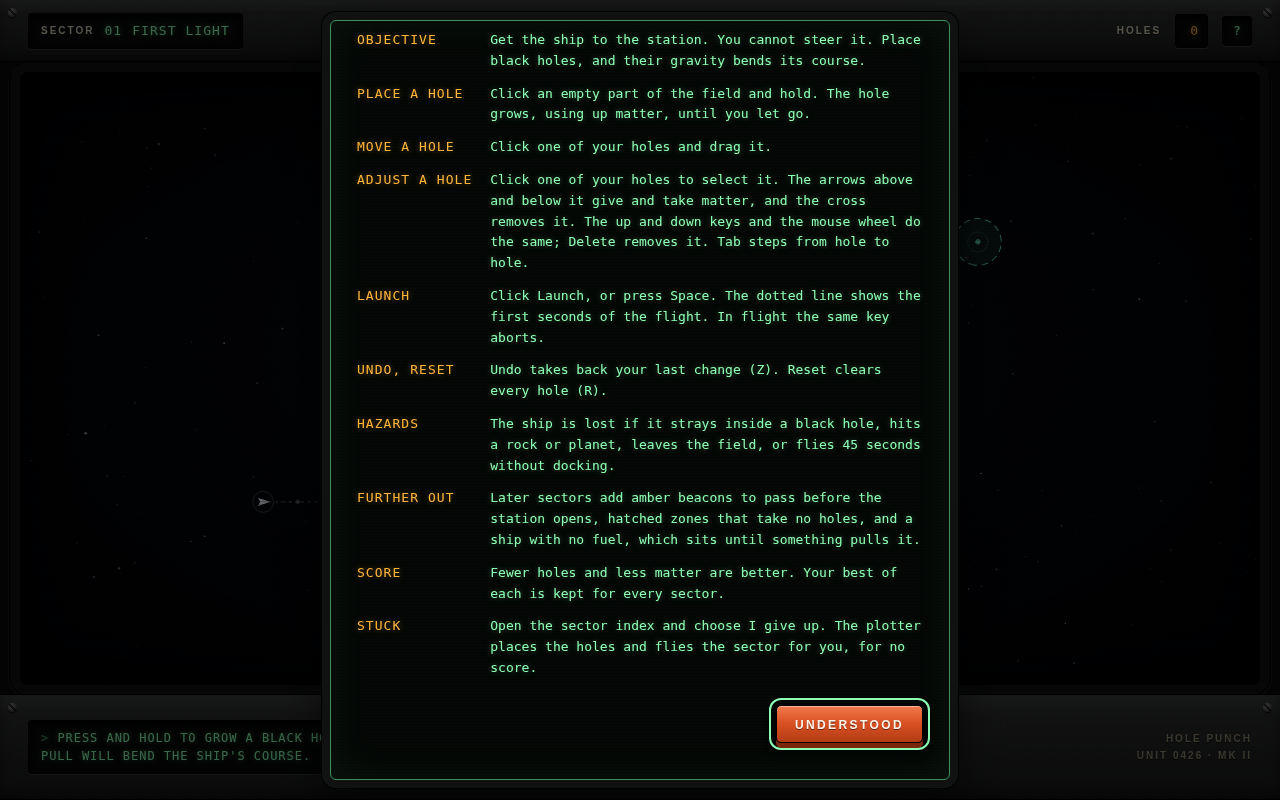
A recent indie game project called Hole Punch surfaced on Hacker News, earning 208 upvotes and over 50 comments after launch. The game's core mechanic is built around a concept that's both classic and genuinely challenging: the gravity slingshot effect. Players must maneuver their spacecraft around various gravitational fields, using the gravity of celestial bodies to alter their heading and velocity.
The project's tagline — "Sling your spaceship around gravitational fields" — makes clear that this isn't about the instant gratification of traditional space shooters. Instead, the focus is on understanding and applying orbital mechanics. That design philosophy gives the game a natural puzzle-and-skill-challenge feel, closer to finding an optimal path within real physical constraints than to twitch-based gameplay.
Gravity Slingshots: From Real Spaceflight to Game Mechanics
The gravity slingshot is a technique widely used in real-world space missions. By passing through a planet's gravitational field, a spacecraft can gain speed or change direction without burning extra fuel — the famous Voyager probes used exactly this principle to visit multiple planets across the outer solar system.
Hole Punch translates this real-world aerospace ingenuity into an interactive experience. Rather than simply pressing arrow keys to move, players must anticipate the continuous effect of gravitational fields on their trajectory, calculating when to approach a body and at what angle to be "flung" toward the desired direction. This mechanic asks players to develop an intuition for acceleration, momentum, and orbital curves, shifting the gameplay from reaction-based control to strategic planning.
Physics-grounded mechanics like these aren't unheard of in the indie game scene, but making complex gravitational interactions feel both intuitive and challenging is a notoriously difficult design problem. Based on community feedback, Hole Punch's approach to this challenge has sparked genuine interest among technically minded audiences.
From a physics standpoint, the gravity slingshot effect (also known as gravitational assist or gravity-assist maneuver) is essentially an elastic collision between a spacecraft and a planet. In the planet's reference frame, the spacecraft enters and exits at the same speed; but switch to the Sun's reference frame, and the spacecraft can gain or lose kinetic energy — how much depends on the planet's orbital velocity and the approach angle. Voyager 2 achieved successive gravity assists from Jupiter, Saturn, Uranus, and Neptune to build up enough velocity to escape the solar system — a feat that would have been impossible with the rocket thrust available at the time. From a game design perspective, the challenge is that gravity is a continuously acting vector force: a ship's trajectory is constantly curving, and players need to think several steps ahead to anticipate the net force direction, rather than responding in real time like in a typical shooter. Games that have attempted realistic orbital mechanics — such as Kerbal Space Program — are notorious for their steep learning curves as a result.
Why Projects Like This Resonate in Tech Communities
Hacker News skews heavily toward developers and technical professionals, who tend to have a natural appreciation for projects that weave scientific principles into interactive design. The 200+ upvotes Hole Punch received reflect a stable audience in tech communities for games that "teach physics through play."
On one level, gravitational simulation involves real-time numerical computation and collision detection — an inherently interesting engineering problem for developers. On another level, making abstract physical concepts visual and playable carries genuine educational value, giving players an intuitive feel for how orbital mechanics work through the act of playing.
It's worth noting that the publicly available information is fairly limited, consisting mainly of a brief project description and a community discussion thread. Details about specific level design, control schemes, and the technical stack will require a visit to the project's main page.
From an engineering implementation perspective, real-time gravitational simulation typically relies on numerical integration methods to update a spacecraft's state frame by frame. Common approaches include the Euler method (simple, but error accumulates quickly) and the more accurate fourth-order Runge-Kutta method (RK4), which maintains trajectory stability at larger time steps and is the go-to choice for simulating multi-body gravity in indie games. When multiple gravitational sources are present, developers also need to handle Sphere of Influence (SOI) switching logic — the same simplified model Kerbal Space Program uses to reduce the computational complexity of the N-body problem. For developers, balancing physical accuracy against frame-rate overhead is itself a compelling systems design challenge, and that's a big part of why projects like this tend to generate meaningful technical discussion on Hacker News.
Takeaway
Hole Punch is a space-themed game built around the gravity slingshot mechanic, translating real-world orbital mechanics into interactive gameplay that rewards thinking and planning. The attention it has received on Hacker News reflects the tech community's ongoing interest in physics-driven, educational indie games. For players who enjoy physics puzzles or space themes, it's a niche project well worth checking out.
Related articles

When Did Paid Childcare Become the Norm? Working Mothers and the Evolution of Childcare
When did paid childcare become the norm? This article traces the evolution from the rise of childcare centers in the 1970s–80s and the 1990s linking of federal subsidies to work requirements, to declining stigma and rising costs, and explores advocates' 25-year effort to catch up with other countries on childcare and paid parental leave.

Red Flags for Product-Market Fit: A Practical Guide from Top VCs and the Superhuman Founder
Investors from Iconiq and Sapphire Ventures and Superhuman founder Rahul Vohra share PMF red flags and practical methods, including the 40% disappointment rule, retention curves, and acquisition costs.

What Task Should AI Agents Take Over Most? Heated Reddit Discussion
Reddit discussion: Which task do you most want AI agents to take over completely? Cross-app data migration, CRM updates, and report generation top the list, but insufficient reliability and the trust gap are the biggest obstacles to automation adoption.