HomePod Mini 2 New Colors Overview: S10 Chip Powers Siri AI

Apple's HomePod Mini 2 debuts with new colors and the S10 chip, laying the hardware groundwork for Siri AI.
Apple has officially launched the HomePod Mini 2, with the main changes centered on exterior colors and the chip. It offers multiple new colorways, continuing the strategy of appealing to younger buyers through color. The core upgrade is the S10 chip, which provides the compute foundation for Siri AI, but the new AI features will be rolled out gradually through future system updates — a "hardware first, software later" approach. It also adds sound glow to express the device's working state via light and enhance interaction. Overall, it's a steady iteration that boosts compute reserves and visual appeal.
Apple's HomePod Mini 2 has officially arrived, bringing a fresh color lineup and an upgraded S10 chip to the second-generation smart speaker. From the outside in, the HomePod Mini 2 is trying to answer one question: in an era of white-hot smart home competition, what new story can Apple's small speaker still tell?
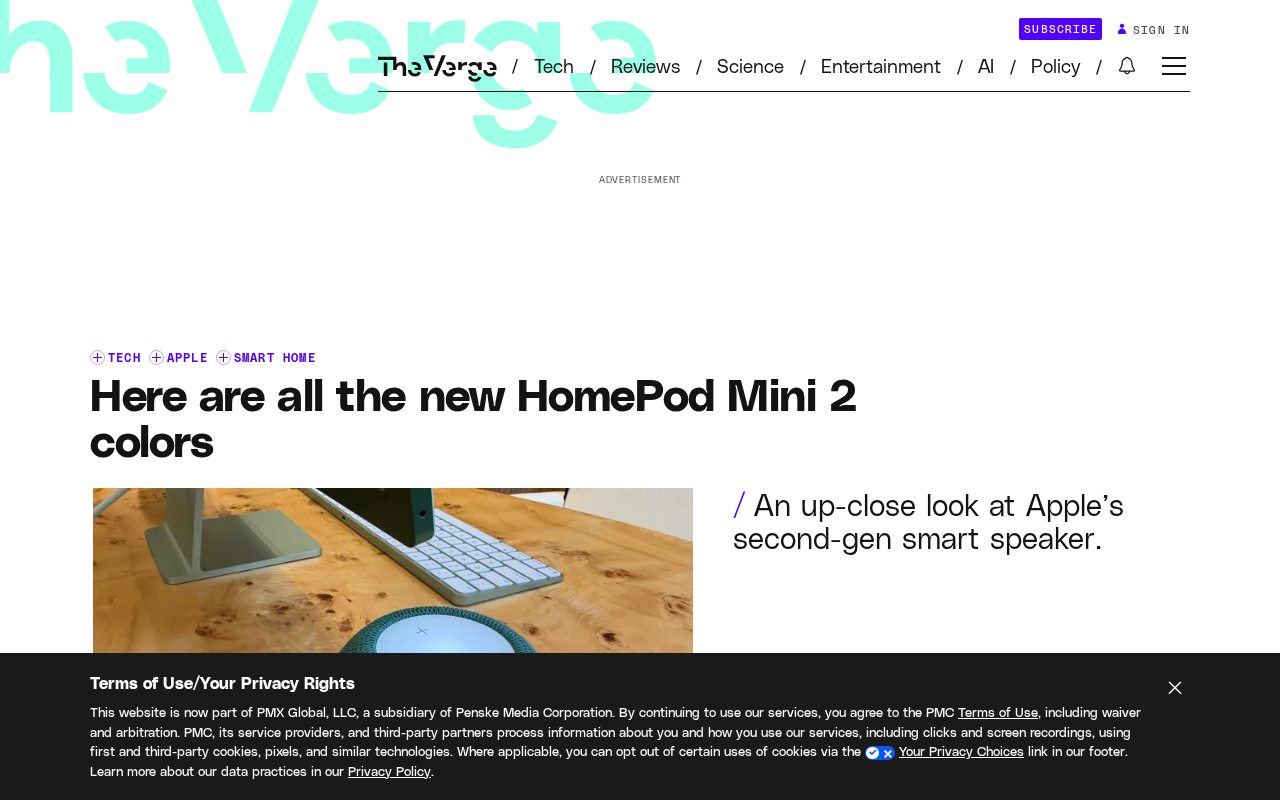
New Color Options: Color as the First Selling Point
The exterior is the most immediately noticeable change in the HomePod Mini 2. Apple has prepared a range of new colorways for the product, continuing the original HomePod Mini's strategy of using color to appeal to a younger market. For a compact device that typically sits on a desk, nightstand, or kitchen counter, color is itself a major part of the purchase decision.
In person, these new colors make the HomePod Mini 2 feel more like a home decoration than a plain electronic device. Apple clearly understands that the homogenized competition among smart speakers long ago spread from audio specs to aesthetic appeal — after all, among the many competitors, not many products are instantly recognizable and worth displaying.
S10 Chip: Laying the Groundwork for Siri AI
The core upgrade of the HomePod Mini 2 is its S10 chip. This chip provides the compute foundation needed to run Siri AI, but one key detail stands out: Apple says support for the new AI features will be rolled out gradually through future system updates.
This means that when users first get their hands on it, the HomePod Mini 2's AI capabilities won't be fully unlocked right away. This "hardware first, software later" approach is not unusual in Apple's product line — the chip is in place ahead of time, waiting for a system update to unlock the full experience. For users who care about AI features, this is a check that requires patience to cash.
From a chip-selection perspective, putting the S10 into a small speaker shows that Apple has a clear hardware plan for transforming Siri with AI. As the voice gateway to the home, a smart speaker's AI experience directly determines user stickiness, and the addition of the S10 can be seen as Apple upping the ante in this direction.
The S10 chip is a SiP (System in Package) chip that Apple first debuted on the Apple Watch Series 10. Its architecture shares roots with the iPhone's A-series chips but has been specifically optimized for the power consumption, heat, and size constraints of wearables and small devices. Unlike phone chips, this kind of SiP packs the CPU, GPU, neural engine, memory, and wireless modules into an extremely small space, making it well suited to devices like the HomePod Mini that lack active cooling and are size-constrained.
For smart speakers, the significance of the chip lies mainly in on-device AI capabilities. The Neural Engine allows voice wake, sound source localization, noise reduction, and some natural language processing to be handled locally rather than entirely uploaded to the cloud. This both reduces response latency and lowers the risk of privacy exposure. Putting the S10 into the HomePod Mini 2 means Apple has reserved local compute for more complex Siri AI features down the road, rather than relying solely on servers.
Sound Glow and Hardware Details
Beyond the colors and the chip, the HomePod Mini 2 also offers a sound glow feature. This kind of visual feedback is increasingly common on smart speakers: it expresses the state of "the speaker is working" through light, enhancing the sense of interaction and giving the device more presence while playing.
Overall, the HomePod Mini 2's hardware updates center on two areas — the chip and the exterior — making it a steady, incremental iteration. Apple has not made radical changes to the product's form, but rather upgraded its compute reserves and visual appeal within the existing framework.
Sound glow can be understood as a feedback mechanism that visualizes audio status: the device responds through changes in the light effect on the top touch area based on volume, rhythm, or the interaction state of the voice assistant. Its value lies not in audio quality itself, but in compensating for the inherent shortcoming of smart speakers — the lack of a screen.
On a screenless device, users have a hard time telling whether the speaker heard a command, is processing it, or what volume level it's at. Light feedback becomes the most direct form of status language, similar to a router's indicator light or a game controller's breathing light. Apple has previously used a colored halo on top of the HomePod to express Siri's working state, and sound glow can be seen as a continuation and expansion of that design language, giving the device more ambiance while playing music while also serving as an interaction cue.
What This Upgrade Means
The launch of the HomePod Mini 2 reveals two judgments Apple is making in the smart speaker race. First, hardware must reserve room for AI — the addition of the S10 chip shows that Siri's AI capabilities are highly anticipated, though the pace of delivery depends on software updates. Second, appearance remains an important competitive dimension for small smart speakers, and the new colors are a direct response to that judgment.
For users already within the Apple ecosystem, the HomePod Mini 2 is a low-barrier entry device; for those on the fence, whether it can win them over with future Siri AI updates still depends on how much substance Apple delivers at the software level. The hardware is in place — now it's time for the software to deliver.
From a product cadence perspective, the HomePod Mini 2 is a classic "mid-cycle refresh": it retains the original's form factor and acoustic structure while swapping in a new chip and expanding the color options. Apple has consistently taken a relatively conservative iteration strategy with smart speakers, because this category has a long replacement cycle and users are less sensitive to audio upgrades than dependent on ecosystem integration.
"Hardware first, software later" is also consistent with Apple's overall AI strategy in recent years. Apple tends to lay the compute foundation on-device first and then gradually unlock features through system versions — Apple Intelligence is advancing on exactly this cadence. For users, this means the actual experience at launch may lag behind the marketing; for Apple, it ensures device coverage by the time AI features go live and avoids the awkwardness of "software waiting for hardware."
One-line Summary
Apple's HomePod Mini 2 debuts with new colors and the S10 chip, laying the hardware groundwork for Siri AI.
Paragraph Summary
Apple has officially launched the HomePod Mini 2, with the main changes centered on exterior colors and the chip. The new product offers multiple new colorways, continuing the strategy of appealing to a younger market through color and making the device feel more like home decor. The core upgrade is the S10 chip, which provides the compute foundation for Siri AI, but the new AI features will be rolled out gradually through future system updates — a "hardware first, software later" cadence. It also adds sound glow, using light to express the device's working state and enhance the sense of interaction. Overall, this is a steady, incremental iteration: Apple made no radical changes to the form, instead boosting compute reserves and visual appeal. For ecosystem users, it's a low-barrier entry device; whether it can win over fence-sitters with Siri AI still depends on delivery at the software level.
Related articles

Amphibious Transforming Drone: Beyond 100x Power Savings, What Are the Real Needs?
Is the amphibious transforming drone just a gimmick? Starting from the 100x power difference of the M4 Morphobot, explore real application scenarios and thesis topic ideas, analyzing boundary conditions where pure drones and pure ground robots both fail.

Warhound Raises $200 Million: Genetically Engineered "War Dogs" Paired with Anduril Gear
Warhound raises $200M, backed by Ben Lamm and Palmer Luckey, to genetically engineer dogs for military and law enforcement use and equip them with Anduril gear. This article analyzes its technology direction, funding logic, and ethical controversy.

Claude API Comes to Google Cloud: IAM Integration and SDK Access Guide
Anthropic hosts the full Claude API on Google Cloud with IAM-controlled permissions and unified billing. This guide covers the Vertex AI and Anthropic-hosted entry points, IAM role configuration, and SDK access.