HouseSpaceAI: Upload 2D Floor Plans, AI Automatically Generates Interior Design Schemes
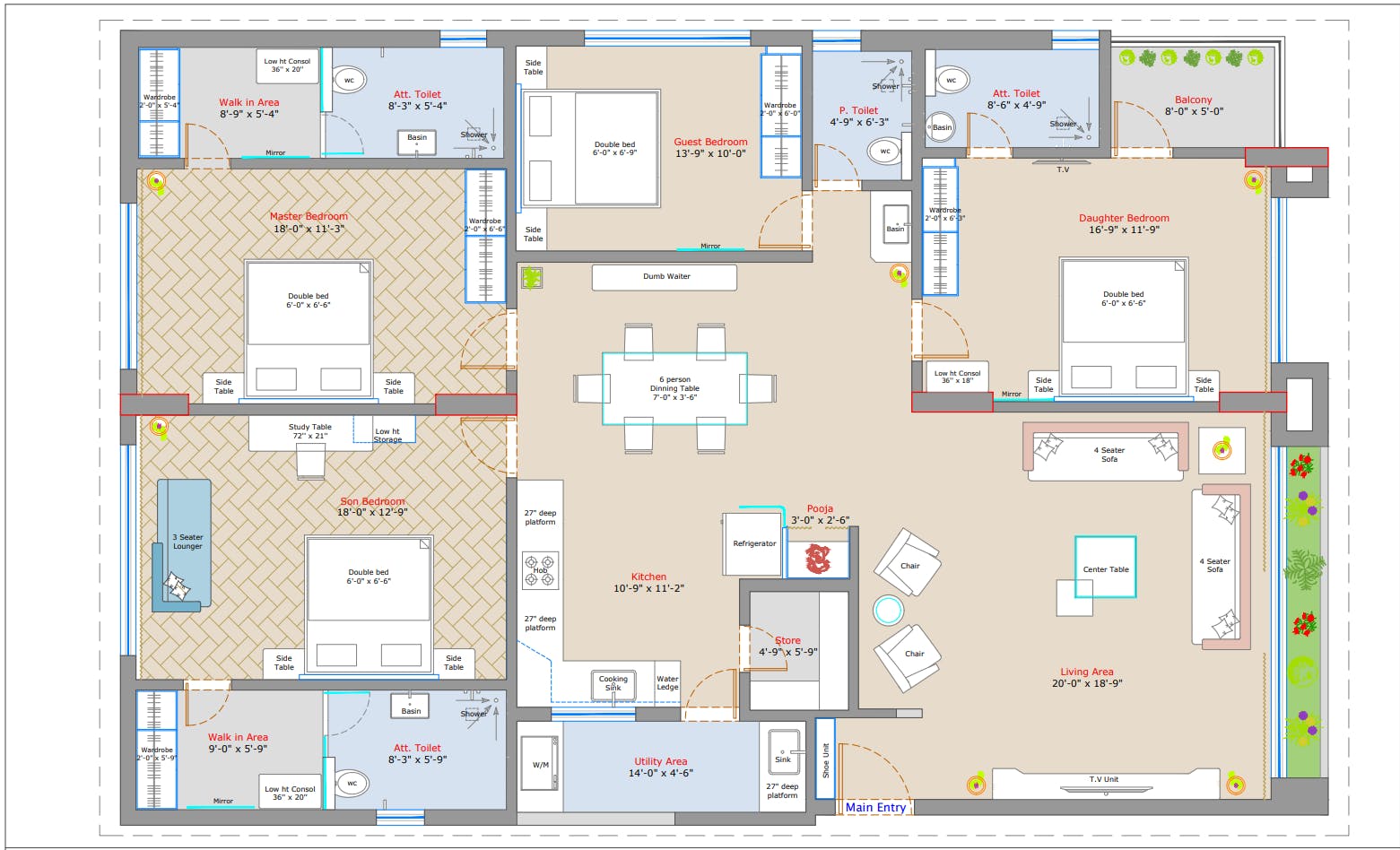
AI tool transforms 2D floor plans into complete interior design schemes within minutes using Agent technology.
HouseSpaceAI leverages generative AI to democratize interior design by accepting simple 2D floor plans or hand-drawn sketches as input and generating complete design schemes through AI Agents. Unlike traditional 3D modeling tools requiring technical expertise, it lowers barriers dramatically while maintaining multi-step reasoning capabilities that simulate professional designer workflows. The platform shows potential for AR preview integration and addresses real market demand, though challenges remain in ensuring professional usability, compliance with building codes, and practical implementation value.
The AI Leap from Floor Plans to Your Dream Home
Interior design has always been a field with high professional barriers and significant communication costs. Ordinary users often struggle to translate their mental visions into visualized design schemes, while hiring professional designers means substantial fees and lengthy communication cycles. Recently launched on Product Hunt, HouseSpaceAI aims to break down these barriers using generative AI—users simply provide a 2D floor plan or simple hand-drawn sketch, and the AI Agent can complete an ideal interior design scheme within minutes.
Product Hunt's Unique Value as a Product Launch Platform: Product Hunt is the world's largest new product discovery community, showcasing dozens of newly released tech products, apps, and services daily. It uses a 'daily leaderboard' mechanism where product visibility is determined by user upvotes, making it a crucial channel for startups to acquire early users and media attention. The platform's users primarily consist of tech professionals, investors, and early adopters with high acceptance of new technologies. Launching on Product Hunt requires preparation of: 1) an attractive product tagline; 2) demo videos or GIFs; 3) detailed product descriptions; 4) founders personally responding to comments. A successful Product Hunt launch can bring thousands of website visits, hundreds of registered users, and even attract investor attention. For AI applications like HouseSpaceAI, Product Hunt is an ideal testing ground for validating Product-Market Fit, with user feedback quickly exposing usability issues and demand blind spots.
The product, created by Kunal Lunia, has already garnered attention and feedback from early users on Product Hunt. Its tags span Artificial Intelligence, Augmented Reality, GitHub, and Interior Design, reflecting the creator's ambition to integrate AI, AR, and open-source ecosystems into interior design scenarios.
HouseSpaceAI's Core Approach: Driving AI Design with 2D Input
Dramatically Lowering the Barrier to Interior Design Input
The most noteworthy aspect of HouseSpaceAI is its extreme simplification of input format. Traditional 3D home modeling tools (like SketchUp, Kujiale, etc.) typically require users to master certain modeling skills or at least be familiar with the software's interaction logic.
Technical Barriers of Traditional 3D Tools: Traditional interior design software like SketchUp, Kujiale, and Sanweijia are based on parametric modeling technology, requiring users to manually create walls, place furniture, and adjust material textures. SketchUp uses Push-Pull Modeling, requiring users to understand three-dimensional coordinate systems; while Chinese cloud design platforms like Kujiale simplify operations, users still need to accurately draw floor plans in 2D before switching to 3D views for detail adjustments. These tools typically have a learning curve of several hours to days, making the cost prohibitive for ordinary users who simply want to quickly preview renovation effects. More critically, these tools are WYSIWYG editors—users must clearly know what they want, while users lacking design experience often fall into the predicament of 'not knowing where to start.'
HouseSpaceAI lowers the barrier to "a floor plan" or "a hand-drawn sketch"—the lowest-cost materials that almost all home buyers can provide. By hiding the modeling process in an AI black box, HouseSpaceAI transforms the user's role from 'design executor' to 'requirement provider,' a fundamental shift in interaction paradigm.
This design philosophy aligns with an important trend in generative AI's application to interior design: exchanging the most natural, lowest-cost input for high-quality structured design output. Users no longer need to precisely drag walls and place furniture, but instead hand over the heavy lifting of spatial reasoning and aesthetic decisions to the AI Agent.
Technical Foundation of Generative AI: Generative AI refers to artificial intelligence systems capable of creating new content, including text, images, audio, and other forms. In interior design, generative AI primarily relies on two core technologies: first, image generation technology based on Diffusion Models, such as Stable Diffusion and DALL-E, which can generate high-quality interior renderings based on text descriptions or reference images; second, multimodal understanding models based on Transformer architecture, capable of parsing spatial structures in floor plans and identifying functional zones. These technological breakthroughs enable AI to go beyond simple image filters to understanding spatial relationships, following design rules, and generating furniture layout schemes that conform to ergonomics. Since 2023, with the maturation of multimodal large models like GPT-4V and Claude, AI's ability to understand architectural drawings has significantly improved, laying the technical foundation for applications like HouseSpaceAI.
The Role of AI Agents in Interior Design
The product description emphasizes using "AI Agents" to complete designs, meaning it's likely not just a single-generation image model, but an intelligent agent with multi-step reasoning capabilities: first parsing the spatial layout in floor plans, then generating furniture placement, color schemes, and even style recommendations based on floor plan characteristics. Compared to traditional "text-to-image" modes, the Agent-based process more closely resembles a real designer's workflow—understanding spatial constraints, iterating design schemes, and delivering executable results.
How AI Agents Work: AI Agents (intelligent agents) are AI systems with autonomous planning, multi-step reasoning, and tool-calling capabilities, distinct from traditional single input-output models. In interior design scenarios, a typical AI Agent workflow includes: 1) Perception phase—parsing floor plans to identify walls, doors, windows, load-bearing structures, etc.; 2) Planning phase—generating design strategies based on room dimensions, lighting conditions, and user requirements; 3) Execution phase—calling furniture libraries and material libraries to generate specific schemes; 4) Evaluation phase—checking whether designs comply with ergonomic and fire safety constraints; 5) Iterative optimization—adjusting schemes based on feedback. This Agent-based design process simulates human designer thinking. Compared to directly generating renderings with Stable Diffusion, Agents can ensure the implementability and professionalism of generated results. Current mainstream Agent frameworks like LangChain and AutoGPT have been applied to such vertical scenarios.
HouseSpaceAI's Application Scenarios and Potential Value
For ordinary consumers, HouseSpaceAI's core value lies in rapidly visualizing interior design schemes. During home purchase or renovation decision-making phases, users often need to evaluate multiple layout and style possibilities within limited time. An AI tool that can generate multiple design schemes based on your own floor plan within minutes can significantly shorten the "imagine-validate" decision cycle.
Combined with its Augmented Reality tag, one can infer that the product may introduce AR preview functionality in the future, allowing users to "see" AI-generated interior design effects in real space. For decision-making scenarios like interior design that heavily depend on spatial perception, this is a naturally fitting direction.
AR Technology Applications in Interior Design: Augmented Reality (AR) technology allows users to "see" what their future home will look like before purchasing or renovating by overlaying virtual objects on real environments. Apple's ARKit and Google's ARCore provide mobile AR development frameworks, and applications like IKEA Place and Home Depot's Project Color have validated AR's feasibility in home furnishing scenarios. Users scan rooms with their phone cameras, the application automatically identifies floors, walls, and other planes, then can virtually place furniture and change wall colors to view effects in real-time. Combined with AI-generated design schemes, AR can solve the pain point of 'renderings look beautiful but uncertain about actual effects.' Technical challenges include: 1) fusion of virtual objects with real lighting (requires real-time rendering); 2) spatial positioning accuracy (millimeter-level errors lead to unreasonable furniture placement); 3) continuity of multi-room navigation. If HouseSpaceAI can integrate AI design with AR preview, it will form a complete closed loop of 'input floor plan → AI generates scheme → AR real-world validation.'
Additionally, the GitHub tag's appearance suggests the project may have some open-source attributes, or at least be open to the developer community. This is a signal worth noting for teams hoping to integrate AI interior design capabilities into their own applications.
A Sober Perspective: The Realistic Boundaries of Early-Stage AI Design Products
As a product in its early stages, HouseSpaceAI still has many aspects requiring validation.
First, the reliability of going from 2D drawings to high-quality design schemes is a core challenge—the ambiguity of hand-drawn sketches and scale errors in floor plans can all affect AI's precision in understanding space.
Second, whether generated results can truly meet the actual needs of construction and furniture procurement, rather than merely remaining at the level of "beautiful renderings," will determine whether it's a fun toy or a genuine productivity tool.
Professional Constraints Faced by AI Design: Truly implementable interior design must satisfy multiple professional constraints: 1) Building codes—load-bearing walls cannot be modified, bathrooms require waterproofing layers, gas pipes cannot be sealed, etc.; 2) Ergonomics—cabinet heights must match user height, corridor widths must be at least 80cm, beds need activity space beside them; 3) Fire safety—each room needs evacuation routes, electrical loads cannot exceed standards; 4) Cost control—material budgets, construction timelines, and other economic constraints. Current AI image generation models excel at creating visual aesthetics but often ignore these hard constraints, generating schemes that 'look beautiful but cannot be constructed.' For example, AI might place a refrigerator 3 meters from the sink (violating kitchen workflow) or design a bedroom without windows (violating lighting requirements). To make AI design truly usable, rule engines or constraint solvers need to be introduced into the generation process, which is the core technical difficulty of current AI home furnishing applications. Some companies adopt a hybrid model of 'AI generates drafts + professional designer review' to balance efficiency and quality.
For such vertical AI applications, the true competitive moat often lies not in "being able to generate design drawings," but in the professional usability of generated results and the completeness of design workflows.
Conclusion: The Future of AI Interior Design Tools Is Worth Anticipating
HouseSpaceAI represents a typical case of generative AI penetrating the interior design industry: encapsulating complex professional design capabilities into minimalist user input, with AI Agents handling the intermediate reasoning and creation. The direction of democratizing interior design that it targets has genuine market demand, but the product's ultimate success or failure still depends on the stability of generation quality and practical landing value. For practitioners focused on AI application implementation and ordinary renovation users, HouseSpaceAI is an early-stage project worth continued attention.
Key Takeaways
- Input Barrier Revolution: From traditional 3D modeling tools (requiring mastery of parametric modeling techniques in software like SketchUp) down to just a floor plan or hand-drawn sketch, leveraging AI black boxes to handle complex spatial reasoning
- AI Agent Multi-Step Reasoning: Unlike single text-to-image models, Agents simulate human designer workflows through perception → planning → execution → evaluation processes, implementing tool calling through frameworks like LangChain
- AR Preview Potential: Combined with mobile AR frameworks like ARKit/ARCore, can form a complete closed loop of 'floor plan input → AI design → AR real-world validation,' bridging the perception gap between renderings and actual implementation
- Professional Constraint Challenges: Truly implementable designs must satisfy hard constraints like building codes, ergonomics, and fire safety; current AI image generation models easily ignore these rules and need constraint solvers
- Product Hunt Validation: As an early validation platform for tech products, can rapidly obtain feedback from technical users, expose product usability issues, and is an ideal testing ground for validating Product-Market Fit
Related articles

AI Large Model Interview Trends: 625 Real Post-Interview Reviews Reveal Core Focus Areas
Based on real data from 1,700+ students and 625 interview reviews, discover what AI large model interviewers focus on: multi-Agent architecture, deep fundamentals, and enterprise project experience.

Nathan Fielder Documentary Focuses on Elizabeth Holmes and the Theranos Scandal
Comedy director Nathan Fielder premieres documentary You Can See Everything at Telluride, offering a unique perspective on Elizabeth Holmes and the Theranos fraud scandal, exploring Silicon Valley's startup mythology and the boundaries of deception.
Multi-Model Multi-Machine Orchestration: Deep Dive into Unified AI Scheduling Architecture
In-depth analysis of multi-agent orchestration architecture: building unified AI scheduling with ACP, MCP, git worktree to achieve local model execution + cloud model review collaboration, with minimum viable loop validation and key risk analysis.