How Agentic AI Bridges Knowledge Silos in EU Water Projects

A paper proposes an Agentic AI ecosystem using dual-domain water and climate embedding models plus a ReAct controller to consolidate EU project documents, with a 26.7% relative improvement in retrieval MRR.
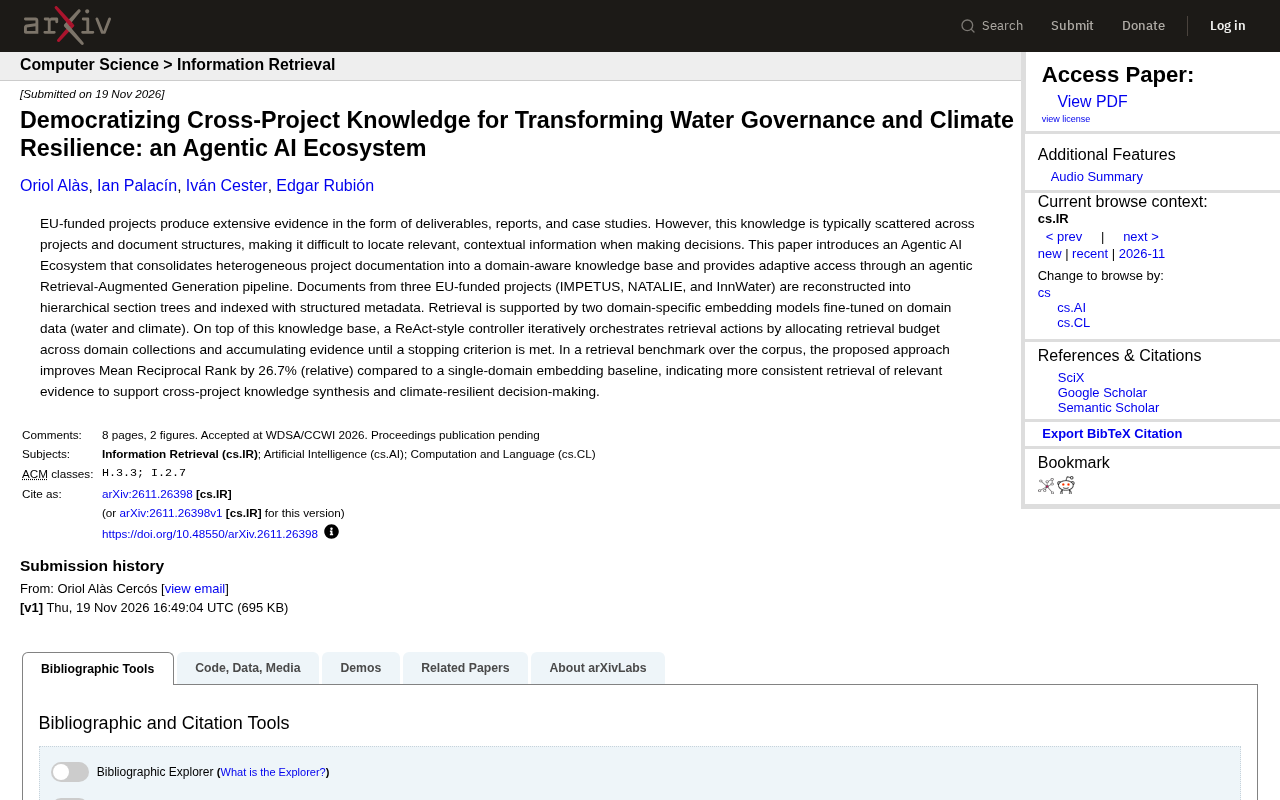
To address the fragmentation of EU-funded project documents and the difficulty of cross-project knowledge synthesis, a new paper proposes an Agentic AI ecosystem: it restructures documents from the IMPETUS, NATALIE, and InnWater projects into hierarchical section trees with structured metadata indexes, building a domain-aware knowledge base. The system uses two embedding models fine-tuned on water and climate domains respectively, paired with a ReAct-style controller that iteratively orchestrates retrieval actions, allocates retrieval budgets, and accumulates evidence. Retrieval benchmark tests show a 26.7% relative improvement in Mean Reciprocal Rank (MRR) over single-domain embedding baselines. The paper argues that this architecture not only improves retrieval efficiency but also transforms fragmented project knowledge into queryable, traceable knowledge assets, with practical significance for water governance and climate resilience decision-making; however, embedding model details and stopping conditions are not disclosed, and generalization ability remains to be verified.
EU-funded research projects produce a steady stream of deliverables, reports, and case studies each year, yet this knowledge is often scattered across projects and document structures, making it difficult for decision-makers to quickly locate relevant, contextualized information when they need it. A new paper proposes an Agentic AI ecosystem that attempts to consolidate heterogeneous project documents into a domain-aware knowledge base and provide adaptive access through an agentic Retrieval-Augmented Generation (RAG) pipeline. This approach deserves attention in water governance and climate resilience, fields long plagued by knowledge fragmentation.
Knowledge Silos: A Common Dilemma in EU Project Documentation
The paper notes that while EU-funded projects have accumulated rich evidence, knowledge is typically dispersed across projects and within document structures. This fragmentation has two direct consequences: cross-project synthesis is difficult to achieve, and in decision-making scenarios, it is hard to quickly retrieve contextualized, relevant information. Water governance and climate resilience decisions often require synthesizing research findings from multiple projects, but traditional keyword search or single-domain embedding models struggle to reliably recall relevant evidence across heterogeneous document collections.
The root of this problem lies in the heterogeneity of document structures and the diversity of domain terminology. Deliverables from different projects vary in chapter organization, metadata standards, and terminology usage, and simply concatenating documents does not produce a usable knowledge base. The paper takes a document-structure reconstruction approach, restructuring documents from three EU projects—IMPETUS, NATALIE, and InnWater—into hierarchical section trees and building a structured metadata index for them.
Retrieval-Augmented Generation (RAG) is a technical architecture that combines external knowledge retrieval with large language model generation. Traditional large language models have knowledge fixed in their training parameters and struggle to cover the latest or private documents in specific domains; RAG retrieves relevant snippets from an external knowledge base before generation and injects the retrieval results as context into the prompt, enabling the model to answer based on real-time, traceable documents. The core advantages of RAG are reducing hallucinations, supporting knowledge updates, and providing citation sources. The "agentic RAG pipeline" proposed in the paper introduces agent orchestration on top of standard RAG, so that retrieval is no longer a single-round fixed process but rather a controller dynamically plans multi-step retrieval actions based on the query—better suited to heterogeneous, cross-domain EU project document collections.
Dual-Domain Embedding Models and the Agentic RAG Pipeline
Building on the knowledge base, the paper designs two key technical components. The first is two domain-specific embedding models, fine-tuned on water and climate domain data respectively, to support retrieval. The second is a ReAct-style controller that iteratively orchestrates retrieval actions, allocates retrieval budgets across domain collections, and accumulates evidence until a stopping condition is met.
The core logic of this design is that a single embedding model struggles to cover the semantic spaces of both water and climate domains simultaneously, while the ReAct controller allows the system to dynamically decide, based on the query, which domain collection to invest more retrieval resources in. Compared with static retrieval pipelines, this agentic orchestration is closer to how human experts approach retrieval on cross-domain questions—first probing broadly, then focusing to accumulate evidence.
Embedding Model refers to a class of neural network models that map text into dense vectors, so that semantically similar texts are closer in vector space. In Retrieval-Augmented Generation (RAG) systems, embedding models are responsible for generating vector representations for both the document library and user queries, then recalling relevant document snippets through similarity computation (such as cosine similarity). Domain-specific embedding models are additionally fine-tuned on corpus from a particular professional domain, making their vector space better align with the terminology and expression conventions of that domain. For example, terms such as "flood peak" and "runoff coefficient" in the water domain may not align precisely with relevant documents in general-purpose embedding models, and domain fine-tuning can significantly improve this. The paper uses two domain embedding models to cover the semantic spaces of water and climate respectively, precisely to mitigate semantic drift and insufficient recall of a single general-purpose model in cross-domain retrieval.
ReAct is an agent framework that interleaves reasoning and acting, originally proposed by Yao et al. in 2022. In the ReAct paradigm, the large language model alternates between generating "Thought" and "Action," where actions can be external operations such as calling retrieval tools or querying databases, and the model continues reasoning based on the returned Observation until reaching a final answer. The ReAct-style controller in the paper accordingly iteratively orchestrates retrieval actions, dynamically deciding which domain collection to allocate retrieval budget to, and accumulating evidence until a stopping condition is met. This design makes the retrieval process no longer a single static query but an agent behavior with multi-step planning and adaptive adjustment capabilities.
Retrieval Benchmark: 26.7% Relative Improvement in MRR
The paper conducted retrieval benchmark tests on the corpus, and the results show that the proposed method's Mean Reciprocal Rank improved by 26.7% relative to single-domain embedding baselines. This improvement indicates that the system can more reliably recall relevant evidence, thereby supporting cross-project knowledge synthesis and climate resilience decision-making.
It should be noted that 26.7% is a relative improvement rather than an absolute one, and the paper's abstract does not provide the baseline's absolute MRR value. However, this relative improvement has practical significance in retrieval tasks, especially on cross-project, cross-domain document collections, where improved ranking quality directly affects whether decision-makers can find key evidence within limited time.
Mean Reciprocal Rank (MRR) is a ranking quality metric commonly used in information retrieval. For each query, the system returns a ranked list, and MRR takes the reciprocal of the rank of the first relevant document (e.g., 1 if ranked first, 1/3 if ranked third), then averages across all queries. A higher MRR means relevant documents more often appear at the top of the result list. In decision-support scenarios, an improvement in MRR means decision-makers are more likely to see key evidence on the first screen of retrieval results, reducing information screening costs. Note that MRR only focuses on the position of the first relevant result and does not evaluate the recall completeness of subsequent relevant documents, so it is usually used in conjunction with other metrics (such as Recall@k, nDCG). The paper reports a 26.7% relative improvement, meaning the new method's MRR is about a quarter higher than the baseline, but the baseline absolute value is not disclosed, and the actual ranking quality still needs to be evaluated with the full paper.
Implications for Water Governance and Climate Resilience Decision-Making
Water governance and climate resilience decisions typically involve comprehensive judgment of multi-source evidence, from project reports to case studies, and decision-makers need to weigh information at different scales. The value of the Agentic AI ecosystem lies not only in retrieval efficiency but also in transforming dispersed project knowledge into queryable, traceable knowledge assets. Hierarchical section trees and structured metadata allow retrieval results to retain document context, while the ReAct controller's evidence accumulation mechanism helps form interpretable retrieval trajectories.
From a broader perspective, this work demonstrates the potential of Agentic AI in scientific research knowledge management: not simply using large models to generate answers, but achieving adaptive evidence collection on heterogeneous knowledge bases through agent-orchestrated retrieval actions. For researchers interested in AI applications and open-source tools, its architectural approach—domain embedding models plus a ReAct controller—has reference value.
Limitations and Points to Watch
The paper's abstract does not disclose the specific architecture of the embedding models, the scale of fine-tuning data, or details of the ReAct controller's stopping conditions, making it difficult to assess the system's generalization ability to other domains or larger-scale corpora. In addition, the composition of the query set and the evaluation protocol for the retrieval benchmark are not explained in the abstract. This information is crucial for reproduction and practical deployment and warrants attention when the full paper is released.
Overall, this study proposes a clearly structured Agentic RAG solution to the problem of knowledge fragmentation in EU projects and provides quantifiable improvements in retrieval metrics. For fields such as water governance and climate resilience that require cross-project knowledge synthesis, this direction has practical significance.
Related articles

ChatGPT Plus Subscription Pitfall Guide: Go/Plus/Pro Tier Comparison and Quick Activation
A complete ChatGPT Plus subscription guide based on a Bilibili tutorial: from registering an account, comparing Go/Plus/Pro tiers, to the practical steps for quickly completing your subscription.

GPT-6.2 Sol/Astra Released! A Step-by-Step ChatGPT Plus Subscription Guide and Tier Comparison
GPT-6.2 Sol/Astra is out—here's a ChatGPT Plus subscription guide: register an account, compare Go/Plus/Pro tiers, and subscribe in a minute.

Comparing Three Channels for Subscribing to GPT Plus in China: Is Website Top-Up the Easiest?
How to subscribe to GPT Plus in China? This article compares website top-up, credit card, and mobile top-up channels—process, cost, and risk—with steps and tips to help you choose wisely.