How AI Agents Are Disrupting Penetration Testing: From Vulnerability Discovery to Code Auditing

AI chat tools can only advise; true vulnerability discovery requires a full-capability AI Agent.
This article clarifies the fundamental difference between AI chat tools and AI Agents from a security practitioner's perspective. Tools like DeepSeek can generate code but can't create files or run commands on your machine, forcing a tedious human relay loop. A true Agent must possess six core capabilities — environment awareness, task planning, autonomous decision-making, direct execution, memory, and tool use — enabling it to break down complex goals and iterate to completion. Mapped onto penetration testing, this aligns naturally with the discover-validate-fix cycle, though reliability against real targets still requires ongoing validation.
Can AI Help Us Find Vulnerabilities?
Many security professionals still think of AI-assisted vulnerability discovery as a distant concept: can large language models actually help us find real vulnerabilities? What does this mean for the cybersecurity industry and for security engineers? This isn't a question that can be answered with a simple yes or no — what matters is whether you're using an ordinary AI chat tool or an autonomous AI Agent.
According to hands-on demonstrations by security educators on Bilibili, understanding this distinction is the prerequisite for grasping the real value of AI in penetration testing. AI chat tools like Doubao, Kimi, DeepSeekAd, and Tongyi Qianwen are used by everyone from toddlers to grandparents — they can answer questions and generate images and videos. But in real-world security work, they have one glaring limitation: they can tell you what to do, but they can't actually do it for you.
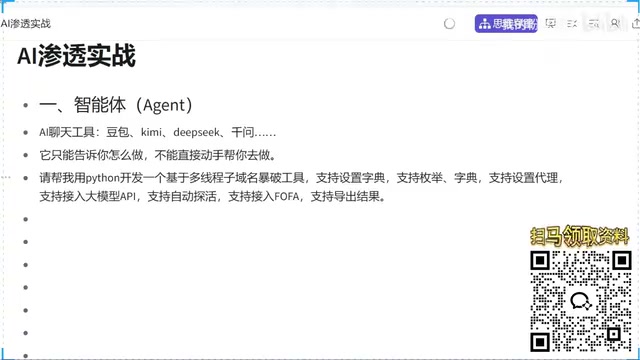
The Chat Tool Bottleneck: Knowing How ≠ Getting It Done
Here's a scenario familiar to any security professional: you want to build a Python-based subdomain brute-force tool. You open Doubao, start a new conversation, describe your needs, and it does plan things out before generating complete code. But what it won't do is create the file on your machine and actually run the tool.
The rest is on you: create a .py file, paste in the code, run it, and test it. If there's an error or the output isn't what you expected, you copy the error message back into the chat window, wait for it to tell you what to fix, paste the updated code back, and repeat. This "human relay" loop is a massive time sink.
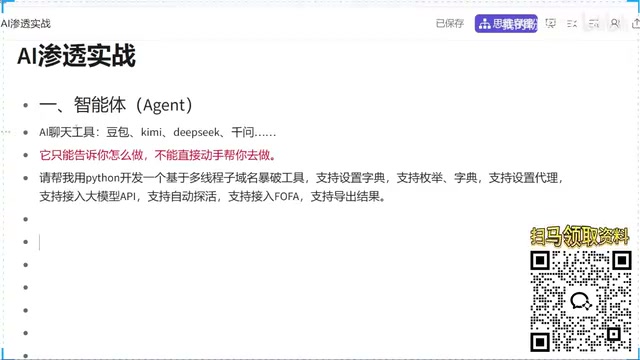
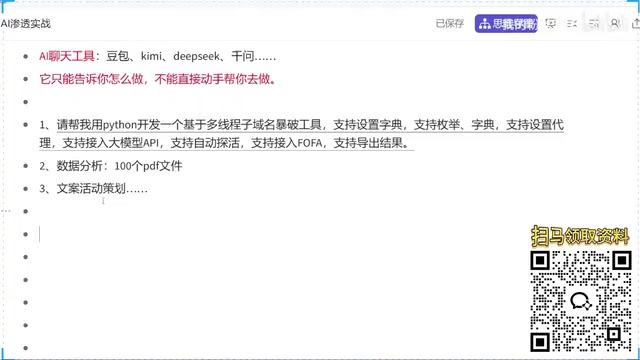
The ideal AI would work like this: you state your requirements, and it writes the code, creates the files, runs them, debugs any issues — all on its own. This mode of operation is especially valuable in penetration testing. Vulnerability discovery, code auditing, and CTF challenges all follow the same high-frequency loop: identify a problem → try a solution → validate the result → iterate. That loop is exactly where manual work is most time-consuming.
What Does It Actually Mean for an AI to Be "Smart"?
This isn't just about writing tools — complex tasks demand an AI that can take action. Consider a data analysis scenario: hand it 100 PDF files and ask it to extract and summarize the data. Doing that manually is incredibly tedious. Or imagine planning a large-scale event that requires creating dozens of files and ultimately delivering a PowerPoint, Word document, and Excel spreadsheet.
A truly smart AI should take your goal and deliver the finished result. That's the bar an AI must clear to deserve the label Agent.
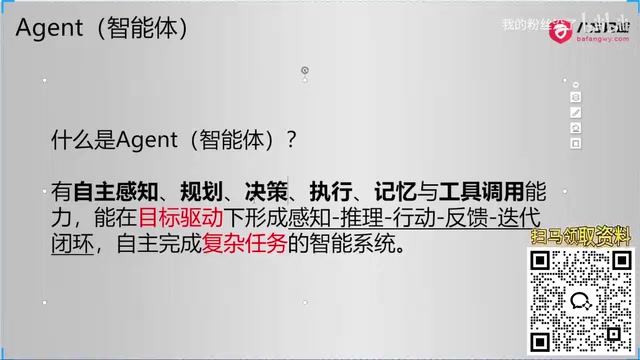
The concept of an Agent originates from the "autonomous agent" idea in AI research — systems that perceive their environment, plan independently, and take continuous action to accomplish a goal. Unlike traditional question-and-answer large language models, Agents typically operate on a "think → act → observe" loop (the ReAct framework), where the outcome of each action is fed back into the model to drive the next decision, continuing until the task is complete. In engineering terms, this means the model must be deeply integrated with external tools — file systems, terminals, browsers, APIs — and must maintain goals and context across multiple steps. Mainstream Agent frameworks include LangChain Agent, AutoGPT, and Devin. Security-specific implementations have also emerged, such as PentestGPT and HackingBuddyGPT, designed specifically for penetration testing use cases.
The Six Core Capabilities of an AI Agent
Using script, software, website, or app development as an example, a competent Agent must possess all six of the following capabilities — none of them optional:
1. Autonomous Environment Awareness
When running on your machine, it can tell whether it's looking at an empty folder, a half-finished codebase, or a completed project that needs further optimization. It can independently assess the current state of the task.
2. Task Planning
Given a goal like "build a piece of software," it can break the task down into subtasks — frontend, backend, database connections, file storage — and tackle them step by step.
3. Autonomous Decision-Making
When it hits a problem — no internet access, missing dependencies — it figures out a workaround instead of stopping and waiting for you. Decision-making is the dividing line between a "smart" and a "not-so-smart" AI.
4. Direct Execution
This is what ordinary chat tools lack most. An Agent can create files, connect to databases, and run operating system commands — rather than just telling you which commands to run yourself.
5. Memory
In complex projects, you'll have extended, multi-turn conversations with it over time. It needs to remember what you said earlier and maintain coherent context throughout.
6. Tool Use
At the basic level, this means creating files and connecting to databases. More advanced capabilities include calling tools like git and other utilities to accomplish its goals.
Only an AI that possesses all six of these core capabilities qualifies as an Agent. Give it a complex objective, and it will iterate autonomously until the task is done and the result is delivered.
What This Means for the Security Industry
Map these capabilities onto penetration testing and the impact on the security industry becomes clear. In traditional penetration testing, engineers manually write scanning scripts, audit code line by line, and debug exploit chains through repeated trial and error. An Agent with execution and decision-making capabilities can automate the "discover → validate → fix" loop, dramatically cutting the time spent on repetitive work.
That said, it's worth being realistic: the material covered here focuses more on unpacking the Agent concept and hasn't yet dived into the full technical details of vulnerability discovery, code auditing, or automated CTF challenge solving. Whether Agents can reliably find real vulnerabilities, how to control false positives, and how dependable their decision-making is against complex targets — these are questions that still need to be validated through real-world practice. For security professionals, rather than worrying about being replaced, the smarter move is to learn how to harness these Agent tools early and turn them into a force multiplier for your own capabilities.
The "discover → validate → fix" loop in penetration testing already has academic research to back it up. A 2024 MIT study found that a GPT-4-based Agent could autonomously exploit publicly disclosed CVE vulnerabilities end-to-end without any human prompting, achieving a success rate of roughly 87%. However, performance dropped significantly against undisclosed zero-day vulnerabilities. This finding aligns closely with the enormous gap between "automated exploitation of known vulnerabilities" and "discovering new vulnerabilities from scratch" — the former is largely pattern matching and tool orchestration, while the latter remains the core challenge of security research. For practitioners, the most realistic value of Agents lies in compressing the time spent on standardized tasks like information gathering, vulnerability reproduction, and report writing — not in replacing the high-level penetration work that demands creative judgment.
Related articles

Chain of Thought Isn't Just for AI: How Humans Can Use CoT to Improve Thinking Quality
Chain of Thought isn't just a prompt trick for large models. Starting from a Hacker News discussion, this article analyzes why CoT works for human thinking too, breaks down actionable ways to transfer it, and highlights the key differences between human CoT and machine CoT.
Cloudflare Teams Up with OpenAI: Closi…
Cloudflare Teams Up with OpenAI: Closing the Loop from Vulnerability Discovery to Defense with AI
Cloudflare uses OpenAI Daybreak to investigate security vulnerabilities and generate reviewable remediation plans, while developers use Codex to boost coding efficiency and quality.

Orca Multi-Agent Orchestration in Practice: A Guide to Parallel Collaboration with Claude and Codex
Orca is Stable AI's free open-source agent workbench supporting 34 agents like Claude Code and Codex in parallel. Learn its Git worktree isolation, multi-model orchestration, and mobile management.