How AI Apps Become Users' "New Default Tool": Decoding the Retention Formula

Decoding how AI apps overcome habit inertia and switching costs to become users' new default tools.
Starting from a viral tweet declaring an app as a "new default," this article explores why replacing existing tools is so difficult — from status quo bias to multi-layered switching costs — and how AI-native apps achieve it through experience leaps, instant value delivery, and organic word-of-mouth growth rather than feature stacking.
The Product Thinking Behind a Single Tweet
Recently, a brief but weighty tweet caught attention in the tech community: "This is the best new app I've tried in a while, and it will likely become my new default."
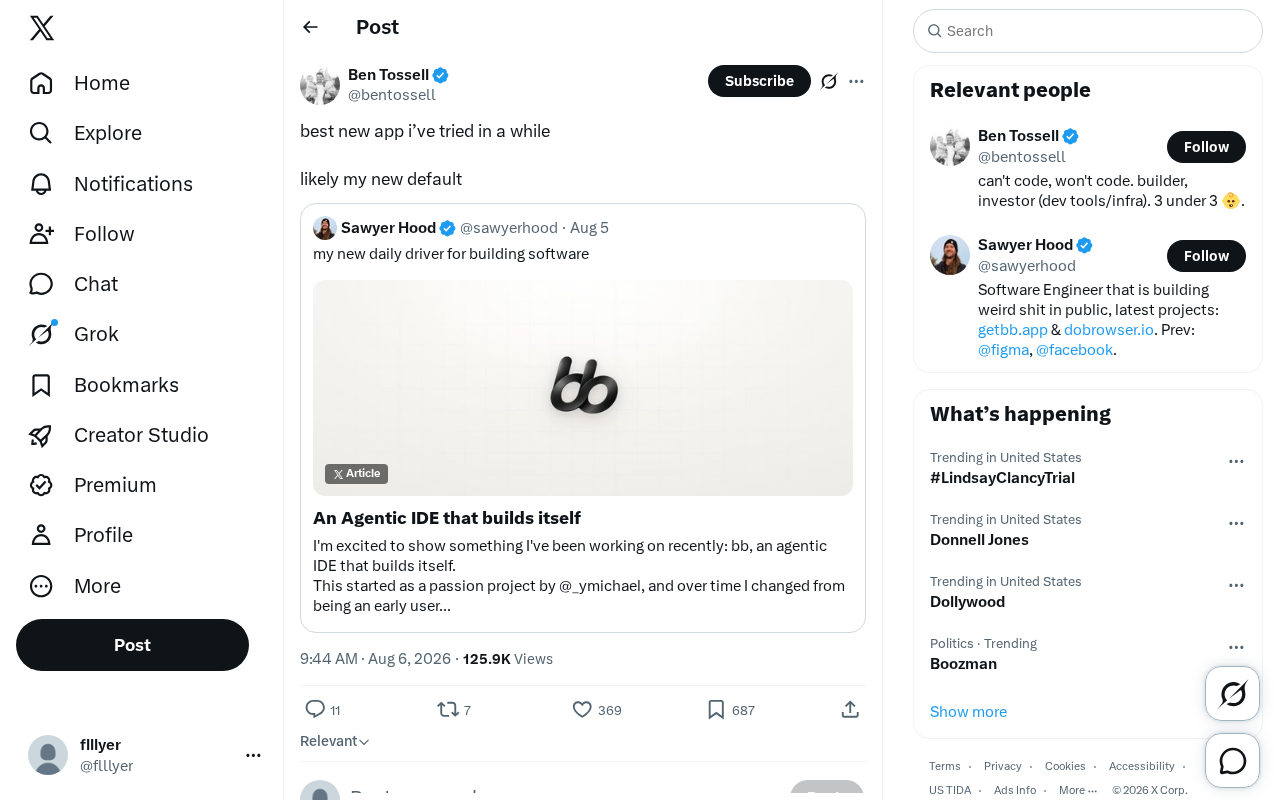
While the original post didn't name the specific app, the evaluation itself reflects a core question in today's AI application market: In an era of app overload, what kind of product can truly win "default" status with users?
The phrase "new default" is worth savoring. In software usage habits, "default" represents the highest level of trust — it's the tool users open without thinking, the infrastructure embedded in their daily workflow. The leap from "trying out" to "default" is precisely what every product team dreams of yet finds extremely difficult to achieve. In fact, in product strategy research, the "default effect" itself is a widely discussed concept — pre-installed browsers on operating systems and factory-set input methods on phones command enormous market share simply by being the default. When an app can become a user's "new default" through experience rather than pre-installation advantage, it means the product has achieved a significant leap beyond existing solutions in pure product strength.
Why Becoming the Default Tool Is So Difficult
The Inertia Barrier of Habits
Users' dependence on existing tools often exceeds rational judgment. Even if a new app is functionally superior, breaking through long-established muscle memory and workflows requires extremely strong product force as leverage. The psychological concept of "status quo bias" means that a new product must be significantly better than the current solution to motivate users to make the switch.
This concept was first systematically articulated by behavioral economists William Samuelson and Richard Zeckhauser in their 1988 research. They found that when facing choices, people disproportionately favor options that maintain the status quo, even when change is clearly more beneficial. Nobel laureate Daniel Kahneman connected this to "loss aversion" — people's perceived pain of losing something they already have is roughly twice the pleasure of gaining something of equal value. This means a new app being merely "a bit better" is far from enough — it needs to deliver at least twice the perceived value of the existing tool to offset the psychological resistance of switching. In practical product scenarios, this inertia also manifests in keyboard shortcut habits, file organization methods, and even spatial memory of interface layouts — all behavioral patterns deeply embedded in users' neural pathways.
The Real Costs of Migration
From data imports and configuration settings to team collaboration adaptation, the hidden costs of switching tools are often underestimated. An app that can make users voluntarily abandon their existing habits and set it as their "default" has typically done extensive work on reducing migration friction — whether through seamless data synchronization or zero-learning-curve interaction design.
In economics and management science, switching costs are broken down into three dimensions: procedural switching costs (time and effort spent learning new systems and evaluating alternatives), financial switching costs (sunk costs already paid, subscription fees for new tools, direct expenses of data migration), and relational switching costs (emotional bonds with the existing tool ecosystem, network effect disruption in team collaboration). Take enterprise SaaS as an example: Slack maintained user stickiness against Microsoft Teams' free bundling strategy precisely because the channel structures, integration configurations, and communication habits users accumulated in Slack constituted powerful procedural switching barriers. Products that successfully achieved user migration — such as Notion's conquest of Evernote users — often provided one-click import, format compatibility, and even keyboard shortcut mapping, systematically dismantling each layer of migration resistance.
The New Logic of Product Competition in the AI Era
From Feature Stacking to Experience Leaps
Current AI application competition is fierce, with many products falling into a feature arms race. But products that make users spontaneously say "this is the best I've tried" are often not the ones with the most features, but rather the ones that deliver transformative experiences in key scenarios.
Feature bloat is a classic dilemma in the software industry. Microsoft Word has hundreds of features, but most users regularly use no more than 20% — the excess features not only fail to create value but actually increase cognitive load and interface complexity. Product design expert Kathy Sierra offered the insight that "users don't care what your product can do; they care what they can become after using your product." In the AI era, this difference in thinking is even more pronounced: one approach is the "traditional app + AI features" stacking model, embedding AI as yet another menu option within existing architecture; the other is "AI-native apps" that rethink the user-software interaction paradigm from the ground up. The latter often delivers true experience leaps — for example, traditional search engines require users to decompose complex needs into keyword combinations, while AI-native conversational search allows users to directly express complete intent. This isn't a matter of adding or removing features; it's a fundamental shift in interaction paradigm.
AI capabilities make such "experience leaps" possible. Tasks that previously required multiple steps can now be completed in one natural language interaction; work that previously required specialized knowledge is now accessible through intelligent assistance. This order-of-magnitude efficiency improvement is the core driving force that compels users to change their default habits. Notably, "order-of-magnitude improvement" here is not rhetorical exaggeration — when a task that originally took 30 minutes is reduced to 30 seconds, that's a 60x efficiency difference, sufficient to break through any psychological threshold of status quo bias.
The Importance of Instant Value Delivery
Interestingly, the original tweet emphasized "tried recently" — indicating that this app delivered clear value in a short period of time. In an attention-scarce world, if an app cannot prove its value within the first few minutes, it rarely gets the opportunity for deeper engagement. This confirms the critical importance of "first-run experience" in contemporary product design.
In the product growth field, this is quantified as the "Time-to-Value" (TTV) metric — the time interval from when a user first opens the product to when they feel its core value. Modern PLG (Product-Led Growth) models consider TTV one of their North Star metrics. Dropbox's "drag in a file and sync across devices" and Zoom's "click a link to join a meeting" are classic examples of TTV optimization. In the AI application space, competition on this metric is even more intense: when ChatGPT delivers a valuable response after the user types their first sentence, it sets an extremely high TTV standard. Excellent first-experience design typically follows the principle of "progressive onboarding" — rather than displaying all features at once, it lets users complete one meaningful core operation along the shortest path, building usage motivation through an "Aha Moment," then gradually revealing more capabilities.
The Signal Value of User Word-of-Mouth
The Marketing Weight of Spontaneous Recommendations
Spontaneous recommendations born from genuine usage experience carry marketing value far exceeding any paid advertising. When a user publicly states that a product will become their "new default," they're not just evaluating the product — they're also vouching for their own judgment and taste. This kind of recommendation backed by personal credibility often sparks intense curiosity within peer communities.
From a marketing science perspective, Nielsen's global survey data shows that 92% of consumers trust recommendations from people they know, while trust in brand advertising is only 33%. In B2B and developer tools, this trust gap is even more extreme. Net Promoter Score (NPS) research shows that "promoters" (users giving 9-10 ratings) have 5-8x the customer lifetime value of "detractors," and their recommendation conversion rates far exceed any paid channel. Social media further amplifies this effect — a single sincere recommendation tweet from an industry KOL can achieve transmission efficiency exceeding hundreds of thousands of dollars in advertising budget. This is why many successful AI tools (such as Cursor, Perplexity, and Arc Browser) relied almost entirely on users' spontaneous social sharing for early growth rather than traditional marketing spend.
Word-of-Mouth Diffusion from Individual to Group
A single tweet may be just the beginning. When enough early adopters send similar signals, it creates a discussion wave within the community, triggering broader experimentation and validation. This is the typical early growth path of many breakout apps — from sincere recommendations by a small group of opinion leaders, gradually diffusing into mainstream awareness.
This transmission mechanism closely aligns with Everett Rogers' "Diffusion of Innovations" theory. Rogers categorized technology adopters into five groups: innovators (2.5%), early adopters (13.5%), early majority (34%), late majority (34%), and laggards (16%). Among these, early adopters are often opinion leaders within their communities, and their adoption decisions have a demonstration effect on subsequent groups. Geoffrey Moore further noted in Crossing the Chasm that a dangerous "chasm" exists between early adopters and the early majority — a product must transform from "a cool new thing" into "a reliable productivity tool" to cross it. When a user employs phrasing like "new default," they're conveying precisely the latter signal: this isn't just an interesting novelty to try, but an infrastructure-level tool worth long-term reliance.
Conclusion: Core Product Experience Is What Truly Matters
Regardless of which specific app earned this praise, the insight behind it is clear: in today's highly homogenized AI application landscape, what truly cuts through the noise and wins users' "default" status will always be products that achieve excellence in their core experience.
For developers, rather than competing endlessly on feature lists, it's better to focus on how to make users feel they "can't live without it" from their very first use. After all, becoming a user's "new default" is the most authentic proof of a product's vitality. In an era where dozens of AI apps launch every week, a product that makes users proactively replace their existing tools must have achieved unprecedented breakthroughs in some key dimension — whether it's speed, intelligence level, interaction naturalness, or deep understanding of specific workflows. Such breakthroughs don't come from imitating and stacking competitors' features, but from profound insight into users' real pain points and reimagining solutions from scratch.
Related articles

Gaussian Process Bandit Optimization: Exploration Strategies and Inference Regret Guarantees
Cumulative regret guarantees in Bayesian optimization fail to reflect final recommendation quality. This article examines a new study that provides inference regret guarantees for Gaussian process bandit optimization through exploration query strategies and fill distance analysis, validated on hyperparameter optimization and control tasks.

The Most Detailed Codex Guide on Bilibili: From Installation to Real-World Practice
The most detailed Codex guide on Bilibili: from app store installation to daily work mode configuration, with a real coffee shop project demonstrating file organization, data extraction, dashboard creation, and other practical tasks. Learn to use Plan Mode and desktop pets to leverage Codex efficiently.

Appearance Compensation in Volume Rendering: Why RGB Accuracy Cannot Guarantee Density Correctness
Volume rendering research reveals that volumetric data perfectly reproducing external RGB views may still contain density errors: appearance compensation can double central density and keep external rays unchanged even when L2 error exceeds 14.52%. Density recovery depends on appearance capacity, spatial resolution, and measurement design.