How Beginners Can Start Contributing to Open Source: A Complete Guide from Zero to Your First PR

A complete guide for programming beginners to make their first open source contribution.
This guide walks programming beginners through the entire process of contributing to open source projects—from choosing the right project and finding good first issues, to making non-code contributions and submitting your first Pull Request. It covers practical strategies for Python learners, explains the Fork & Pull workflow, and emphasizes the value of patience, consistent engagement, and starting small.
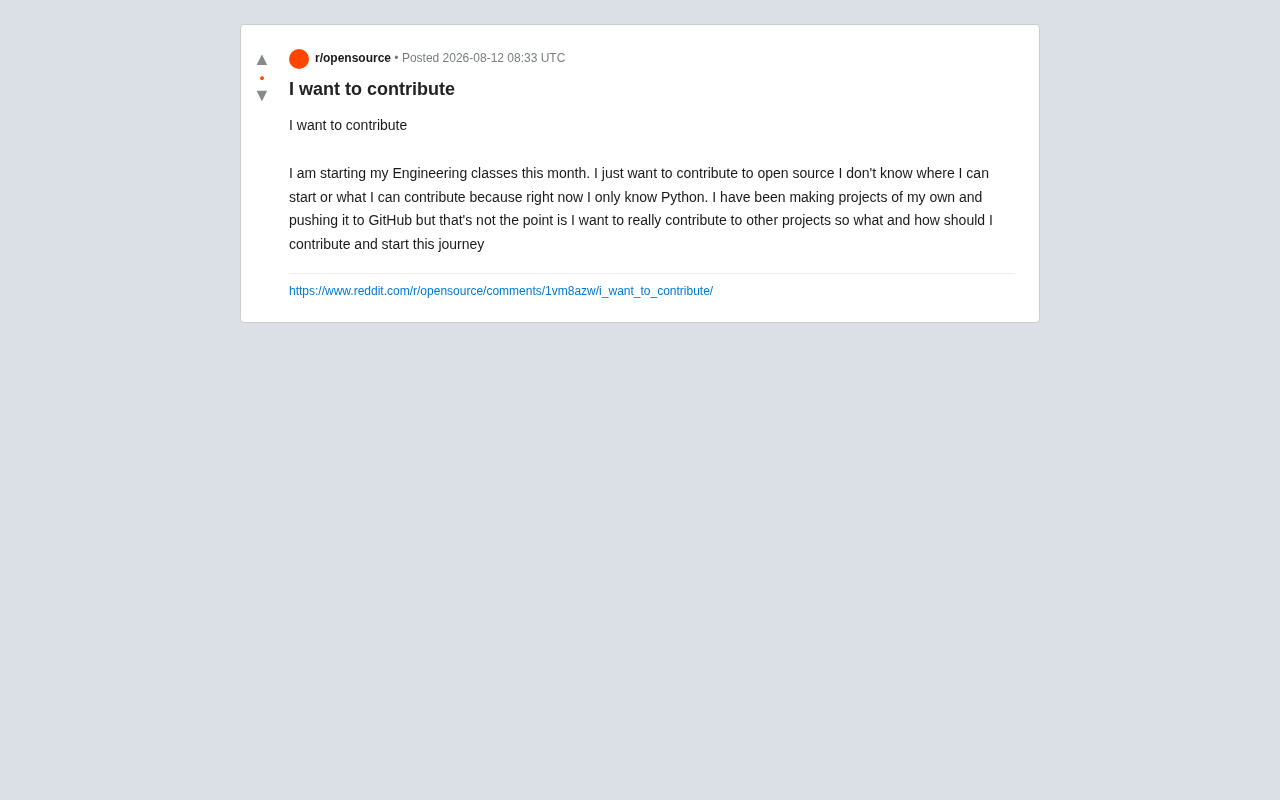
For beginners just stepping into the world of programming, contributing to open source projects is often seen as an important path to improving technical skills and gaining real-world experience. Recently, a student about to begin an engineering program posted on Reddit asking for help: they only know Python, and while they've been working on personal projects and uploading them to GitHub, what they really want is to contribute to other people's open source projects—but they don't know where to start. This question may seem simple, but it actually represents a common struggle shared by countless programming newcomers.
This article takes this typical scenario as a starting point to systematically outline the paths and methods for beginners to participate in open source.
Why You Should Contribute to Open Source Projects
Many beginners believe they need to be technically proficient before they're qualified to contribute to open source. In fact, the opposite is true—participating in open source is itself a highly efficient way to learn.
By reading code from real projects, you gain exposure to industry-grade coding standards, collaboration workflows, and architectural design—experiences that are hard to come by when working alone on small projects. Industry-grade projects typically follow strict design patterns (such as MVC, SOLID principles), comprehensive error handling mechanisms, and thorough test coverage—practices that rarely emerge spontaneously in personal projects. Additionally, a track record of open source contributions serves as a highly compelling portfolio when job hunting. Especially for students still studying engineering, an active GitHub contribution history often impresses recruiters more than course grades.
More importantly, the open source community provides opportunities to interact with developers worldwide. Your code will be reviewed by experienced maintainers (Code Review), and this feedback loop can dramatically accelerate technical growth. Code Review is a core quality assurance practice in software engineering—after you submit a Pull Request, maintainers review the code changes line by line, checking logical correctness, style consistency, and potential performance issues, then offer suggestions for modifications in the form of comments. This process is essentially equivalent to receiving free one-on-one mentoring from senior engineers, an extremely scarce learning resource for beginners. In companies, junior engineers typically need months to receive this density of feedback, whereas in the open source community, every PR submission is a learning opportunity.
Where to Start: Choosing the Right Open Source Project
The most common mistake newcomers make is immediately targeting highly popular large-scale projects (like CPython, TensorFlow, etc.). While these projects are attractive, they have high barriers to entry, massive codebases, and strict maintainer reviews—easily discouraging beginners. Take CPython as an example: its codebase contains over 1.6 million lines of code, involves a mix of C and Python, and the contribution process requires multi-layered review by several core developers. A single PR might take weeks or even months from submission to merge.
A Gradual Project Selection Strategy
For beginners who only know Python, here's a recommended order for finding entry points:
- Start with tools you already use: Look for Python libraries or tools that you use daily and that are moderately sized. Since you have an intuitive understanding of their functionality, it's easier to spot issues or areas for improvement. For example, if you frequently use the requests library for HTTP requests, or Click for building command-line tools, when you encounter unclear documentation or edge cases during use, that itself is an entry point for contribution.
- Look for the
good first issuelabel: GitHub officially introduced this labeling system in 2017, encouraging project maintainers to clearly mark tasks suitable for new contributors. These issues typically have limited scope of changes (often involving only one or two files), don't require deep understanding of the overall architecture, and have clear expected outcomes. Enteringlabel:"good first issue" language:Pythonin the search box lets you filter tasks suitable for getting started. Besides good first issue, other common beginner labels includehelp wanted,beginner-friendly, andeasy. - Use aggregation platforms: Websites like Up For Grabs, Good First Issue, and First Timers Only specifically collect open source tasks suitable for beginners, saving you significant filtering time. Up For Grabs (up-for-grabs.net) catalogues thousands of open source projects marked with beginner-friendly labels, with language filtering support. Good First Issue (goodfirstissue.dev) directly pulls active issues with relevant labels from GitHub, updated daily. First Timers Only is an advocacy movement that encourages maintainers to create issues specifically reserved for people who have never contributed to open source before, providing extremely detailed step-by-step instructions. There's also the CodeTriage platform, which lets you subscribe to projects you're interested in and receive daily emails about issues that need help, helping you build a habit of consistent engagement.
Open Source Contribution Isn't Just About Writing Code
Hidden within this Reddit user's confusion is a common misconception: that "contribution" equals "submitting complex feature code." In reality, the forms of open source contribution are far more diverse than imagined. According to GitHub's 2023 Octoverse report, documentation-related contributions account for a significant proportion of overall open source activity, and many well-known project maintainers have publicly stated that high-quality documentation contributions are even more welcome than code contributions.
Non-Code Contributions Are Equally Valuable
For developers just starting out, the following types of contributions are both easy to get started with and bring real value to the community:
- Improving documentation: Fixing typos, adding missing explanations, translating documents—these are all contributions that maintainers warmly welcome. Documentation contributions have a low barrier but extremely high value—good documentation directly determines a project's user experience and adoption rate. Many developers are skilled at writing code but not at writing documentation, so this area has a chronic shortage of contributors.
- Reproducing and reporting bugs: Carefully writing a clear Issue with reproduction steps, environment information (operating system, Python version, dependency versions), and a comparison between expected behavior and actual behavior is itself a valuable contribution. A high-quality bug report can save maintainers hours of troubleshooting time.
- Writing test cases: Adding unit tests for functions lacking test coverage both deepens your understanding of the code and improves project quality. Common testing frameworks in the Python ecosystem include pytest and unittest. Learning to use the coverage.py tool can help you find areas of insufficient test coverage in a project—these areas are often where contribution opportunities lie.
- Answering community questions: Helping other users solve problems in the project's discussion area. This not only helps others but also builds your credibility and familiarity with the project in the maintainers' eyes, paving the way for future code contributions.
Starting with these "low-risk" tasks, you can gradually familiarize yourself with the project's collaboration workflow and communication culture, laying the groundwork for future code contributions.
The Standard Open Source Contribution Workflow
Understanding the technical workflow of open source collaboration can help you avoid many common beginner mistakes. A standard contribution workflow typically includes the following steps:
- Read the contribution guide: Almost all well-established projects have a
CONTRIBUTING.mdfile. Be sure to read it carefully first to understand the code style, commit conventions, and PR requirements. This file typically includes the project's required language version, dependency management tools (such as pip, poetry), code formatting tools (such as Black, isort, flake8), commit message writing conventions (many projects adopt the Conventional Commits standard), branch naming conventions, and automated checks that the CI/CD pipeline needs to pass. Following these standards is not only a sign of respect for maintainers but also significantly increases the probability of your PR being accepted. Many beginners' first PRs are rejected not because of incorrect code logic, but because they didn't follow these formatting and process conventions. - Fork and Clone: Fork the project to your own account, then clone it locally. The Fork-Clone-PR workflow is the most mainstream open source collaboration model on GitHub, also known as the "Fork & Pull" model. The Fork operation creates a complete copy of the original repository under your GitHub account, giving you full read and write permissions on this copy. Clone then downloads this remote copy to your local development environment. The design philosophy behind this model is: contributors don't need write access to the original repository to participate in development, and maintainers decide whether to accept changes by reviewing Pull Requests—striking an elegant balance between open collaboration and quality control.
- Create a feature branch: Don't modify directly on the main branch. Create an independent feature branch for each change. Branch naming typically follows a semantic format, such as
fix/typo-in-readmeorfeature/add-timeout-parameter, so maintainers can immediately understand the branch's purpose. Keep your main branch (main/master) synchronized with the upstream repository to ensure your changes are based on the latest code. - Communicate before committing: For larger changes, it's advisable to explain your plan in the Issue first to avoid having significant work rejected. You can comment "I'd like to work on this issue" to express your intention and wait for the maintainer to confirm before getting started. This communication culture is very important in the open source community—it prevents duplicate effort and gives maintainers an opportunity to provide directional advice before you begin.
- Submit a Pull Request: Clearly describe the content and motivation of your changes, patiently wait for the maintainer's review, and adjust based on feedback. A good PR description should include: the problem being solved (with a link to the relevant Issue), the specific changes made, testing methods, and necessary screenshots or execution results.
Stay Patient and Maintain the Right Mindset
Open source contribution is a marathon, not a sprint. Beginners will often encounter rejected PRs, harsh review comments, and long periods without any response—these are all normal occurrences and shouldn't be discouraging. Many well-known open source maintainers are volunteers who invest time maintaining projects outside of their full-time jobs, and PR review cycles can range from a few days to a few weeks. If you haven't received a response after two weeks, it's perfectly acceptable to leave a polite reminder comment.
For this student who's just starting their engineering program, the best advice is: commit consistently, and start small. Spend a little time each week browsing Issues in projects that interest you, try solving a simple problem, and gradually build up your contribution rhythm. As your Python skills deepen and your understanding of the project grows, you'll naturally be able to take on more challenging tasks. It's worth noting that many successful open source contributors emphasize the importance of "going deep on one project"—rather than broadly submitting one small PR to ten different projects, it's better to continuously contribute to one or two projects and become a recognized active member of the community. The depth of learning and network resources you gain will far exceed the former approach.
The doors to the open source world are always open—the only barrier is the courage to take that first step.
Related articles

Gaussian Process Bandit Optimization: Exploration Strategies and Inference Regret Guarantees
Cumulative regret guarantees in Bayesian optimization fail to reflect final recommendation quality. This article examines a new study that provides inference regret guarantees for Gaussian process bandit optimization through exploration query strategies and fill distance analysis, validated on hyperparameter optimization and control tasks.

The Most Detailed Codex Guide on Bilibili: From Installation to Real-World Practice
The most detailed Codex guide on Bilibili: from app store installation to daily work mode configuration, with a real coffee shop project demonstrating file organization, data extraction, dashboard creation, and other practical tasks. Learn to use Plan Mode and desktop pets to leverage Codex efficiently.

Appearance Compensation in Volume Rendering: Why RGB Accuracy Cannot Guarantee Density Correctness
Volume rendering research reveals that volumetric data perfectly reproducing external RGB views may still contain density errors: appearance compensation can double central density and keep external rays unchanged even when L2 error exceeds 14.52%. Density recovery depends on appearance capacity, spatial resolution, and measurement design.