How Can a Restaurant Fully Migrate to Open Source Software? A Paris Owner's Real-World Experience

A Paris restaurant owner explores migrating all business software to open source to cut costly SaaS subscriptions.
A Parisian restaurant owner shares his plan to replace expensive proprietary SaaS tools with open source alternatives across POS, inventory, food safety compliance, and more. The article examines available solutions like Odoo, DIY IoT temperature monitoring, and the real challenges of migration—time constraints, maintenance burden, staff training, and regulatory compliance—while highlighting the untapped opportunity for the open source community to serve non-technical micro-businesses.
An Open Source Request from a Parisian Restaurant
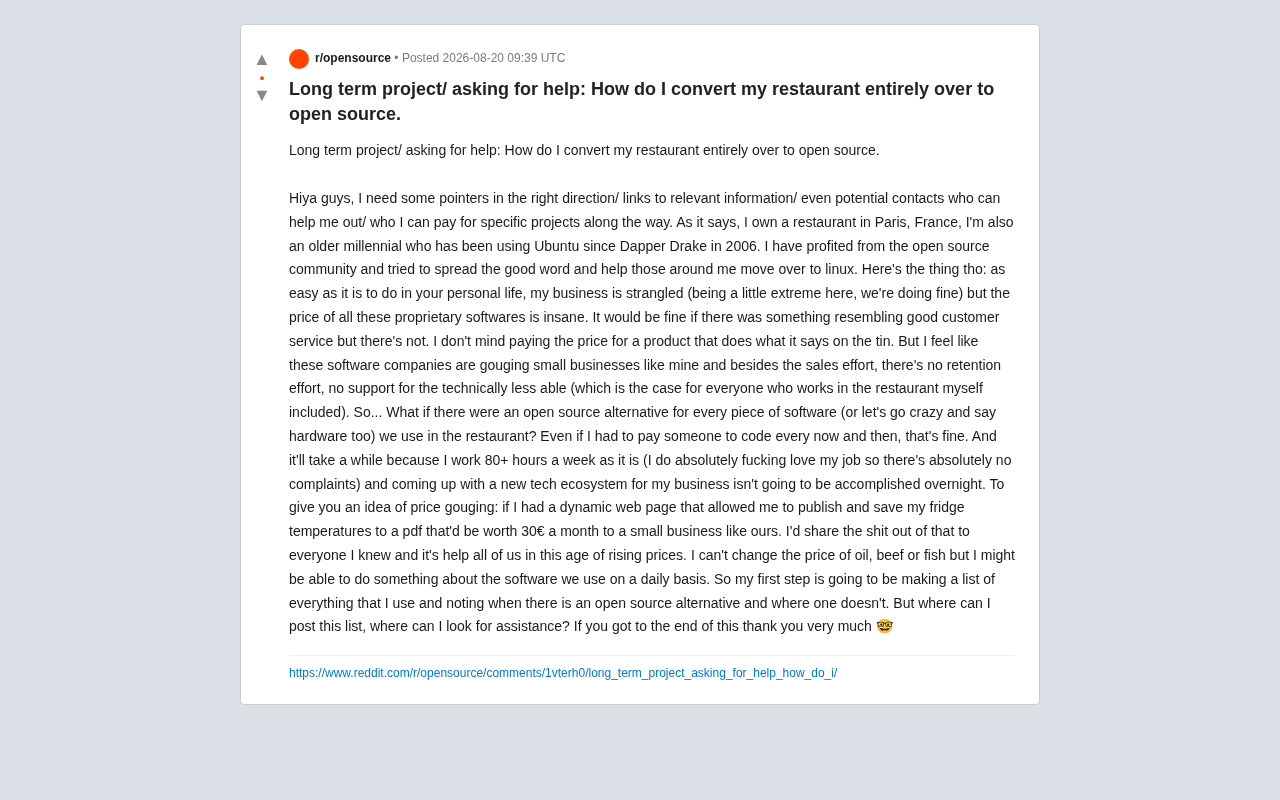
In Reddit's open source community, a Parisian restaurant owner sparked a highly representative discussion: How can you migrate an entire restaurant's software systems to open source solutions?
The poster is an "elder millennial" who has been a loyal Linux user since Ubuntu Dapper Drake in 2006, and has long advocated open source philosophy among those around him. Ubuntu Dapper Drake (version 6.06) was the first Long Term Support (LTS) release in Ubuntu's history, promising three years of desktop support and five years of server support. This version represented Linux desktop's first genuine attempt to serve non-technical users—out-of-the-box hardware support, a graphical installer, and the "Linux for Human Beings" slogan made it many people's gateway into the open source world. A user who started with Linux in that era has typically witnessed the complete evolution of the open source desktop from "usable" to "good."
However, when he tried to bring the open source spirit into his food service business, he encountered real-world challenges far more complex than personal use.
His core pain point is crystal clear: Proprietary software pricing is excessively harsh for micro-businesses, while the accompanying customer service is virtually non-existent. He doesn't oppose paying for good products, but he believes software companies are gouging small businesses like his—putting effort only into sales, with no sincerity in retention, and no support for users with limited technical ability.
The Restaurant Industry's Software Cost Trap: Subscription Fees Are Eating Into Profits
This owner's complaint isn't isolated—it reflects a structural problem in the entire restaurant industry's digitalization. The Software as a Service (SaaS) subscription pricing model has become the industry standard over the past decade. For medium and large enterprises, paying monthly for maintenance-free, auto-updating cloud services is a reasonable trade. But for micro-businesses, this model creates a severe cost accumulation effect: a small restaurant might need multiple software subscriptions simultaneously, easily totaling over €300-500 per month. More critically, the marginal service cost of these tools is virtually zero for vendors, yet pricing is unrelated to business scale—meaning a small restaurant with €300,000 in annual revenue might pay similar software fees as a chain generating €30 million, while the profit ratio difference is enormous.
The software systems involved in daily restaurant operations are quite extensive:
- POS system: Checkout, ordering, table management
- Inventory & procurement management: Ingredient tracking, supplier coordination
- Employee scheduling & attendance
- Food safety compliance: Temperature logs, HACCP procedures
- Online ordering & reservation systems
- Finance & accounting software
HACCP (Hazard Analysis and Critical Control Points) is a systematic food safety management methodology that is mandatory for all food operators under EU regulations. For restaurants, HACCP's core practices include: timed temperature recording of refrigeration equipment (typically every 4 hours), temperature checks when receiving ingredients, verification of cooking core temperatures, and cleaning/sanitization records. These records must be kept for a specified number of years for health inspections. Traditionally, restaurants completed this work with paper forms, but digital compliance tools reduce human error through automatic data collection and archiving while improving traceability during inspections.
The poster gave a highly convincing example: A dynamic web page that records and exports refrigerator temperatures to PDF is worth €30/month to his small restaurant.
This detail reveals the essence of the pain point. Refrigerator temperature logging is technically a very low-threshold function, but under compliance requirements it's an absolute necessity—so proprietary software vendors charge ongoing subscription fees. When ingredient costs can't be controlled, this owner realized: Software costs might be the only expense he can actively optimize.
"I can't change the price of oil, beef, or fish, but maybe I can do something about the software we use every day."
Overview of Available Open Source Alternatives for Restaurants
From a technical ecosystem perspective, this owner's vision isn't wishful thinking. The restaurant industry actually already has many mature open source alternatives.
POS & Restaurant Management Systems
- Odoo (Community Edition): Offers modular functionality including POS, inventory, accounting, and CRM—a representative open source ERP for SMEs. Odoo is an open source ERP system developed by Belgian company Odoo SA, using a modular architecture covering dozens of business modules. Its Community Edition is fully open source under the LGPL license, while the Enterprise Edition requires per-user paid subscriptions. Odoo's POS module supports touchscreen operation, kitchen printing, split-table billing, and other restaurant-specific features, and can run offline. However, note that there's a significant feature gap between the Community and Enterprise editions—many advanced reports, automated workflows, and official technical support are only available in the Enterprise Edition. The community has numerous third-party service providers (Odoo Partners) offering implementation services. Initial investment may be higher than SaaS solutions, but long-term Total Cost of Ownership (TCO) is often lower.
- Floreant POS / uniCenta: Open source POS systems designed specifically for food service and retail
- Chromis POS: A lightweight restaurant POS solution
General Infrastructure & Compliance Tools
- NextCloud: Replaces Google Workspace/Office 365 for file collaboration and storage
- Grafana + IoT sensors: Combined with temperature sensors for automatic refrigerator temperature recording and visualization
- Nextcloud + custom forms: Meets compliance document generation needs
For the specific "refrigerator temperature PDF" requirement, it's technically entirely feasible with a Raspberry Pi + DS18B20 temperature sensor + a simple web service—hardware costs of just a few dozen euros with no monthly fees. The Raspberry Pi is a credit-card-sized single-board computer priced at approximately €35-75, running Linux with full GPIO (General Purpose Input/Output) interfaces. The DS18B20 is a digital temperature sensor manufactured by Dallas Semiconductor, costing less than €2 each with ±0.5°C accuracy, communicating with the Raspberry Pi via the 1-Wire protocol. A complete automated temperature logging solution requires only: one Raspberry Pi, several DS18B20 sensors (one per fridge/freezer), WiFi connectivity, and approximately 50 lines of Python script. Data can be stored in an SQLite database, with a Flask or FastAPI microservice generating PDF reports. Total hardware cost is approximately €50-80 with zero ongoing subscription fees. This precisely validates his judgment: many "SaaS features" sold at high prices have a severe mismatch between their technical complexity and pricing.
The Real Challenge of Restaurant Open Source Migration Isn't Technical
This owner's action plan is quite pragmatic: Step one is to list all software currently used by the restaurant, marking one by one which have open source alternatives and which don't. This is an absolutely correct starting point—the prerequisite for migration is always a clear inventory of the current state.
However, the real difficulties of full open source adoption for a restaurant often lie beyond the technology itself:
- Time cost: The poster works over 80 hours per week with almost no energy to build a tech ecosystem from scratch
- Maintenance & support: Open source software saves licensing fees but requires someone responsible for deployment, updates, and troubleshooting
- Staff training: Restaurant teams have limited technical ability; systems must be sufficiently user-friendly
- Compliance & stability: If food safety-related systems fail, the consequences can be severe
This is also why he explicitly stated willingness to "occasionally pay someone to write code"—this is actually the healthy form of open source business models: Software is free, but you pay for services, customization, and support. This avoids being locked into proprietary software while ensuring sustainable business operations.
The commercial sustainability of open source software is a long-debated topic. Current mainstream open source business models include: Open Core—basic features are open source while advanced features are paid, like Odoo and GitLab; Managed Service—software is free but paid cloud hosting and operations are offered, like WordPress.com; Professional Services—software is free but consulting, customization, and training are charged; and Support Subscription—like the Red Hat model. For micro-business users, the healthiest model is "free software + pay-as-needed services": businesses can freely use and modify software, paying per-engagement or per-project when professional help is needed. This model avoids vendor lock-in while creating sustainable revenue for service providers.
Implications for the Open Source Community: Micro-Businesses Are an Overlooked Market
This post represents a user group that mainstream open source narratives have overlooked: non-technical micro-business owners.
The open source community has long been better at serving developers and tech enthusiasts, but for practical needs like "I just want a cheaper, more controllable way to run my restaurant," there's often no systematic support path. This owner's request points to a larger opportunity:
- Vertically-focused open source solution bundles (like a "restaurant open source suite"): Pre-configured integration of POS, inventory, compliance, and scheduling modules to lower the deployment barrier for non-technical users
- Localized open source service provider networks offering deployment and maintenance for small businesses: Similar to IT outsourcing providers but focused on open source solution implementation and long-term support
- Community-driven demand crowdfunding, turning common needs like the "€30 temperature logging feature" into open source projects: Through platforms like Open Collective or GitHub Sponsors, letting businesses with shared needs collectively fund development
As the poster said, if such a great solution existed, he would "evangelise the hell out of it to everyone he knows." In an era of broadly rising prices, helping small businesses save on software subscriptions is itself the most fundamental and powerful expression of the open source spirit.
Conclusion: The Open Source Journey from Personal Hobby to Business Practice
From Ubuntu enthusiast to someone trying to transform an entire restaurant's operations with open source, this Parisian owner's story reveals the real picture of open source philosophy moving from personal use to business practice. It exposes the current open source ecosystem's shortcomings in serving micro-businesses while pointing to a potential, underestimated market demand.
For any SME wanting to break free from proprietary software constraints, this case offers equally simple and practical advice: First inventory, then evaluate, migrate step by step, and pay for services when necessary. Open source isn't a free lunch, but it gives small businesses the choice to no longer be passively gouged.
Related articles

Automate Job Search with AI Agents and Residential Proxies for Precise Matching
Build an AI Agent with MCP and residential proxies to bypass recruitment site anti-scraping and geo-restrictions, scrape thousands of DevOps jobs, then have Claude score and rank each against your resume. Includes proxy comparison experiments, project structure, and cost analysis—filtering only, no auto-submission.

The AI Task Assistant That Knows When to Back Off: A Cure for Activation Struggles
One Small Step is an AI assistant for task initiation struggles, using agentic decisions for guilt-free reminders, timely retreat, and cross-platform task management. The developer shares real test results on 13 tasks and architectural trade-offs.

FastAPI: A High-Performance Python Framework and a Production-Ready API Development Powerhouse
FastAPI is a high-performance web framework based on Python type hints, supporting async and automatic OpenAPI docs. With over 100k GitHub stars, this article analyzes its core strengths, production readiness, and selection advice.