How Can Linear Attention Learn from Nonlinear Teachers? New Research Reveals Its Fundamental Limitations

Linear attention facing nonlinear targets can only extract the linear component — all other nonlinear structure becomes effective noise.
This arXiv paper extends linear attention's ICL theory from linear regression to nonlinear single-index targets y=f(x⊤w)+ε, establishing a core "nonlinearity-noise equivalence": linear attention only extracts the linear Hermite component of the target function, while all remaining nonlinear structure is folded into effective noise contributing to generalization error. This reduction allows existing linear theory results to transfer directly to nonlinear tasks, explains degraded generalization under limited pretraining data, and analytically characterizes the phase transition from task memorization to task generalization as diversity increases. The deeper value lies in clearly bounding linear attention as a simplified Transformer proxy — its fundamental inability to replicate nonlinear ICL capabilities — while providing a clean theoretical base for introducing nonlinear mechanisms in future work.
From Linear Regression to Nonlinear Targets
Linear Attention has long been regarded as an analytically tractable model for understanding the in-context learning (ICL) mechanisms of Transformers. Compared to full softmax attention, it is mathematically more manageable, making it an ideal lens through which researchers can dissect the inner workings of ICL. Prior work has largely focused on linear regression tasks, using asymptotic analysis to characterize the learning and generalization behavior of linear attention.
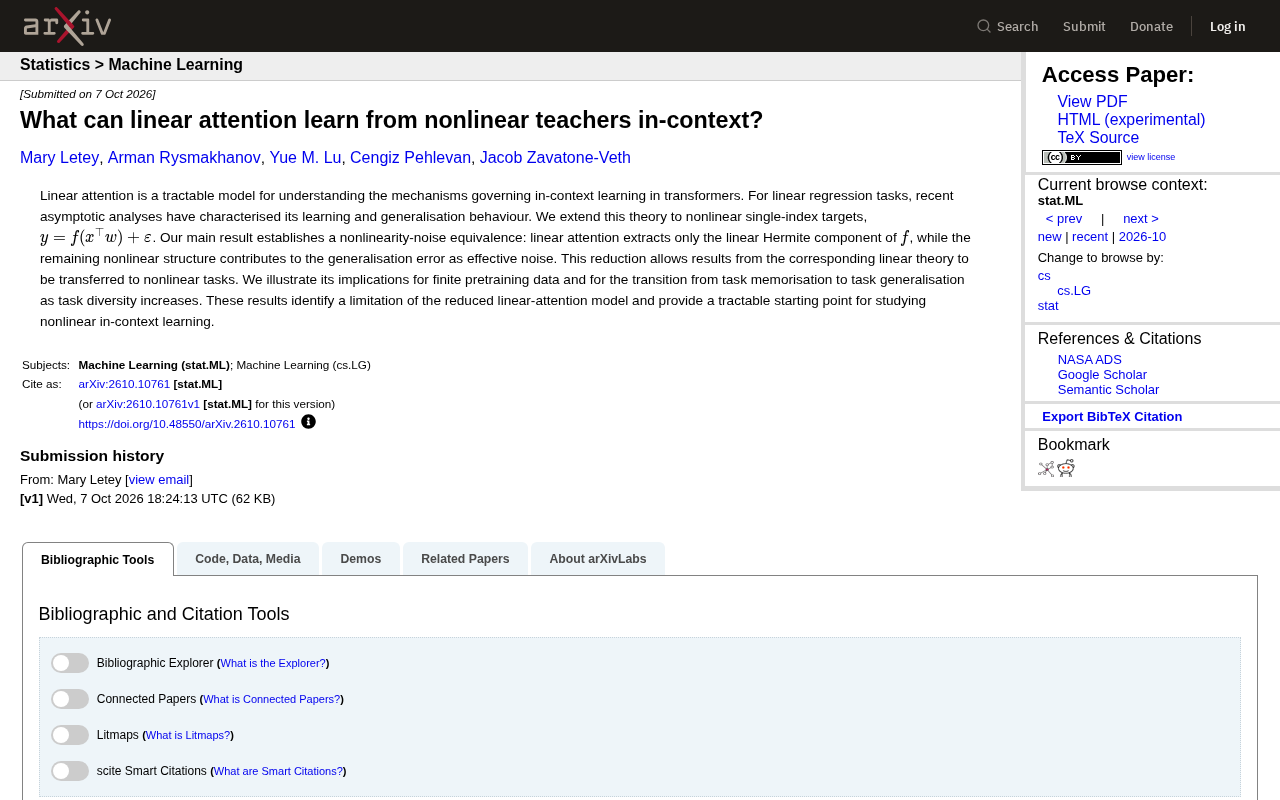
A newly published paper on arXiv (arXiv:2610.10761v1) advances this theoretical framework one step further, extending the analysis from linear regression to nonlinear single-index targets — functions of the form $y=f(x^\top w)+\varepsilon$. These targets introduce genuine nonlinearity while maintaining structural simplicity, providing a suitable testbed for probing the capability boundaries of linear attention.
Linear attention is a simplified variant of standard Transformer attention that replaces the exponential (softmax) kernel with a linear kernel. Its forward computation can be written in closed-form matrix multiplication, enabling rigorous asymptotic analysis using classical statistical learning tools such as bias-variance decomposition and random matrix theory. In-context learning (ICL), by contrast, refers to a model's ability to adapt to new tasks at inference time using only a handful of input-output examples provided in the prompt, without updating any parameters. This capability was observed in large models like GPT-3 and quickly became a major research focus, though its theoretical mechanisms have long lacked clear explanation. A key finding from prior work on linear attention is that, for linear regression tasks, a properly pretrained linear attention layer effectively implements a single gradient descent step — a correspondence that provides an analytically interpretable mechanical explanation for why models can learn from in-context examples. The present paper extends this analytical framework into the nonlinear regime, a natural progression within this theoretical tradition.
Core Finding: Nonlinearity-Noise Equivalence
The paper's most central result is the proposal of a "nonlinearity-noise equivalence." The authors show that when facing nonlinear single-index targets, linear attention can only extract the linear Hermite component of the target function $f$. All remaining nonlinear structure is not actually learned by the model — instead, it contributes to the generalization error as effective noise.
The implication is straightforward: for linear attention, a teacher signal with complex nonlinear components is equivalent to a task that has only a linear component but higher noise. In other words, the model cannot distinguish between "genuine nonlinear signal" and "random noise" — it discards the former as if it were the latter.
This reduction yields a practical theoretical convenience. Since the nonlinear components can be folded into noise, analytical results originally derived for linear tasks can be directly transplanted to nonlinear tasks, without reconstructing an entirely new theoretical framework.
Hermite components come from the Hermite polynomial expansion, the standard tool for orthogonally decomposing functions under the Gaussian measure — analogous to Fourier analysis for periodic functions. Any square-integrable function $f$ can be expanded as $f(t)=\sum_{k=0}^{\infty} \hat{f}_k H_k(t)$, where $H_k$ is the $k$-th order Hermite polynomial and the $k=1$ term is the "linear Hermite component." Intuitively, if $f$ is purely linear, only the $k=1$ term is nonzero; if $f$ contains quadratic, cubic, or higher-order nonlinearities, the corresponding higher-order coefficients are also nonzero. The paper's core result shows that the structural constraints of linear attention cause it to naturally "see" only the $k=1$ projection — higher-order terms appear indistinguishable from white noise from its perspective. This finding is consistent in spirit with the data processing inequality in information theory: a processor with limited expressive capacity cannot extract structure from a signal that exceeds its representational ability.
Implications for Pretraining Data and Task Diversity
Building on this equivalence, the authors further explore two practically relevant scenarios.
The first concerns behavior under limited pretraining data. When the number of pretraining samples is constrained, the amplification of effective noise directly impacts the model's generalization performance, providing a quantitative perspective on ICL behavior under low-data conditions.
The second involves the transition from task memorization to task generalization. The research observes that as task diversity increases, the model undergoes a transition from "memorizing specific tasks" to "generalizing to new tasks." This phenomenon has been discussed in prior ICL research, and the present paper incorporates it into the nonlinear target analysis framework, enabling this transition to be tracked and characterized within an analytically tractable model.
The transition from task memorization to task generalization is typically described in ICL theory as a phase transition: when the number of pretraining tasks is small, the model tends to memorize specific seen tasks and performs poorly on new ones; once task diversity exceeds a critical threshold, the model shifts to extracting shared structure across tasks and generalizes to unseen ones. This phenomenon has been repeatedly observed in analyses of Bayes-optimal predictors and in numerical experiments with softmax attention. The intuition is that after exposure to a sufficiently large and varied set of tasks, the model is forced to abandon rote memorization of specific tasks and instead learn meta-level inductive rules. This paper incorporates the transition into the nonlinear single-index setting and provides an analytic characterization, allowing researchers to precisely describe the conditions under which the transition occurs — for instance, how much task diversity is needed to cross this threshold.
Revealing a Fundamental Limitation
The most valuable contribution of this work may not be in proving what linear attention can do, but in clearly delineating what it cannot do. Since linear attention only captures the linear Hermite component and discards all remaining nonlinear structure as noise, using the simplified linear attention model to understand the nonlinear ICL capabilities of real Transformers introduces an inherent explanatory gap.
This means researchers should exercise caution when using linear attention as a "toy model" to infer the behavior of large models — certain nonlinear ICL capabilities exhibited by real models are precisely what linear attention is fundamentally incapable of reproducing.
That said, the authors also emphasize that this result simultaneously provides an analytically tractable starting point. With the boundaries of linear attention clearly established, future work can systematically introduce nonlinear mechanisms on top of this foundation, progressively approximating the learning behavior of real Transformers. It offers a clean, controlled theoretical base from which to study nonlinear in-context learning.
Why This Research Deserves Attention
In-context learning is one of the most striking emergent capabilities of large language models, yet its internal mechanisms remain far from fully transparent. Using analytically tractable models like linear attention to reverse-engineer ICL is an important direction in current theoretical research.
The contribution of this paper lies in using rigorous asymptotic analysis to clarify what actually happens when linear attention faces nonlinear tasks — the signal is dimensionally reduced, and the nonlinearity is converted into noise. This is both an extension of existing linear theory and an honest delineation of its scope of applicability. For researchers seeking to understand the nature of Transformer generalization, results that clearly define boundaries are often more valuable than optimistic claims about capability.
Related articles

CSS Anchor Positioning: A New UI Positioning Approach Without JavaScript
A deep dive into CSS Anchor Positioning: from anchor-name and position-anchor to the anchor() function, position-area shorthand, position-try-fallbacks, anchor-size, and upcoming anchor queries.

New AI Chart Interaction: Continuous Follow-up Questions and Visualization in Conversation
Explore a new AI interaction method for continuously generating charts in conversation. Use the /visualize command to ask follow-up questions and visualize answers in the same chat window, improving data analysis efficiency.

Cursor Merges Into X Subscription: Paid Plans Share Unified Usage Pool, Grok Model Coding Usage Doubled
Cursor joins The X Subscription with a unified usage pool and doubled Grok coding quota. Third-party models shift to API pricing. Existing users can keep or migrate plans.