How Can Machine Learning Precisely Predict Maize Land Suitability?

Machine learning combining feature selection and gradient boosting achieves 99.41% accuracy in predicting maize land suitability in Ethiopia.
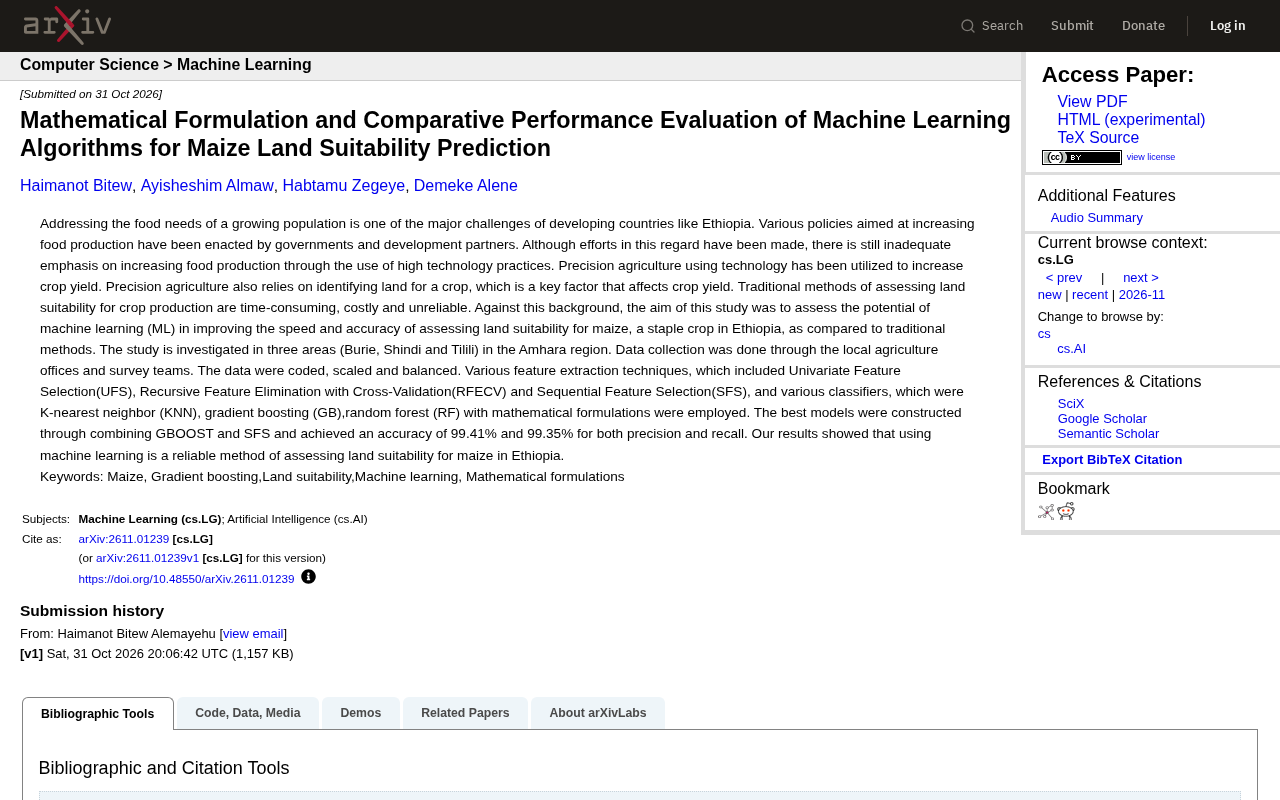
This study explored using machine learning to replace traditional land suitability assessment for maize in three areas of Ethiopia's Amhara region. After data encoding, scaling, and balancing, it compared three feature extraction techniques (UFS, RFECV, SFS) and classifiers including KNN, gradient boosting, and random forest. The gradient boosting + SFS model performed best with 99.41% accuracy and 99.35% precision and recall, significantly outperforming manual methods. The study notes that machine learning can greatly reduce time and cost and minimize human error for precision agriculture, but sample coverage is limited to three regions and generalization and the cost-accuracy trade-off need further validation.
Traditional land suitability assessment methods are time-consuming, costly, and unreliable—and machine learning is changing that. A study on maize cultivation in Ethiopia shows that combining feature selection with gradient boosting algorithms can achieve over 99% accuracy in land suitability prediction.
Why Smarter Land Assessment Is Needed
In developing countries like Ethiopia, meeting the food demands of a growing population is a major challenge. Although the government and development partners have introduced various policies to increase food production, they remain insufficient in leveraging high-tech approaches to boost output. Precision agriculture depends on identifying suitable cropland, yet traditional assessment methods are time-consuming, expensive, and unreliable. As a staple crop in Ethiopia, maize's land suitability assessment accuracy directly affects yields.
Study Design and Methods: Data Practices Across Three Regions
The study was conducted in three areas of the Amhara region—Burie, Shindi, and Tilili—with data collected through local agricultural offices and survey teams. The data were encoded, scaled, and balanced to ensure reliable model training. The study employed three feature extraction techniques: univariate feature selection (UFS), recursive feature elimination with cross-validation (RFECV), and sequential feature selection (SFS), and compared multiple classifiers including K-nearest neighbors (KNN), gradient boosting (GB), and random forest (RF), along with the corresponding mathematical formulations.
Univariate Feature Selection (UFS) is a filter-based feature selection method that independently evaluates the statistical relationship between each feature and the target variable (such as chi-square tests, mutual information, or ANOVA) and retains the top-scoring features. UFS is computationally efficient and highly interpretable, but it ignores interactions between features and may miss features that only reveal their value in combination.
Recursive Feature Elimination with Cross-Validation (RFECV) is a wrapper-based method: it first trains a model on all features, then progressively eliminates the least important features based on the feature importance provided by the model, evaluating the performance of the remaining feature subset with cross-validation at each elimination round, and finally selects the number of features that yields the highest validation score. RFECV can capture joint effects among features, but computational cost rises significantly as the number of features increases.
Sequential Feature Selection (SFS) is a greedy search strategy available in forward and backward variants: forward SFS starts from an empty set and adds one feature at each step that most improves model performance; backward SFS starts from the full set and progressively eliminates features. SFS also considers feature combinations but is prone to local optima, and each step requires retraining the model, making it suitable for scenarios with moderate feature dimensionality.
Algorithm Comparison and the Best Model
The best model, built by combining GBOOST and SFS, stood out with an accuracy of 99.41%, and both precision and recall of 99.35%. This result significantly outperforms traditional methods, demonstrating that machine learning offers high reliability and speed advantages in land suitability assessment. The study also notes that the inclusion of mathematical formulations provides a more rigorous framework for algorithm comparison.
Gradient Boosting (GB/GBOOST) is an ensemble learning method that serially trains a series of weak learners (typically shallow decision trees), with each new tree fitting the residuals (i.e., the negative gradient direction) of the previous round's predictions, thereby progressively reducing overall loss. Unlike the parallel bagging of random forests, GB's serial additive structure makes it more sensitive to hard-to-fit samples and often achieves high accuracy on tabular data, but training is slower and more sensitive to hyperparameters (learning rate, tree depth, number of iterations), requiring cross-validation tuning to avoid overfitting.
K-Nearest Neighbors (KNN) is an instance-based lazy learning method: at prediction time it computes the distances between the test sample and all training samples, then takes the K nearest neighbors for majority voting or weighted averaging. KNN requires no explicit training and is intuitive, but it is sensitive to feature scale (hence the data scaling in the study) and is susceptible to the curse of dimensionality on high-dimensional data.
Random Forest (RF) constructs multiple decision trees via bootstrap sampling, randomly selects feature subsets at each split, and finally votes or averages the results. RF is robust to noise and overfitting, can output feature importance, and often serves as a strong baseline model for tabular data classification.
Implications for Precision Agriculture
The study confirms that machine learning can rapidly and accurately assess maize land suitability, providing support for agricultural decision-making in Ethiopia and similar regions. Compared with manual assessment, ML models can substantially reduce time and cost while minimizing human error. In the future, as data accumulate and models are optimized, such methods are expected to extend to other crops and regions, contributing to food security.
Despite the high accuracy achieved, the authors also note that the samples cover only three regions, and the model's generalization ability still requires further validation. In addition, the combinatorial space of feature selection methods and classifiers is large, and practical applications must balance computational cost against accuracy.
Precision Agriculture is an agricultural production paradigm centered on managing spatial variability: it relies on GPS, remote sensing, soil sampling, and sensors to obtain information about within-field differences in soil properties, terrain, and crop growth, and then implements variable-rate fertilization, variable-rate irrigation, and differentiated planting decisions rather than treating the entire field uniformly. Land suitability assessment is precisely the precursor to precision agriculture—only after identifying which plots are suitable for which crops can subsequent differentiated inputs be justified. The role of machine learning models here is to map multi-dimensional environmental and soil indicators to suitability grades, replacing manual scoring that depends on expert experience, making assessment results reproducible, batch-generatable, and continuously updatable as new data accumulate.
One-line Summary
Machine learning combined with feature selection and gradient boosting achieves 99.41% accuracy in predicting maize land suitability in Ethiopia.
Paragraph Summary
This study explored using machine learning to replace traditional land suitability assessment for maize cultivation in three areas of Ethiopia's Amhara region. After encoding, scaling, and balancing the data, the study compared three feature extraction techniques—univariate feature selection (UFS), recursive feature elimination with cross-validation (RFECV), and sequential feature selection (SFS)—along with classifiers including K-nearest neighbors, gradient boosting, and random forest. Results showed that the model combining gradient boosting with SFS performed best, achieving 99.41% accuracy with precision and recall both at 99.35%, significantly outperforming traditional manual methods. The study concludes that machine learning can greatly reduce assessment time and cost and minimize human error, supporting precision agriculture decisions; however, since the samples cover only three regions, the model's generalization ability and the balance between computational cost and accuracy require further validation.
Related articles

AI Can Read Neural Network Weights Directly: Do Models Already Exceed Expectations?
A Reddit developer experiment shows language models can directly read neural network weights and infer their function. Astra, Opus 5.5, and Muse Spark 1.3 all passed the test, sparking discussion on model generalization and training sources.

India's Microdrama Market Explodes: EloElo Secures $80M Investment from NBCUniversal
EloElo secures $80M from NBCUniversal to boost StoryTV, its microdrama platform with over 33M monthly active users, as India's microdrama market draws global capital.

Acoustic Detection of Multi-Rotor UAVs: Fusing Handcrafted Features with Pre-Trained Embeddings
Study reveals data leakage from random splits in UAV acoustic detection, proposes source-disjoint protocol with stacked ensemble of handcrafted features and YAMNet embeddings, achieving 95.29% accuracy for low-cost drone detection.