How Can RAG Frameworks Solve the Challenge of Detecting Implicit Misogyny?
Study uses RAG to detect implicit misogyny, finding detection gains vary by dataset but explanation quality improves consistently.
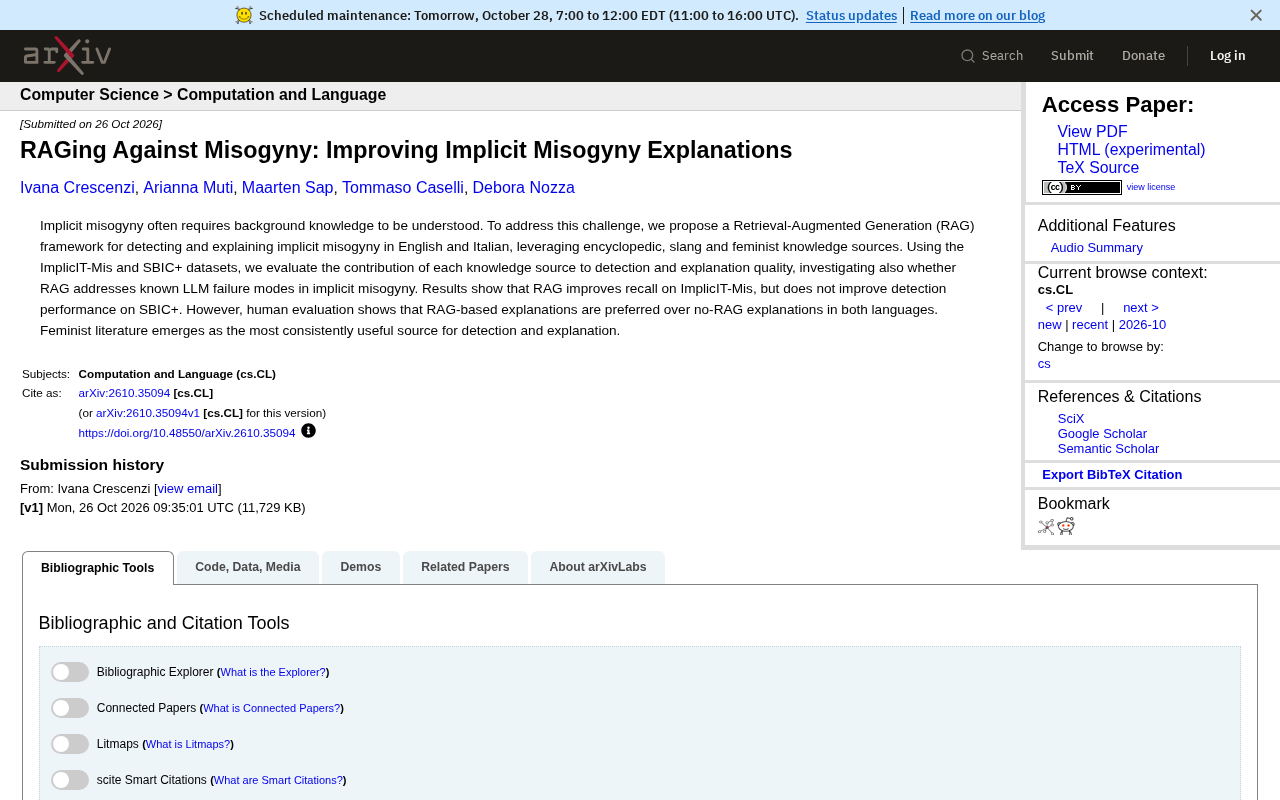
A study built a RAG framework integrating encyclopedic, slang, and feminist knowledge to detect and explain implicit misogyny in English and Italian. On ImplicIT-Mis, RAG improved recall, capturing more hidden cases; but on SBIC+, detection did not improve, showing RAG's effectiveness depends on dataset characteristics. Human evaluation showed RAG-based explanations were preferred in both languages, with clear explainability benefits. The most robust finding: feminist literature is most consistently effective in both detection and explanation, as it provides a critical framework rather than mere facts or language decoding. The study suggests RAG is not a panacea and knowledge source choice involves value judgments, with critical perspective crucial for implicit bias detection.
Implicit misogyny often requires background knowledge to be identified—a seemingly harmless joke, an internet meme, may conceal derogatory implications toward women. Traditional large language models often miss or misjudge such content due to lack of context. A recent study proposes a Retrieval-Augmented Generation (RAG) framework to detect and explain implicit misogyny in English and Italian, prompting a re-examination of RAG's actual effectiveness.
Study Design: Three Knowledge Sources and Two Datasets
The RAG framework constructed in this study integrates three types of knowledge sources: encyclopedic knowledge, slang knowledge, and feminist knowledge. The team used two datasets, ImplicIT-Mis and SBIC+, to evaluate the contribution of each knowledge source to detection and explanation quality, and to explore whether RAG addresses known failure modes of LLMs on implicit misogyny tasks.
The key to this design is that it does not treat RAG as a panacea, but rather decomposes the actual role of different knowledge sources. For a task like implicit misogyny that relies heavily on cultural context, a single knowledge base is often insufficient—encyclopedias provide factual background, slang databases decode internet language, and feminist literature offers a critical perspective. Only by combining all three can the full spectrum from literal to deep meaning be covered.
Retrieval-Augmented Generation (RAG) is a technical architecture that combines external knowledge retrieval with language model generation. Its core process is: given an input query (such as text to be detected), the system first retrieves relevant document fragments from an external knowledge base, then feeds these fragments as context along with the original input into a large language model, allowing the model to make judgments or generate explanations based on the retrieved evidence. The value of RAG lies in compensating for the limitations of a model's parametric knowledge—the model does not need to memorize all background knowledge during training but can dynamically acquire it at inference time. This makes RAG particularly suitable for tasks requiring timeliness, domain expertise, or cultural context. However, RAG's effectiveness highly depends on retrieval quality and knowledge base coverage; if the retrieved content is irrelevant or the knowledge source itself is biased, it may introduce noise instead.
Implicit misogyny refers to expressions that do not contain direct insulting words but demean women through implication, presupposition, stereotypes, or power relations. Its difference from explicit misogyny (such as direct verbal abuse) is that its identification relies heavily on shared cultural background, internet subculture knowledge, and critical perspective. For example, some internet memes appear neutral on the surface but actually carry derogatory presuppositions about women's appearance, abilities, or roles. Such content poses a challenge to traditional models because what the model needs to judge is not only literal semantics but also implied meaning and intent.
Detection Performance: Improvement, But Not Across the Board
Experimental results present a mixed picture. On the ImplicIT-Mis dataset, RAG improved recall, meaning the model could capture more previously missed cases of implicit misogyny. However, on the SBIC+ dataset, RAG did not improve detection performance.
This inconsistency indicates that RAG's effectiveness highly depends on dataset characteristics and task settings. SBIC+ samples may themselves have more sufficient contextual clues, or there may be a misalignment between its annotation standards and the knowledge retrieved by RAG. The study does not avoid this negative result but presents it as a core finding—RAG is not a silver bullet, and its gains in the detection stage are conditional.
Interestingly, the improvement in recall has special significance in implicit misogyny scenarios. False negatives mean harmful content is allowed through, and their social cost is far higher than misjudgments. RAG's improvement in recall on ImplicIT-Mis at least points to a valuable direction: by supplementing context through external knowledge, the model becomes less likely to "turn a blind eye."
Recall is a core evaluation metric in classification tasks, defined as the proportion of all true positives correctly identified by the model. In implicit misogyny detection, high recall means the model misses fewer misogynistic contents. The counterpart is precision, which is the proportion of content judged as misogynistic that is actually misogynistic. There is often a trade-off between the two: increasing recall may come at the cost of lowering precision. In content moderation scenarios, false negatives (letting harmful content into the community) are generally considered to have greater social harm than false positives (normal content being mistakenly deleted), so recall is often the more closely watched metric. RAG's improvement in recall on ImplicIT-Mis shows that retrieved external knowledge helped the model supplement context, enabling more hidden cases to be identified.
Explanation Quality: Human Evaluation Shows Clear Preference
Although detection performance was mixed, the results on explanation quality were quite consistent. Human evaluation showed that in both English and Italian, RAG-based explanations were preferred over explanations without RAG.
The significance of this finding is that the harm of implicit misogyny lies not only in the content itself but also in its hidden nature—if the model can only give the conclusion "this is misogyny" without explaining why, users will find it hard to be convinced and cannot use it for content governance. The reason RAG-provided explanations are more preferred is likely that they can cite specific knowledge evidence and clearly explain "why this sentence is problematic." For platform moderation and educational scenarios, explainability is sometimes more practically valuable than pure detection accuracy.
Feminist Literature: The Most Stable Knowledge Source
The most robust finding of the study is that feminist literature is the most consistently useful knowledge source in both detection and explanation.
This result is intriguing. Encyclopedic knowledge provides neutral facts, slang knowledge addresses language decoding, while feminist literature directly provides a critical framework—it not only tells the model "what this word means" but also tells the model "why this expression constitutes derogation." For content like implicit misogyny that requires judging intent and power relations, the lack of critical perspective is precisely the key to traditional models' failure.
This also suggests a broader implication: in tasks involving social bias detection, the choice of knowledge source is itself a value judgment. Including feminist literature in the retrieval database is not a neutral engineering decision but a redefinition of "what counts as valid knowledge."
Implications for RAG Applications
This study offers several reminders for developers currently enthusiastic about RAG implementation. First, RAG's benefits vary by task and dataset; one cannot assume that "adding retrieval always makes it better" and must conduct empirical validation in the target scenario. Second, the quality and perspective of knowledge sources matter more than quantity—among the three knowledge sources, only feminist literature showed cross-task stability. Third, explanation quality and detection performance can be decoupled; when detection metrics stagnate, RAG may still create value in the explainability dimension.
Implicit misogyny detection is essentially a context completion problem, and RAG happens to provide a mechanism for context completion. But what to supplement and where to supplement from determine the effectiveness of completion. The answer given by this study is not perfect, but honest enough: RAG is useful, but only useful when the right knowledge sources are used.
ImplicIT-Mis and SBIC+ are the two datasets used in this study, with different design goals and data characteristics. ImplicIT-Mis is a dataset specifically constructed for implicit misogyny, covering English and Italian; its samples often lack explicit clues and require background knowledge for judgment, making it more sensitive to RAG's context completion capability. SBIC+ (an extended version of the Social Bias Inference Corpus) is a broader social bias dataset covering multiple bias types, and its samples may contain richer context or clearer annotation clues. The differences between the two datasets in task settings, annotation standards, and contextual sufficiency explain the divergence in RAG's effectiveness: when the dataset itself has sufficient contextual clues, the marginal benefit of external retrieval decreases; when annotation standards misalign with retrieved knowledge, RAG may even yield no gain. This reminds researchers that when evaluating RAG, dataset characteristics must be clarified, and conclusions from a single dataset cannot be generalized.
One-line Summary
Study uses RAG to detect implicit misogyny, finding detection gains vary by dataset but explanation quality improves consistently.
Paragraph Summary
A study constructed a RAG framework integrating encyclopedic, slang, and feminist knowledge to detect and explain implicit misogyny in English and Italian. On the ImplicIT-Mis dataset, RAG improved recall, capturing more hidden cases; however, on the SBIC+ dataset, detection performance did not improve, indicating that RAG's effectiveness highly depends on dataset characteristics. Human evaluation showed that in both languages, RAG-based explanations were preferred over those without RAG, with clear explainability benefits. The study's most robust finding is that feminist literature is the most consistently effective in both detection and explanation, as it provides a critical framework rather than mere facts or language decoding. The study suggests that RAG is not a panacea, and the choice of knowledge source itself involves value judgments; critical perspective is particularly crucial for implicit bias detection.
Related articles

Three New Metapunk Skills: Building a Closed Loop for AI Software Development
Metapunk's new version adds Implement Spec, PR, and Retro skills to complete the AI software development loop. This article analyzes each skill's features and workflow to help improve AI Agent development efficiency and code quality.

6 Dark Tales of Terror: TED-Ed Uses Animation to Illustrate Fables of Human Nature
TED-Ed's six horror stories collection includes The Monkey's Paw, the Japanese tale of Oiwa, Death's Godfather, Beowulf, Poe's The Masque of the Red Death, and Hoichi the Earless. This article analyzes how these animated shorts use cross-cultural fables to explore desire, betrayal, and the price of death—and why they suit classroom discussion.

A Practical Guide to Calling Lightweight Ollama Models from Python
A complete hands-on guide to installing Ollama, pulling a 0.8B lightweight model, and calling it from Python—covering service startup, model name matching, first-load delays, and other pitfalls, with a measured 0.23s per call.