How Can Software Engineers Transition to Robotics Technician Roles? Reddit Users Share Their Experience
A software degree plus self-study can open doors to robotics technician roles, but projects must prove hardware debugging ability.
A software engineering graduate asked on Reddit whether a software background plus self-taught practice can lead to a robotics technician role. Practitioners said a software degree is a resume highlight, but employers value hands-on ability more: safely using multimeters and oscilloscopes, reading schematics, and troubleshooting independently. Self-taught projects should document the troubleshooting process rather than showcase complexity—more convincing than certificates. Certificates and training can fill electronics gaps but shouldn't be over-invested in. Direct entry-level applications are highly competitive; adjacent roles like equipment maintenance or automation commissioning are recommended, where a software background is a differentiating advantage. Interviews often test troubleshooting scenarios, so prepare ahead.
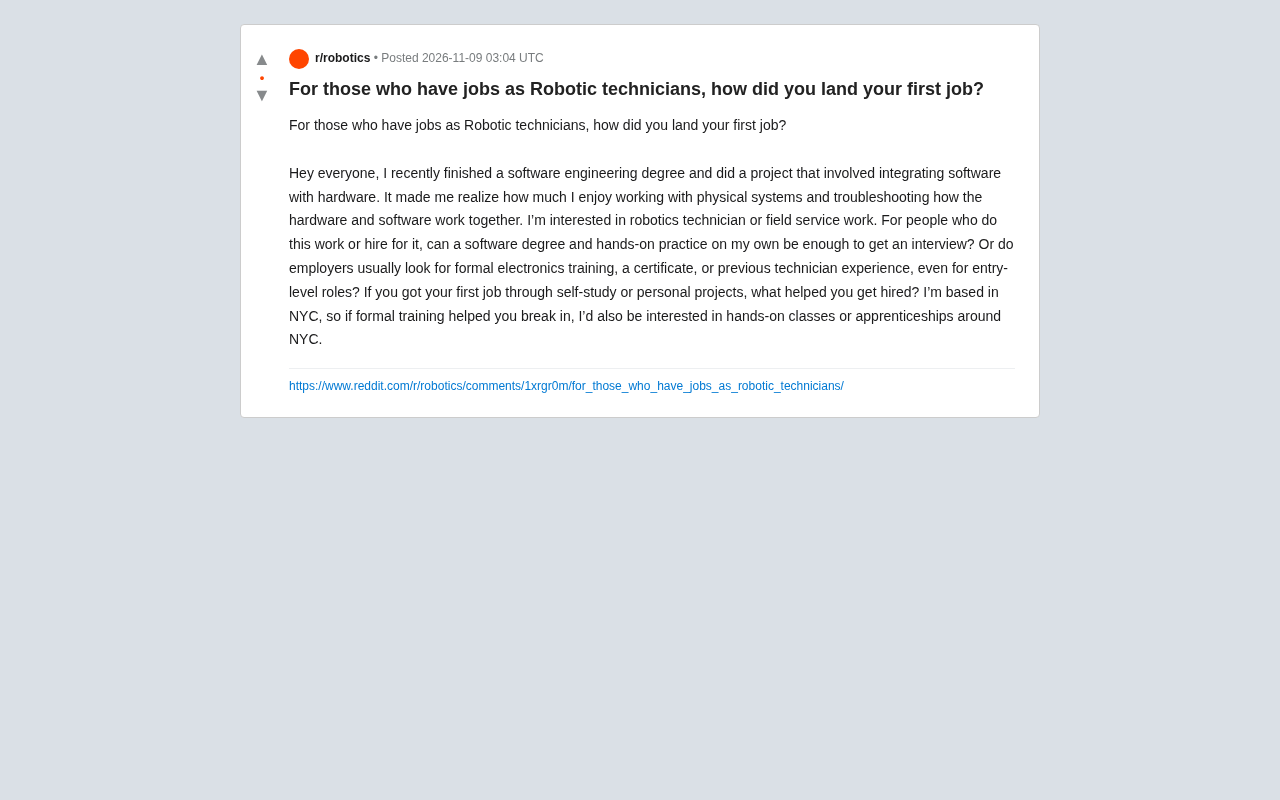
A developer who just earned a software engineering degree posted on Reddit asking: Can a software background plus self-taught practice open the door to a robotics technician role? This question resonates with many engineers who want to move from pure software into hardware-software integration. The responses from practitioners and hiring managers were pragmatic—sometimes even brutally honest.
A Software Degree Is a Plus, But Not a Ticket In
The original poster mentioned that after completing a hardware-software integration project, he developed a strong interest in physical systems. He asked directly: do employers actually value formal electronics training, certificates, or previous technician experience?
According to feedback from multiple robotics technicians and field service engineers, a software degree is a highlight on a resume, but it rarely gets a candidate through the initial screening on its own. One user who works at an industrial robot integrator said that when hiring entry-level technicians, what matters most is hands-on ability—whether you can safely use a multimeter and oscilloscope, read electrical schematics, and independently troubleshoot equipment on site. These skills are hard to prove through a software project alone.
Another hiring manager's reply was even more direct: "If I have two candidates—one with only a software degree and self-taught projects, and another with a two-year electronics technician certificate plus internship experience—I'll interview the latter first." He did add, however, that a software background is genuinely advantageous when debugging robot programs and understanding communication protocols, so it's not a negative.
Multimeters and oscilloscopes are the two most fundamental instruments in electronics troubleshooting. A multimeter is mainly used to measure voltage, current, resistance, and continuity—checking whether power supply is normal, or whether a circuit is open or shorted. An oscilloscope is used to observe signal waveforms over time, determining whether encoder pulses or signals on communication buses (such as RS-485 or CAN) are distorted or subject to interference. When troubleshooting industrial robots on site, technicians typically first use a multimeter to confirm the emergency stop circuit and power supply, then use an oscilloscope to check signal integrity. These operations may seem simple, but they require an understanding of electrical safety standards and measurement principles—exactly the kind of ability that pure software projects struggle to demonstrate.
What Makes a Self-Taught Project Convincing
Several people in the thread who successfully broke into the field shared their experiences. The consensus: projects should demonstrate a genuine understanding of hardware debugging, not just code writing. One field service technician in New York said he landed an interview based on a robotic arm project he built himself—the key wasn't how complex the arm was, but that he thoroughly documented the debugging process: how he traced wiring when the motor wouldn't turn, how he used an oscilloscope to locate the problem when encoder readings were abnormal, and how he checked termination resistors after a communication timeout. These details convinced the interviewer that he had on-site thinking.
Another commenter suggested that if the goal is a field service role, it's best to highlight troubleshooting case studies on the resume rather than project scale. He mentioned being asked a specific scenario in an interview: "The robot suddenly stops responding—what's your first step?" He answered that he would first check the emergency stop circuit and power supply, then investigate communications. That approach helped him get the offer.
Termination resistors are matching resistors used in differential communication buses (such as CAN and RS-485) to suppress signal reflection, typically 120Ω, installed at both ends of the bus. When communication lines are long or impedance is mismatched, signals reflect at the ends, causing waveform distortion, bit errors, and even communication failure. When troubleshooting communication timeout faults on site, checking whether termination resistors are missing or have abnormal resistance is one of the standard steps. Understanding this means the technician can not only read code errors but also locate problems at the physical layer—exactly the hardware thinking that interviewers want to assess in scenario questions.
Certificates and Training: Not Mandatory, But They Fill Gaps
Opinions in the thread were divided on whether formal training is necessary. Some argued that if you have no electronics background at all, certificate programs at community colleges or technical schools can help you build foundational concepts, and some employers do use certificates as a screening criterion. Others emphasized that hands-on ability and project experience are more convincing than certificates, especially at small companies or integrators, who prefer to interview people who can hit the ground running.
The original poster mentioned being in New York, and commenters suggested looking into continuing education courses at local community colleges as well as training programs offered by robot manufacturers. However, multiple practitioners warned against getting certificates for their own sake—if you already have a software degree, a few hands-on courses in electronics and PLCs are enough; there's no need to pursue another full degree.
PLC (Programmable Logic Controller) is the core control device on industrial automation production lines, implementing logic control, sequencing, and interlocking through languages such as ladder logic. Robotics technicians interact with PLCs daily: reading production line status, confirming whether the robot has received a start signal, and troubleshooting I/O point faults. A software engineer's programming mindset helps in understanding PLC program structure, but ladder logic differs significantly from general-purpose programming languages and involves electrical wiring and sensor signals. Therefore, adding a hands-on PLC course can significantly shorten the learning curve—which is why the thread recommends "a few hands-on courses in electronics and PLCs."
Which Roles Are More Realistic Entry Points
Overall, the thread suggests that competition for direct applications to robotics technician positions is fiercer than expected, especially at the entry level. Several technicians recommended entering through adjacent roles: equipment maintenance technician, automation line commissioning technician, or junior field support at a robot integrator. These positions are more accepting of a software background and allow you to build hardware experience on the job.
One commenter working in New York said his first job was in automation equipment maintenance, and he moved to a robotics technician role after six months. He believes that combined software-hardware skills are highly valued in maintenance and commissioning roles, because many faults involve both program logic and hardware. For the original poster, a software background is actually a differentiating advantage in these positions.
Practical Advice for Career Changers
Summarizing the thread, here are several actionable recommendations:
- Use projects to prove debugging ability: Document the complete troubleshooting process—it's more useful than showing off project complexity.
- Build foundational electronics skills: At minimum, be able to safely use a multimeter and oscilloscope and read simple circuit diagrams.
- Enter through adjacent roles: Equipment maintenance and automation commissioning positions are more friendly to software backgrounds.
- Leverage local resources: Community colleges and manufacturer training programs in New York can supplement your skills, but don't over-invest.
- Prepare for scenario questions in interviews: Field service roles often test troubleshooting thinking—practice how to locate problems step by step in advance.
Back to the original question: is a software degree plus self-taught practice enough? The consensus in the thread is—whether it's enough depends on how you present yourself and which roles you apply for. A software background is a differentiating advantage, but what employers ultimately want to see is whether you can handle hardware problems safely and independently. For software engineers looking to transition, closing the hands-on skills gap and using projects to demonstrate on-site thinking is more meaningful than agonizing over the degree itself.
One-line Summary
A software degree plus self-study can open doors to robotics technician roles, but you need projects to prove hardware debugging ability.
Paragraph Summary
A software engineering graduate asked on Reddit whether a software background plus self-taught practice can lead to a robotics technician role. Practitioners replied that a software degree is a resume highlight, but employers value hands-on ability more: whether you can safely use a multimeter and oscilloscope, read electrical schematics, and troubleshoot independently. Self-taught projects should thoroughly document the troubleshooting process rather than showcase complexity—this is more convincing than certificates. Certificates and training can fill gaps in electronics fundamentals but shouldn't be over-invested in. Direct applications for entry-level technician roles are highly competitive; entering through adjacent roles like equipment maintenance or automation commissioning is recommended, where a software background is actually a differentiating advantage. Interviews often test troubleshooting scenario questions, so prepare in advance.
Related articles

Seven Years of Evolution: How Far Has the Foldable Come From the First Generation?
From the first foldable to today's latest models, what has seven years changed? Shallower creases, higher brightness, thinner bodies, and smoother software migration—has the foldable crossed the chasm from enthusiasts to ordinary users? This article discusses the question based on a video comparison.

When Did Humans Start Eating Salt? A 10,000-Year History of Salt
When did humans start eating salt? From salt use at the dawn of agriculture 11,000 years ago to ancient seawater evaporation and rock salt mining, and on to the salt trade, salt taxes, and Gandhi's Salt March, this article traces salt's key role in human civilization.

Microsoft Paza Research: How African Language Speech Recognition Breaks Through Architecture and Data Bottlenecks
Microsoft's Paza research evaluates 53 speech models across 39 African languages, revealing architecture choice matters more than pre-training coverage, 200-300 hours is the practical data threshold, and language typology deeply influences recognition performance.