How Can We Evaluate Persona Consistency in LLM User Simulators Without External Annotations?
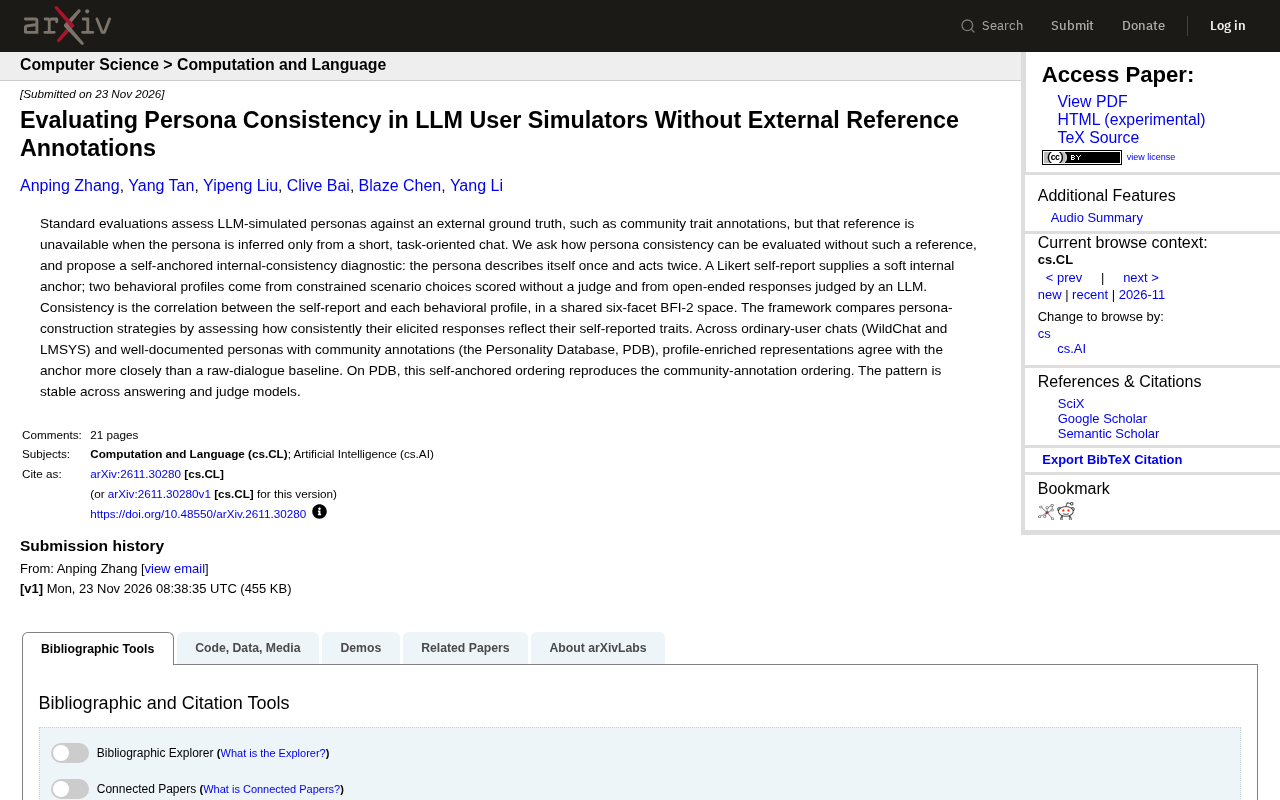
Self-anchored internal consistency diagnostics evaluate LLM simulator persona consistency without external annotations.
The study proposes a self-anchored internal consistency diagnostic for LLM user simulators lacking external persona annotations. Simulators self-report traits via a Likert scale and produce behavioral profiles from constrained selections and open-ended responses, all mapped to a shared BFI-2 space. Experiments on WildChat, LMSYS, and PDB show profile-enhanced representations are more consistent than raw dialogue, and self-anchored rankings reproduce community annotations, stable across models.
Why We Need Reference-Free Persona Consistency Evaluation
LLM user simulators are becoming increasingly common in scenarios such as dialogue system evaluation and social simulation, but evaluating the persona consistency of these simulators faces an awkward dilemma: standard methods require external ground-truth annotations as a reference, such as persona trait ratings from the community. However, when a simulator's persona is inferred solely from a short, task-oriented chat transcript, such external references simply do not exist.
According to the study Evaluating Persona Consistency in LLM User Simulators Without External Reference Annotations, the absence of reference annotations calls for new approaches to evaluating persona consistency. The study proposes a "self-anchored internal consistency" diagnostic method that relies on no external annotations at all, using only the simulator's own self-reports and behavioral outputs for cross-validation.

Self-Anchored Diagnostics: Let the Simulator "Self-Report Once, Act Twice"
The core design of the method can be summarized as "self-report once, act twice." First, the simulator self-reports personality traits via a Likert scale, forming a soft internal anchor; then, behavioral profiles are obtained from two different behavioral dimensions: constrained scenario selection (no judge scoring required) and open-ended responses (evaluated by an LLM).
Ultimately, consistency is defined as the correlation between the self-report and each behavioral profile, with both mapped onto a shared six-dimensional BFI-2 personality space. In this way, evaluation becomes a matter of comparing how consistent the responses elicited by different persona construction strategies are with the self-reported traits—entirely without external ground-truth annotations.
The cleverness of the framework lies in shifting the evaluation question from "does the simulator match a real persona" to "is the simulator's behavior consistent with its own self-description." Although this internal consistency cannot fully replace external validity, it provides an actionable diagnostic signal in scenarios where references are lacking.
BFI-2 (Big Five Inventory-2) is the second edition of the widely used Big Five personality inventory in personality psychology, dividing personality into five major dimensions: extraversion, agreeableness, conscientiousness, negative emotionality (neuroticism), and open-mindedness. Each dimension is further subdivided into three facets, for a total of 15 facets, enabling more fine-grained characterization of personality traits. In LLM simulator evaluation, mapping both self-reports and behavioral profiles onto the six-dimensional BFI-2 space (possibly including an additional dimension or a specific variant) ensures that comparisons are made within the same semantic framework, avoiding bias introduced by differing dimension definitions. This standardized space makes correlation analysis interpretable.
The Likert scale is a common rating method in psychometrics, typically asking respondents to indicate their level of agreement with a series of statements, for example on a 5-point or 7-point scale from "strongly disagree" to "strongly agree." In this method, the simulator self-reports personality traits via a Likert scale, effectively generating a continuous, soft internal reference point rather than hard categorical labels. This design allows for capturing subtle differences in personality traits and enables correlation computation with subsequent behavioral profiles (which can likewise be quantified as continuous values) to assess internal consistency.
Experimental Validation: Cross-Dataset and Cross-Model Stability
The study validated the framework's effectiveness on multiple datasets. For general user chats (WildChat and LMSYS), as well as well-known personas with community annotations (Personality Database, PDB), experimental results show that profile-enhanced representations are more consistent with the self-anchor than the raw dialogue baseline.
More critically, on the PDB dataset, this self-anchored ranking is able to reproduce the ranking from community annotations. That is, even without using community annotations as the basis for evaluation, the relative ranking produced by the self-anchored method is consistent with the ranking from external references. This indicates that the method is not only internally self-consistent but also correlated with external validity.
Furthermore, the pattern remains stable across both answer models and judge models. This means the framework does not depend on a specific model choice and has good robustness.
Implications for LLM Simulator Development
This research provides a practical path for evaluating LLM user simulators. During development, developers can use self-anchored diagnostics to quickly compare different persona construction strategies without collecting expensive external annotations. For example, when persona must be inferred from short conversations, one can choose representation methods that show greater consistency in self-anchored evaluation.
At the same time, the framework reminds us that persona consistency evaluation is not a single dimension. The correlation between self-reports and behavioral profiles can reveal the degree of divergence between what the simulator "says" and what it "does," which traditional external annotation methods struggle to capture.
However, the authors also note that the self-anchored method remains a diagnostic tool and cannot fully replace external validation. When conditions permit, combining external references such as community annotations is still the more reliable approach.
Conclusion
The reference-free persona consistency evaluation framework uses self-anchored internal consistency diagnostics to correlate the simulator's self-reports with its behavioral outputs in a shared BFI-2 space. Experiments demonstrate that the method can reproduce the ranking of external annotations across multiple datasets and is robust to model choice. This opens up new possibilities for rapid iteration and evaluation of LLM user simulators.
One-line Summary
Proposes self-anchored internal consistency diagnostics to evaluate persona consistency in LLM simulators without external annotations.
Paragraph Summary
The study addresses the difficulty of evaluating consistency in LLM user simulators when external persona annotations are lacking, proposing a self-anchored internal consistency diagnostic method. The method has the simulator self-report personality traits via a Likert scale to form an internal anchor, and obtains behavioral profiles from two behavioral dimensions—constrained scenario selection and open-ended responses—both mapped onto a shared six-dimensional BFI-2 personality space. Consistency is assessed by computing the correlation between self-reports and behavioral profiles. Experiments on WildChat, LMSYS, and PDB datasets show that profile-enhanced representations are more consistent than the raw dialogue baseline, and that on PDB the self-anchored ranking reproduces the community annotation ranking, remaining stable across answer and judge models. The framework provides a rapid evaluation path for simulator development without expensive external annotations, though the authors note it remains a diagnostic tool and cannot fully replace external validation.
Related articles

Unkernel: Compiling the Linux Kernel to WebAssembly
The Unkernel project compiles a real Linux kernel to WebAssembly, making it possible to run a complete kernel in the browser. This article covers its technical principles, challenges, and prospects.
New Claude Sonnet Model Tested: Performance Approaches Opus with Less Thinking
Anthropic quietly tests a new Sonnet model in Claude Code—performance approaches Opus 5.5 with far fewer thinking tokens, plus Codex transfer optimization, xAI's low-level rewrite, Google Antigravity updates, and the AI science understanding gap.

Building a Reasoning Model from Scratch: Making Complex AI Algorithms Accessible
Mike Finley, author of Build a Reasoning Model from Scratch, shows how a few hundred lines of code, single-sample training, and code reuse make complex AI algorithms like RL and verifiers accessible to all.