How Capacity-Aware Decision Policies Break the Vicious Cycle of Discharge Prediction

Predictive discharge algorithms create censoring bias through decision-filtered data; capacity-aware policies can break the vicious cycle.
The article examines a feedback loop in hospital discharge decisions: when models assess readmission risk and guide discharge, the decisions themselves determine when outcomes are observed, causing censoring bias—disadvantaged groups are underrepresented and model bias becomes entrenched. Combining queueing theory and Markov decision processes, researchers propose a capacity-aware "discharge-up-to" policy that naturally diversifies length-of-stay observations, converging to unbiased risk estimates without explicit fairness constraints. Simulations show 24%-25% lower learning error and a 38%-63% narrower readmission cost gap, challenging the assumption of inherent tension between accuracy and fairness. The article notes that deploying medical AI requires incorporating operational policies into model lifecycle management, and discusses limitations around convergence assumptions and cross-institutional generalizability.
When Prediction Algorithms Decide Discharge: An Overlooked Feedback Loop
Hospital discharge decisions are increasingly relying on predictive algorithms. These models assess patient readmission risk and help physicians determine when to discharge a patient. But research from rss points out that when these predictors themselves carry bias, the data generated by discharge decisions reinforces that bias in turn, creating a vicious cycle.
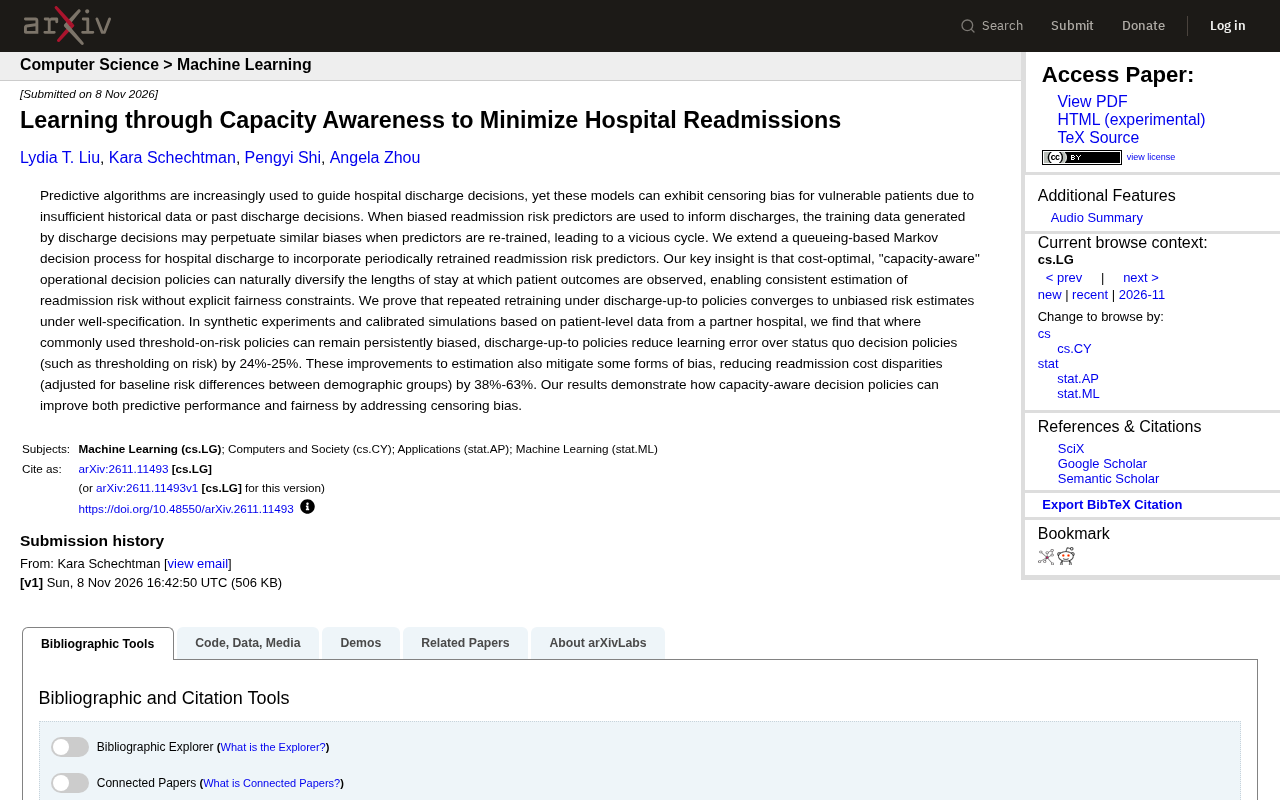
The root of the problem lies in censoring bias. For disadvantaged patient groups with insufficient historical data, models struggle to accurately estimate readmission risk. More critically, discharge decisions themselves determine at what time points we observe patient outcomes—if a certain risk-threshold strategy always keeps high-risk patients in the hospital a few extra days, then data on "what outcomes look like under short lengths of stay" is forever missing. When the model is retrained, it can only learn from data that has been filtered by the decision, and the bias becomes entrenched.
Censoring bias is a core concept in survival analysis, referring to the systematic bias in estimates caused by missing outcome data due to observation cutoff or non-occurrence of events. In the medical context, the outcome of whether a patient is readmitted after discharge can only be observed once the patient is allowed to leave the hospital; if a decision policy keeps certain patients hospitalized for extended periods, the outcomes of these patients under "short length of stay" conditions can never enter the training data. This non-random missingness is directly related to the decision rule and constitutes informative censoring, which distorts risk model estimates. Traditional survival analysis assumes that censoring is independent of outcomes, but in algorithm-driven discharge decisions, this assumption is broken, so data diversity must be actively created at the level of decision policy to correct the bias.
Capacity-Aware Policies: Replacing Fairness Constraints with Operational Logic
The research team combined queueing theory with Markov decision processes to build a discharge decision model that includes a periodically retrained readmission risk predictor. Their core insight is quite illuminating: a cost-optimal "capacity-aware" operational policy can naturally spread patient outcome observation points across different lengths of stay.
In other words, when a decision policy takes operational factors such as ward capacity and turnover pressure into account, it forces the system to accumulate data across a variety of lengths of stay, rather than pushing all patients toward a single risk threshold. This data diversity is precisely what is needed to eliminate censoring bias. The study proves that, under correct model specification, repeatedly retraining "discharge-up-to policies" converges to unbiased risk estimates—without introducing any explicit fairness constraints.
This stands in sharp contrast to the common "risk threshold" strategy. The threshold strategy seems reasonable: keep the patient hospitalized if risk is above a certain line. But it is precisely the breeding ground for persistent bias.
Markov decision process (MDP) is a mathematical framework for sequential decision-making, consisting of states, actions, transition probabilities, and reward functions, with the goal of maximizing cumulative reward over long-term interaction. In this study, states can include patient characteristics, current length of stay, and ward occupancy; actions are "discharge" or "continue hospitalization"; and rewards relate to readmission costs and resource utilization. Modeling discharge decisions as an MDP enables researchers to analyze how policies affect the future data generation process, not just single-step prediction. Queueing theory provides tools for describing ward capacity, arrival rates, and service times, allowing "capacity-aware" policies to explicitly account for operational constraints, thereby spreading observation points across multiple lengths of stay and breaking the feedback loop of censoring bias.
Experimental Evidence: Dual Improvement in Learning Error and Fairness
The research team validated their approach through synthetic experiments and simulations calibrated on patient-level data from a partner hospital. The results show that in scenarios where commonly used threshold policies persistently maintain bias, the "discharge-up-to" policy reduces learning error by 24% to 25% relative to the status-quo decision policy.
More noteworthy is the improvement in the fairness dimension. The improvement in estimation accuracy simultaneously alleviates certain forms of bias: after adjusting for baseline risk differences across demographic groups, the readmission cost gap narrows by 38% to 63%. This means that improving prediction itself can lead to more equitable outcomes, without the need to add extra fairness constraints—which in practice often face controversial trade-offs.
This finding challenges the common assumption that "prediction accuracy and fairness are in inherent tension." At least in this discharge decision scenario, both can be achieved simultaneously through clever operational policy design.
Discharge-up-to policies originate from the "(s, S)" policy idea in inventory management: discharge is triggered when system capacity or resource occupancy reaches a certain threshold, rather than setting an individual risk threshold for each patient. Specifically, the policy decides whether to discharge a patient based on the current ward occupancy level, linking discharge decisions to operational status. The advantage of this policy is that it does not uniformly push all high-risk patients toward long stays, but rather distributes patients naturally across different lengths of stay according to capacity pressure, thereby preserving multi-level outcome observations in retraining data. Theoretical proofs show that, under correct model specification, repeatedly retraining such policies can converge to unbiased risk estimates without explicit fairness constraints.
Implications for Deploying Medical AI
The value of this research extends beyond discharge decisions. It reveals a more general problem: when predictive models participate in decision-making and decisions in turn generate training data, model evaluation and improvement cannot be discussed in isolation from the decision policy. The linear approach of "first train the model, then deploy the decision" in traditional machine learning pipelines fails in this kind of feedback loop.
For practitioners of medical AI, this means operational policies need to be incorporated into model lifecycle management. The reason capacity-aware policies are effective is precisely that they actively create data diversity rather than passively waiting for data to accumulate. This idea may be transferable to other scenarios with similar feedback loops—credit approval, hiring screening, content recommendation—wherever decisions affect observed data, it is worth asking: is our policy systematically obscuring certain information?
The study's limitations should also be acknowledged: the convergence proof relies on the assumption of correct model specification, which may not hold in reality. In addition, the simulation is based on data from a single partner hospital, and cross-institutional generalizability remains to be tested. But the core argument—that operational policy design can be a lever for improving both prediction and fairness—is solid enough to warrant serious attention from healthcare systems and AI researchers.
One-line Summary
Predictive discharge algorithms produce censoring bias because decisions filter the data; capacity-aware policies can break the vicious cycle.
Paragraph Summary
This article explores the feedback loop problem caused by predictive algorithms in hospital discharge decisions: when models assess readmission risk and guide discharge, the decisions themselves determine the time points at which outcomes are observed, leading to censoring bias—disadvantaged groups are underrepresented, and model bias becomes entrenched. The research team combined queueing theory with Markov decision processes to propose a capacity-aware "discharge-up-to" policy that naturally disperses length-of-stay observation points through operational logic, converging to unbiased risk estimates without explicit fairness constraints. Simulations show that this policy reduces learning error by 24%-25% and narrows the readmission cost gap by 38%-63%, challenging the assumption of an inherent tension between prediction accuracy and fairness. The article concludes that deploying medical AI requires incorporating operational policies into model lifecycle management, and discusses the limitations of convergence assumptions and cross-institutional generalizability.
Related articles

Gemini 4 Hydrogen vs Sonnet Comparison Test: Uses Only 1% of Weekly Quota, Performance on Par
Hands-on test: Gemini 4 Hydrogen vs Sonnet on the same CRUD task—Hydrogen used only 1% weekly quota with comparable performance and better UI details, while Anthropic's model used 7%. Developer says daily tasks don't require expensive models.

Gemini 4 Neon Released: Beats Opus 5.5 on Multiple Benchmarks, Google Returns to the Top Tier
Google DeepMind releases Gemini 4 Neon: 61 on the Artificial Analysis intelligence index (3rd) and 1st on the coding index, beating Opus 5.5 on multiple benchmarks. $3/$15 per million tokens; available in the Gemini API and AI Studio.

Gemini 4 Neon Review: Benchmark Scores Rival Carbon, API Cost-Performance Analysis
Full review of Google Gemini 4 Neon: benchmark scores rival Carbon, API priced at 2x Hydrogen, yet Antigravity quota consumption is only 1x (vs Carbon's 3x). Real tests show it replaces 90% of Carbon use cases. Includes channel restrictions, ban risks, and combination strategy analysis.