How Cooley Is Reinventing IPO Legal Workflows with ChatGPT: A Look at the GO Public Tool
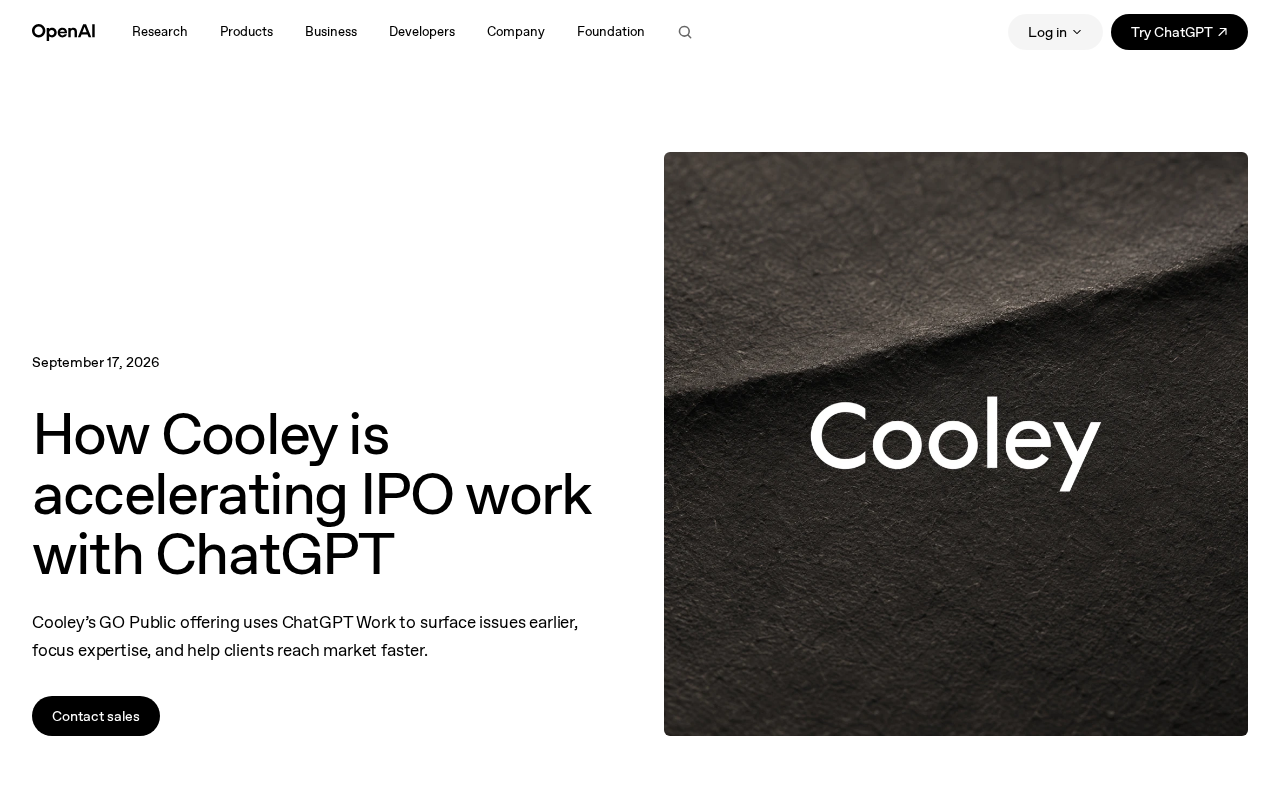
Cooley built the GO Public tool on ChatGPT to bring AI-driven early risk detection into IPO legal preparation.
International law firm Cooley has embedded generative AI into its core IPO legal services by building an internal tool called GO Public on ChatGPT Enterprise. The tool's central value lies in enabling lawyers to surface potential issues earlier in the process, concentrating scarce professional judgment on truly critical decision points rather than burning it on preliminary document screening. IPO work — document-intensive, highly structured, and rich in historical precedent — is a natural fit for large language model assistance. Cooley's approach reflects the mainstream path for professional services firms adopting AI: build custom applications on mature enterprise models, let AI drive efficiency gains, and keep humans in control of final judgment rather than pursuing full automation.
Leading international law firm Cooley is bringing generative AI into the heart of its capital markets practice. Built on ChatGPT Work, the firm developed an internal tool called GO Public to accelerate the legal preparation process for initial public offerings (IPOs). This effort offers a concrete window into how AI is making its way into high-stakes, highly specialized legal services.
GO Public: Injecting Intelligence into the IPO Process
An IPO is one of the most complex and document-intensive legal processes in corporate finance, involving prospectus drafting, financial disclosure review, regulatory compliance checks, and a mountain of repetitive work where errors simply cannot happen. Cooley's core objective in building GO Public is to "inject intelligence" into this process — enabling lawyers to identify potential issues earlier, so that valuable professional judgment can be directed where it matters most.
In other words, AI here isn't replacing lawyers — it's acting as an upfront "risk detector." Under the traditional model, many issues only surface after documents have gone through multiple rounds of review, often close to the filing deadline. With a ChatGPT-powered tool, these issues can theoretically be caught much earlier in the process.
The legal preparation work for an IPO is enormously demanding in practice. In the U.S. market, for example, a company must file an S-1 registration statement with the SEC, a document that typically runs hundreds of pages and covers more than a dozen core sections — business description, risk factors, financial statements, Management's Discussion and Analysis (MD&A), and more. The entire process from kickoff to listing usually takes 6 to 12 months, involving close collaboration among law firms, investment banks, auditors, and underwriters, with documents revised repeatedly throughout. Any material misstatement or omission in the disclosures can trigger regulatory scrutiny or post-listing litigation. It is precisely this combination of massive volume and zero tolerance for error that makes AI-assisted review genuinely valuable in this context.
Why IPOs Are a Natural Fit for AI
From an industry perspective, IPO work is inherently well-suited for large language model assistance. The work is document-intensive, highly structured, rich in historical precedents to draw from, and demands exceptional accuracy.
Generative AI has a clear efficiency edge in tasks like processing structured text, rapid retrieval and comparison, and generating initial drafts. When lawyers are facing mountains of disclosure documents, AI can take on the "heavy lifting" — preliminary screening, clause comparison, consistency checks — freeing humans from mechanical labor.
It's worth emphasizing that ultimate responsibility in legal work always rests with people. Cooley's approach — "focusing lawyers' judgment on what matters most" — captures the dominant paradigm for applying AI in professional services today: AI amplifies efficiency; humans retain judgment.
A Signal of AI Transformation Across Professional Services
Cooley's approach is not an isolated case — it's a microcosm of a broader shift underway across law, finance, consulting, and other professional services. These industries were once considered high-barrier fortresses that AI would struggle to penetrate. Now, through customized tooling, they are steadily tapping into generative AI capabilities.
Building internal tools on top of an enterprise platform like ChatGPT Work also reflects a pragmatic path to adoption: law firms don't need to train models from scratch. Instead, they build an application layer on top of a mature foundation model that fits their own workflows. This lowers the technical barrier and makes integration with existing processes far smoother.
For the industry as a whole, cases like this matter because they validate the feasibility of AI in high-value, high-risk professional contexts. Once leading firms successfully run these models and demonstrate their efficiency and safety, peers tend to accelerate their own adoption.
ChatGPT Work — referring to OpenAI's ChatGPT Enterprise or Teams offerings — differs from the consumer product in several key ways relevant to enterprise use: user data is not used to train models, it supports longer context windows (enabling processing of longer documents), provides admin-level access controls, and offers stronger data privacy compliance guarantees. These features are especially critical for sensitive industries like law — leaks of client financial data, trade secrets, or legal strategy could have serious consequences. By choosing to build on this enterprise-grade platform rather than the public version of ChatGPT, Cooley is making an institutional statement about where data security boundaries must be drawn.
The Line Between Efficiency and Judgment
This initiative also raises questions worth watching over time: In a context like IPOs where the tolerance for error is extremely low, how can AI output be reliably trusted? How are data confidentiality and compliance ensured? And just how broad is AI's ability to "catch problems earlier"?
Based on what's publicly available, Cooley is emphatic that the role is "assistance," not "automated decision-making" — positioning AI as a lever that amplifies human expertise. This measured stance may well be exactly the right posture for professional services firms embracing AI: use technology to push the boundaries of efficiency, but always leave the final call to humans.
Related articles

Prompt → MCP → Agent → Skill: The AI Terminology Evolution Chain Explained in 5 Minutes
A clear guide to five core AI concepts — Prompt, MCP, Agent, Skill, and Cowork — and how they connect in a layered evolution chain from simple instructions to multi-agent teamwork.
OpenAI Discloses Model Anomalies, DeepMind Launches AGI Forum, NVIDIA Partners on Grid Power Management
Sept 17 AI roundup: OpenAI publishes model anomaly disclosure framework with 6 reports, Google DeepMind launches AGI public forum, NVIDIA leads AI energy management alliance with 18 partners.
Build a Local AI Agent with Python in 10 Minutes: Ollama + PydanticAI in Action
A hands-on guide to building a fully local AI agent with Python, Ollama, and PydanticAI in 10 minutes — covering model selection, tool functions, and conversation loops.