Prompt → MCP → Agent → Skill: The AI Terminology Evolution Chain Explained in 5 Minutes
Five core AI concepts — Prompt, MCP, Skill, Agent, Cowork — explained as one clear evolution chain.
This article uses a layered mental model to connect five hot AI concepts into a clear evolution chain. Prompts translate human intent into machine instructions; MCP (Model Context Protocol) is the universal standard that lets AI connect to external systems; Skills package best practices into reusable capability units; Agents can independently plan, execute, and review complex tasks; and Cowork enables multiple specialized Agents to collaborate on tasks too large for any single agent. Together, they form a complete AI "operating system" — from data access to top-level decision-making.
If you've been overwhelmed by the flood of AI buzzwords — Prompt today, Agent tomorrow, MCP the day after — this article is for you. A content creator laid out a layered mental model that strings these terms into a clear evolution chain. Once you understand it, you'll see exactly how AI has transformed from a rigid tool into something closer to a reliable colleague.
Prompt: Where Every AI Interaction Begins
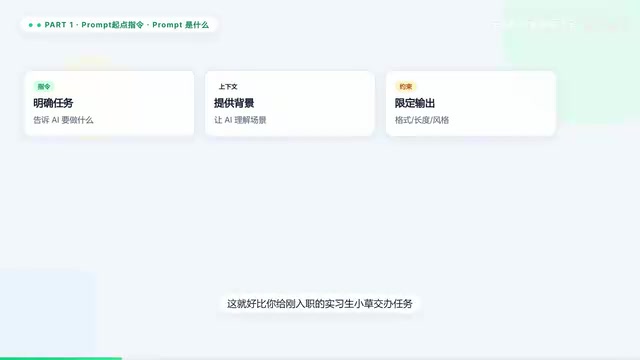
A Prompt — commonly known as a prompt or instruction — is essentially a task description you give to an AI. Without a Prompt, even the most powerful model is just a blank page waiting to be written on. Its core role is that of a "translator" — converting the human-language thoughts in your head into goals the machine can understand and act on.
Think of it like assigning a task to a brand-new intern. If you just say "get me a coffee," they'll be lost: hot or iced? Sugar? Writing Prompts works the same way — you need to clearly communicate your specific requirements to that digital brain on the other side of the screen. The clearer the instruction, the higher the chance of hitting the mark.
Prompts address one-time needs and serve as the starting point of the entire chain. But they have a natural limitation: the AI might understand what you're saying but still lack access to the real-world data needed to actually carry out the task.
MCP: The Data Bridge to the Real World
MCP stands for Model Context Protocol — don't let the acronym intimidate you. It's simply the AI industry's unified standard for data connectivity. With this standard in place, AI can securely and reliably connect to all kinds of external systems — your calendar, your company's database, local files, even the websites you frequent.
The video uses a spot-on analogy: MCP is like the USB-C port on your phone. In the past, connecting an AI to an external application was like rummaging through a drawer full of mismatched old charging cables — every new device meant starting from scratch. Now, a single universal protocol means plug in and go.
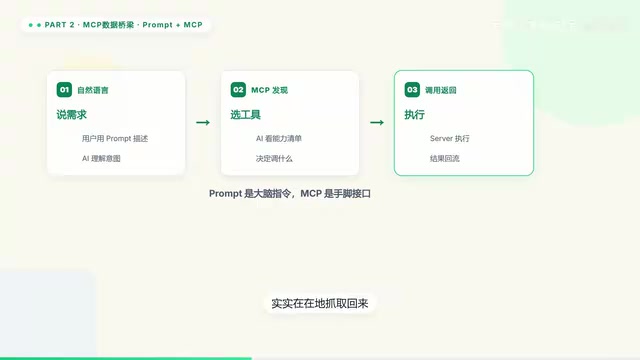
This solves one of AI's core pain points: it used to be a "brain" stranded on an island — intelligent but unable to touch real business data. With the MCP bridge in place, AI isn't just talking anymore. It can actually "reach out" and retrieve the information you need.
A bit of background: MCP was officially released and open-sourced by Anthropic in November 2024. It has since gained support from major AI players including OpenAI and Google DeepMind, and is rapidly becoming the de facto industry standard. Technically, MCP uses a client-server architecture: the AI model acts as the client, while external data sources or tools (like Google Calendar, GitHub, or local file systems) act as MCP servers. The two communicate via a standardized JSON-RPC protocol. This means developers only need to write an MCP adapter for a tool once, and every MCP-compatible AI application can call it directly — eliminating the repetitive work of building custom integrations for each AI. For everyday users, MCP turns requests like "have the AI check my email" or "let the AI access our internal database" from custom engineering projects into plug-and-play standard operations.
Skill: Crystallizing Experience into Reusable Capability Packages
Plain-text Prompts have a critical weakness — they're one-and-done. If every task requires you to re-explain all the rules in a lengthy preamble, you're burning through tokens and your own patience. What we really need is persistent capability — standardized operating procedures (SOPs) that let AI draw on proven approaches over and over again.
Think of two different managers: one who spends every day verbally coaching employees through their work (exhausting for everyone), and one who hands each employee a well-organized operations manual from day one. The manual is the Skill — a capability package. It bundles best practices, complex long-form instructions, and templates into a dedicated playbook the AI can reference anytime.
Through Skills, AI evolves from a use-it-and-discard-it chat tool into a sustainably reusable professional asset. Valuable institutional knowledge and proven methodologies can be preserved indefinitely — no more worrying about critical know-how walking out the door.
Technical context: Skills take different forms across AI platforms, but the underlying concept is always the same: a pre-configured, reusable capability unit. On enterprise AI platforms like Coze (ByteDance) or Baidu's Wenxin Agent, Skills typically appear as "workflows" or "plugins." Developers can encapsulate a fixed process — say, "read customer email → extract key info → populate CRM → draft a reply" — into a single one-click Skill. From a software engineering perspective, Skills are AI's inheritance of the "function encapsulation" and "modular design" philosophy: abstracting high-frequency, complex operations into a black-box interface where callers only need to know the inputs and outputs. This dramatically lowers the barrier to reusing AI capabilities and lets non-technical users assemble complex AI workflows like snapping together building blocks.
Agent: The Digital Employee Who Thinks Independently
An AI loaded with Skills but still requiring a human to trigger every single action is like a powerful calculator that only works when you press the buttons. An Agent is fundamentally different — it's a digital employee with a genuine brain, capable of independent reasoning and self-directed action.
Agents have planning capability: faced with a complex problem, they'll break down the goal themselves, decide which tools to call, execute the steps, and then review the results. A perfect example: you say "help me plan a birthday party." A standard AI might write you some event copy at best. An Agent, handed this broad goal, automatically decomposes it — checking your calendar for availability, using a search engine to find venues, creating a shopping list in a notes app, and finally sending invitations via email. Fully automated, end to end.
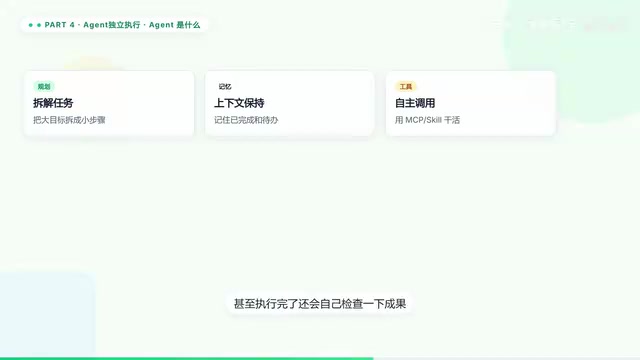
The core value of this shift is that AI moves from passive answering to active execution. The Agent holds genuine execution authority, becoming a command center capable of handling complex tasks from start to finish. You don't just get a strategist advising from the sidelines — you get an operator who actually gets things done.
Technical context: The core operating mechanism of an Agent is typically called the ReAct loop (Reasoning + Acting) — a closed loop where reasoning and action alternate: the Agent analyzes the current state, decides on the next action, executes it, observes the result, then reasons again based on new information, repeating until the task is complete. This is fundamentally different from traditional AI's single-round "one input, one output" model. Mainstream Agent frameworks today include LangChain, AutoGPT, and CrewAI, all centered on managing this "think-act-observe" cycle. It's worth noting that Agent autonomy also introduces new risks: if the goal is vaguely defined, an Agent might head in the wrong direction and keep going without realizing it. In practice, this is why Human-in-the-loop checkpoints are commonly used — requiring human review at critical steps before proceeding, striking a balance between autonomy and control.
Cowork: Multi-Agent Teamwork
What happens when a single Agent hits the ceiling on a truly massive project? That brings us to the top of the evolution chain — Cowork, or multi-agent collaborative work.
When a task is too large for any single agent to handle alone, you assemble a "dream team" of specialized Agents: one focused on writing product requirements, one designing system architecture, one writing code, and one running rigorous tests. They work in close coordination like a real development team, forming a digital assembly line.
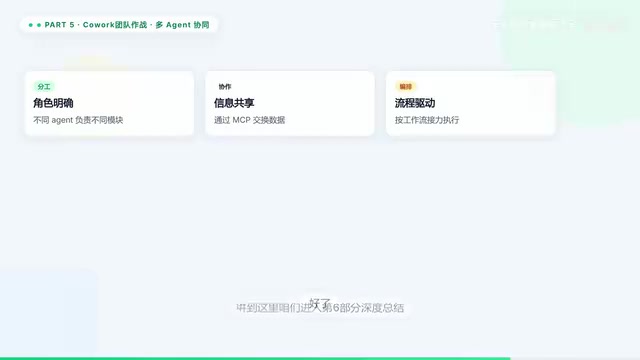
What makes this model especially clever is its built-in intelligent rollback mechanism. If the testing Agent finds a bug in the code the developer Agent wrote, it can send it straight back for a rewrite. Through multi-role division of labor and iterative review workflows, even massive, complex tasks can be completed at high quality — the system won't crash from cognitive overload.
The Complete Evolution Chain, from 30,000 Feet
Step back and look at the full picture. These five concepts form a perfectly layered workflow: you issue instructions via a Prompt, awakening an Agent — the intelligent core; the Agent accesses external information through the MCP data interface, fluently draws on pre-packaged Skill playbooks to get work done, and when the task exceeds its solo capacity, it assembles a squad and completes the challenge through Cowork — seamlessly, from start to finish.
Look deeper and you'll see that this architecture already constitutes an "operating system" purpose-built for AI: at the base layer are the built-in application capabilities (Skills); the middle layer is the data bus laid by MCP; at the top layer, AI Agents with independent reasoning capabilities orchestrate everything. This architecture supports a complete closed loop — from raw data acquisition all the way up to high-level strategic decision-making.
A real-world analogy makes it tangible. Say you're renovating your home: you (the client) issue the Prompt — "redesign the living room in Scandinavian style." The Agent acts like a top-tier project manager, immediately breaking down the plan and coordinating every trade from demolition to furniture sourcing. A fully digital construction pipeline kicks into gear.
Once you've internalized this mental model, AI terminology anxiety becomes a thing of the past. The natural next question: what's the most tedious, repetitive workflow in your work right now — and could your own dedicated AI team handle it on autopilot?
Related articles
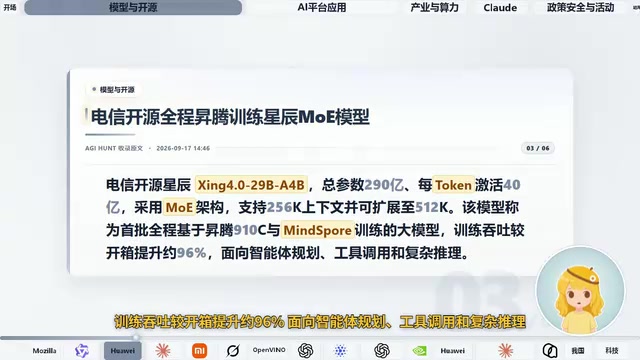
AI Daily Briefing: Qwen3-Omni Full-Modality Model Launches, Huawei Ascend 960 and Grok's New Model Surface
AI Daily: Qwen3-Omni Flash launches with full-modality support and 93% cost cuts; Huawei unveils million-processor AI architecture; Ascend 960 rumored; Grok spotted on GCP; N8N hits CVSS 10 vulnerability.
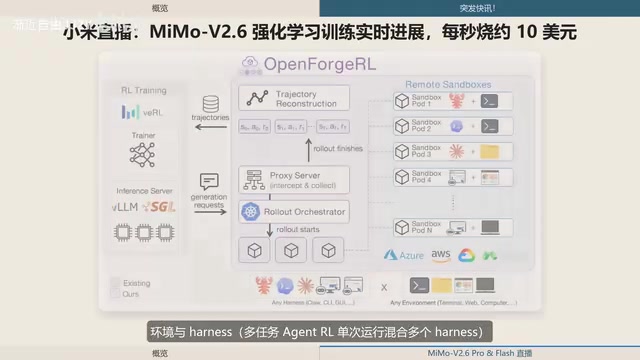
Xiaomi MiMo-V2.6 Live Training: ¥8.55M Spent in One and a Half Days, ~$10 per Second
Xiaomi's MiMo team live-streams MiMo V2.6 Pro/Flash RL training, spending ¥8.55M (~$1.28M) in 1.5 days — ~$10/sec. Covers compute scaling, open-source plans, and DeepSWE benchmarks.
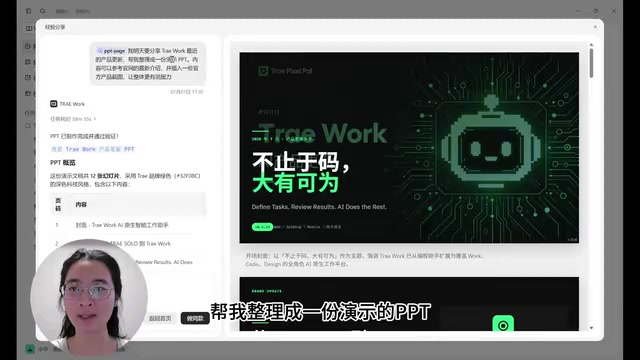
ByteDance Trae Work Getting Started Guide: 11 Use Cases Explained
A hands-on guide to ByteDance's Trae Work AI agent — covering Work, Code, and Design sections across 11 use cases including PPT generation, data analysis, coding, and more.