How Deep Sequence Models Enable Conformal Prediction for Time Series

Three pathways for integrating deep sequence models into conformal prediction for reliable time series uncertainty quantification.
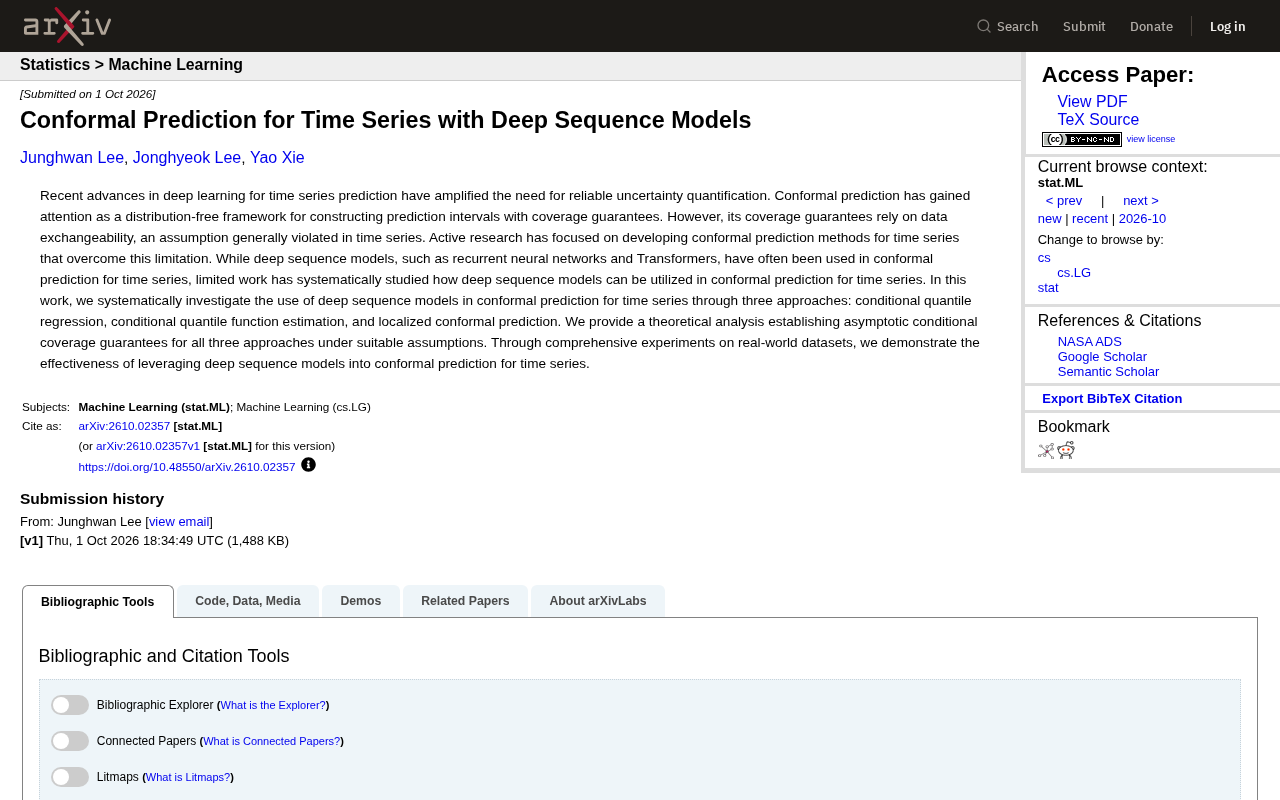
Deep learning time series forecasting has long lacked reliable uncertainty quantification. While conformal prediction offers distribution-free coverage guarantees, its core assumption of data exchangeability is almost always violated in temporal settings. This study systematically examines three pathways for integrating deep sequence models (RNNs, Transformers) into time series conformal prediction: conditional quantile regression, conditional quantile function estimation, and localized conformal prediction. Each pathway offers different trade-offs in implementation complexity, distributional expressiveness, and non-stationarity adaptation. The study further provides theoretical proofs that all three methods achieve asymptotic conditional coverage guarantees — a stronger property than standard marginal coverage. Experiments on real-world datasets confirm effectiveness, offering engineering teams a systematic reference for deploying trustworthy time series predictions in production.
Uncertainty Quantification: A Critical Gap in Time Series Forecasting
Deep learning has made remarkable strides in time series forecasting, yet a long-overlooked problem is becoming increasingly apparent — just how reliable are the predictions these models produce? Point forecasts alone cannot answer this question, and reliable uncertainty quantification is now a shared demand across academia and industry.
Conformal Prediction, as a distribution-free framework, has garnered widespread attention in recent years. Its core value lies in constructing prediction intervals with coverage guarantees without relying on strong assumptions about the shape of the data distribution. In other words, it can tell you — at a specified confidence level — the probability that the true value falls within a given interval, which is especially critical in high-stakes decision-making scenarios.
Exchangeability: A Natural Barrier for Time Series
The coverage guarantee of conformal prediction rests on the premise of data exchangeability — roughly speaking, the idea that the order of data samples does not affect their joint distribution. For time series data, however, this assumption is almost certainly violated. Time series are inherently characterized by temporal dependencies, trends, and autocorrelation structures, meaning sample order carries critical information.
This is the fundamental tension at the heart of applying conformal prediction to time series. A growing body of research has sought to overcome this limitation, proposing various conformal prediction variants tailored to temporal data. While deep sequence models such as RNNs and Transformers are frequently used as backbone components in these methods, a clear research gap remains: there is no systematic study of how deep sequence models can be integrated into conformal prediction for time series.
To maintain some form of coverage guarantee in time series settings, researchers typically employ two classes of workarounds. The first is weighted conformal prediction, which assigns time-decayed or similarity-based weights to historical samples to approximately satisfy a relaxed exchangeability condition. The second leverages mixing properties — if the temporal dependence of a time series decays rapidly as the lag increases (i.e., the series satisfies strong mixing or β-mixing conditions), it can be shown that the coverage error of standard conformal prediction converges at a controllable rate, asymptotically restoring the guarantee. Localized conformal prediction is essentially an extension of this idea, learning inter-sample similarity to construct locally exchangeable data subsets. Understanding this background helps clarify how the three technical pathways differ in the degree of exchangeability violation they are designed to address.
A Systematic Exploration of Three Technical Pathways
The value of this work lies in its refusal to use deep sequence models in an ad hoc fashion. Instead, it systematically examines three modes of integration:
Conditional Quantile Regression
The first pathway is conditional quantile regression. This approach directly uses deep sequence models to estimate target quantiles conditioned on historical information, thereby constructing prediction intervals. The powerful sequence modeling capacity of deep models enables them to capture complex temporal dependencies, yielding a more realistic characterization of the conditional distribution for quantile estimation.
Conditional quantile regression originates from the classical Quantile Regression framework introduced by Koenker and Bassett in 1978. Its training objective is the Pinball Loss: for a target quantile τ, predictions above the true value are penalized with weight (1−τ), while predictions below are penalized with weight τ, causing the model output to converge to the true conditional quantile. In deep learning, multiple quantile heads (e.g., τ=0.05 and τ=0.95) are typically trained simultaneously to construct a 90% prediction interval. Using a deep sequence model (such as an LSTM or Transformer) as the backbone allows quantile estimation to fully exploit long-range temporal dependencies, rather than relying on i.i.d. assumptions. However, standalone quantile regression does not provide finite-sample coverage guarantees; a conformal calibration step is needed to achieve rigorous statistical validity.
Conditional Quantile Function Estimation
The second pathway is conditional quantile function estimation. Rather than estimating only a handful of discrete quantile points, this approach aims to characterize the full conditional quantile function, providing a more complete description of the conditional distribution and offering greater flexibility when constructing prediction intervals.
Localized Conformal Prediction
The third pathway is localized conformal prediction. It uses deep sequence models to learn inter-sample similarity or local weights, assigning differentiated weights to samples during the calibration phase in order to mitigate the effects of broken exchangeability. This locally adaptive approach is a pragmatic response to the non-stationary nature of time series data.
Theoretical Guarantees and Experimental Validation
Beyond method design, the study provides theoretical analysis for all three pathways. Under appropriate assumptions, the authors prove that each of the three methods achieves asymptotic conditional coverage guarantees. This is particularly significant — conditional coverage is a stronger property than marginal coverage, meaning the prediction intervals remain reliable under specific conditions, not merely in an average sense across all samples.
Comprehensive experiments on real-world datasets further validate the effectiveness of the proposed methods. The results demonstrate that appropriately integrating deep sequence models into the conformal prediction framework does improve the quality of time series prediction intervals, striking a better balance between coverage rate and interval width.
The distinction between marginal coverage and conditional coverage deserves a dedicated explanation. Marginal coverage guarantees that, across all test samples, the proportion of prediction intervals containing the true value (in expectation) is no less than the specified confidence level — for example, 90%. This is the standard guarantee of classical conformal prediction and is relatively straightforward to achieve. Conditional coverage is more stringent: it requires that for any given input condition (e.g., a specific historical pattern, time point, or covariate value), the prediction interval maintains the target coverage rate. In practice, a method that satisfies only marginal coverage may severely undercover certain subgroups or time periods while being unnecessarily wide in others, rendering the intervals unreliable in critical scenarios. The asymptotic conditional coverage guarantee means that as the sample size grows, the method progressively approaches the ideal of per-condition reliability — and this is the theoretical core of all three methods' contributions.
Implications for Practitioners
For engineering teams looking to deploy trustworthy predictions in time series applications, this research offers several valuable takeaways. Deep sequence models are not merely tools for improving point forecast accuracy — they can play a central role in uncertainty quantification as well. The three pathways each have distinct strengths: conditional quantile regression is relatively straightforward to implement; quantile function estimation provides a more complete characterization of the distribution; and localized methods are better suited for handling non-stationarity.
As large models and deep sequence architectures become increasingly prevalent in forecasting tasks, enabling these models to output reliable intervals rather than just point estimates will be a necessary step from the lab to production. This systematic study lays the theoretical and methodological foundation for that direction.
Related articles

Random Pruning of the DPO Computation Graph: 1.4x Training Speedup and Lower Peak Memory
DPO training too slow and memory-hungry? This paper proposes a random pruning framework for the DPO computation graph, sampling independently across position, sequence, and branch dimensions; branch pruning achieves a 1.426x step-time speedup and cuts training time by about 30%, with in-depth attribution of memory and time gains.

Why Does JEPA Underperform MLM in Longitudinal EHR Representation Learning?
New study compares JEPA and MLM for longitudinal EHR representation learning on MIMIC-IV: three JEPA variants train stably without collapse but underperform MLM; target size, not heterogeneity, drives prediction error.

Transfer Learning + Visible Light Communication: A New Approach to Energy-Efficient Indoor Positioning
A study proposes a transfer learning-based visible light communication indoor positioning method, achieving 47% accuracy improvement on the BOSCH factory dataset, 67.5% model efficiency under high noise, and introducing the ME composite metric for energy-efficient positioning in energy-constrained industrial IoT scenarios.