How Deterministic Execution Drives Energy-Efficient AI Inference: Understanding Groq LPX and NVIDIA Platform Synergy
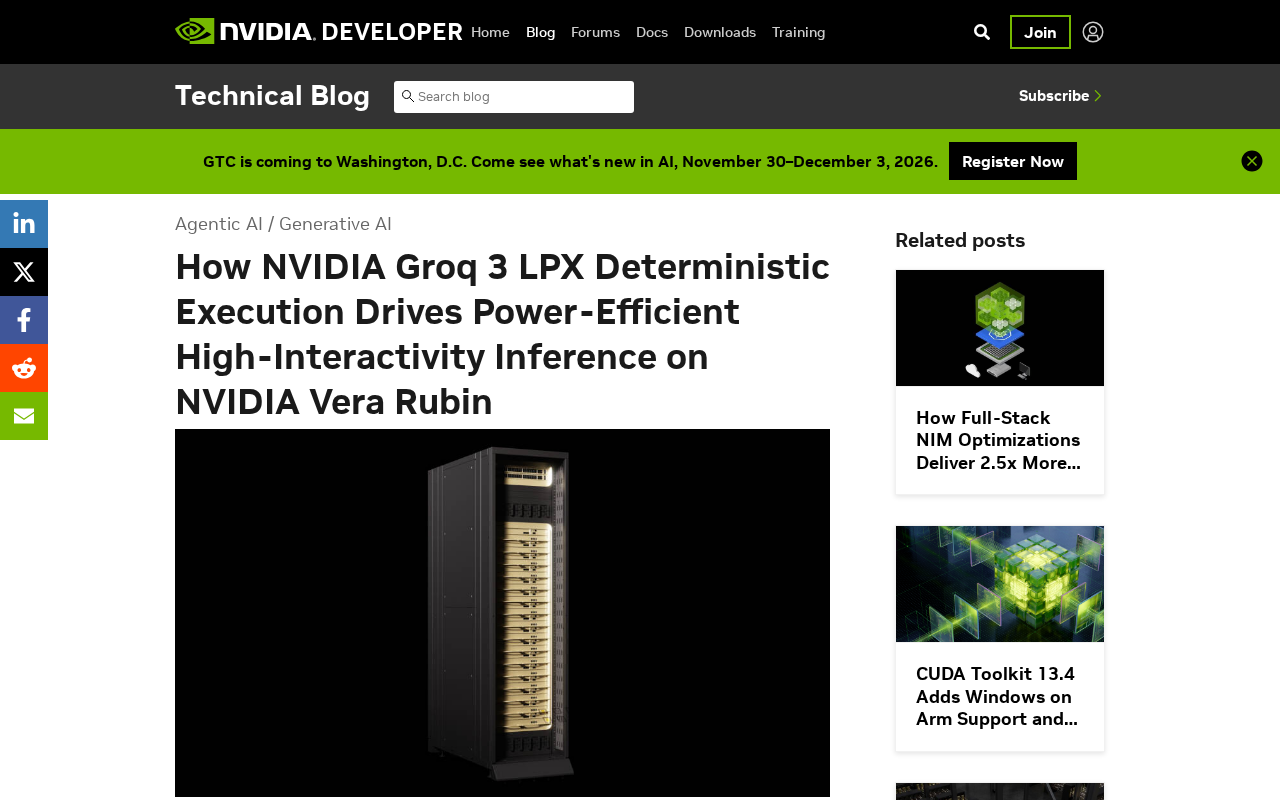
Power constraints are reshaping AI infrastructure, making deterministic execution architectures key for efficient, low-latency inference.
As large model inference demand surges, data center power budgets have surpassed peak compute as the real bottleneck in AI factories. The article explains how deterministic execution architectures — exemplified by Groq LPX — eliminate dynamic scheduling overhead through compile-time static planning, achieving both controlled power draw and predictable latency. It further argues that dedicated inference accelerators and NVIDIA's platform-level infrastructure (interconnect, memory, software stack) are moving toward synergy rather than replacement, jointly serving the system-level goal of maximizing inference throughput per watt. For high-interactivity workloads like Agents and real-time conversation, deterministic architectures hold a decisive edge. The industry's evaluation benchmark is shifting from "peak TFLOPS" to "inference output per watt" and "latency determinism."
Power Has Become the Core Constraint in AI Factories
As demand for large model inference surges, the biggest bottleneck facing AI infrastructure is no longer peak compute — it's power budget. As the NVIDIA Developer Blog points out, power is becoming the defining constraint on what an AI factory can actually deliver. When AI workloads require a full compute platform to operate, every component in that platform must squeeze out maximum energy efficiency.
There's a clear industry logic behind this: data centers have hard limits on power delivery and cooling capacity. Once rack density reaches a certain threshold, what determines actual throughput isn't a single card's theoretical peak compute — it's "how much usable inference can you get per watt." In this context, deterministic execution at the architecture level is emerging as a critical lever for improving energy efficiency.
Why Deterministic Execution Improves Energy Efficiency
Traditional GPUs handling inference tasks rely on complex schedulers, cache hierarchies, and dynamic branch prediction to manage unpredictable execution paths. These mechanisms work well for general-purpose computing, but they introduce additional power overhead and latency variance.
"Deterministic execution" means the chip plans the data flow and computation for every clock cycle at compile time — no dynamic scheduling is needed at runtime. This design delivers two immediate benefits:
- More predictable power draw: Eliminating the overhead of dynamic scheduling and speculative execution means more transistors are doing actual computation rather than control logic;
- Highly predictable latency: For inference scenarios requiring high interactivity — such as real-time conversation or Agent tool calls — stable low latency is more valuable than occasional peak throughput spikes.
Groq has long championed exactly this kind of deterministic architecture. When its LPX solution is combined with NVIDIA's platform-level infrastructure, the combination theoretically delivers both energy efficiency and responsiveness for the "high-interactivity inference" use case.
Groq's LPU (Language Processing Unit) is a prime example of deterministic execution architecture. Unlike GPUs, the LPU uses a SIMD-style dataflow architecture where the compiler statically schedules the model's entire computation graph into the chip's time slots before deployment. At runtime, what operation executes each cycle, where the data comes from, and where it goes — all of it is fully determined in advance. This stands in sharp contrast to GPUs, which rely on runtime CUDA kernel scheduling and warp schedulers to dynamically dispatch instructions. The tradeoff of static scheduling is reduced flexibility — changing the model structure requires recompilation. But the benefit is nearly eliminating the dynamic power consumption of control logic, while minimizing variance in Time To First Token (TTFT) and Inter-Token Latency (ITL), enabling SLA-like latency guarantees. This property is especially valuable in multi-tenant inference services, where tail latency jitter is often the primary factor affecting user experience.
Platform Synergy: From Single Chip to Full Rack
A noteworthy signal is that these solutions increasingly emphasize "platform" over "single chip." The original article references both Groq LPX's deterministic execution and the NVIDIA Vera Rubin platform, hinting at a collaborative approach:
Dedicated inference accelerators efficiently execute core inference operators within a deterministic framework, while NVIDIA's platform layer provides interconnect, memory bandwidth, software stack, and overall system integration. This combination attempts to answer an industry-level question: under power constraints, how do you maximize the output per watt across an entire rack — not just optimize a single chip?
For enterprises operating AI factories, this means procurement decisions are shifting from evaluating "peak TFLOPS" to assessing "usable throughput per unit of power" and "latency stability."
NVIDIA Vera Rubin is NVIDIA's next-generation data center platform, named after astronomer Vera Rubin — continuing the tradition of naming flagship products after scientists (the previous generation was Blackwell). The platform is expected to deeply integrate the Vera CPU with the next-generation Rubin GPU, with a focus on improving NVLink interconnect bandwidth and HBM memory capacity to support inference and training at trillion-parameter scale. In the context of full-rack collaboration, NVIDIA's role goes beyond chip supplier — it acts as a "platform integrator" providing the NVSwitch interconnect fabric, NVLink Switch cabinet networking, and the CUDA/Triton software stack. Dedicated inference accelerators like Groq LPX plugging into this ecosystem means they can leverage NVIDIA's deep experience in system integration, drivers, and compatibility with upper-layer MLOps toolchains — reducing engineering complexity for enterprise deployments.
High-Interactivity Inference Is the Key Battleground
Inference workloads are not monolithic. Batch offline inference prioritizes throughput and cost, while high-interactivity inference is extremely sensitive to latency and latency stability.
As Agents, real-time assistants, and multi-turn conversation applications proliferate, interactive inference is making up a rapidly growing share of workloads. These workloads are characterized by short requests, high concurrency, and strict requirements on both TTFT and ITL. Deterministic execution architectures have a pronounced advantage here — they can provide predictable latency guarantees and avoid the long-tail latency caused by dynamic scheduling in general-purpose architectures.
Time To First Token (TTFT) and Inter-Token Latency (ITL) are the two core metrics for measuring interactive inference experience. TTFT determines how long a user waits from sending a request to seeing the first character — directly affecting perceived responsiveness. ITL governs the pace of subsequent content generation; excessive ITL causes noticeable stuttering in streaming output. In Agent scenarios, a complex task often requires multiple chained LLM calls, and the latency from each hop accumulates and amplifies. This makes controlling P99 latency (the 99th percentile, representing tail cases) more practically meaningful than average latency. By eliminating the randomness introduced by dynamic scheduling, deterministic execution architectures can compress P99 latency to near P50 levels — something that is typically difficult to achieve on general-purpose GPU architectures, especially under high concurrency.
Implications for the Industry
This technical piece from the NVIDIA Developer Blog — while full details are yet to be disclosed — clearly points to several industry trends:
- The competitive focus in AI infrastructure is shifting from raw compute to energy efficiency;
- Deterministic architectures are gaining increasing attention for inference workloads, especially interactive inference;
- The boundary between dedicated accelerators and general-purpose platforms is blurring, moving toward synergy rather than replacement.
For practitioners focused on AI hardware and inference cost, "inference output per watt" and "latency determinism" will be the two key yardsticks for evaluating platform value going forward.
Note: This article is based on publicly available information from the NVIDIA Developer Blog. Some technical details are subject to official subsequent disclosures.
Related articles
Free DeepSeek V4.1 Flash via DSH: Bulk Point Collection & International WorkBuddy Tested
DSH project update tested: WorkBuddy now offers 100 points per claim, rate limits raised beyond 80M tokens with faster resets, and international WorkBuddy supports free Hunyuan 4 and DeepSeek V4.1 Flash.
Capsule: Pack Web Apps and Data into a Single SQLite File
Capsule is a Rust/Tauri 2.0 tool that packs HTML web apps and data into a single SQLite file — privacy-first, local storage, portable sharing, with AI support.
DSH-SUBAGENT-UI Plugin: The Ultimate Sub-Agent Manager for DeepSeek Harness
DSH-SUBAGENT-UI is a DeepSeek Harness browser plugin offering sub-agent overview, search, local categorization, and completion snapshots — install with one command.