How Do Confidence Signals Reveal Problem Difficulty? A New Study Provides Answers
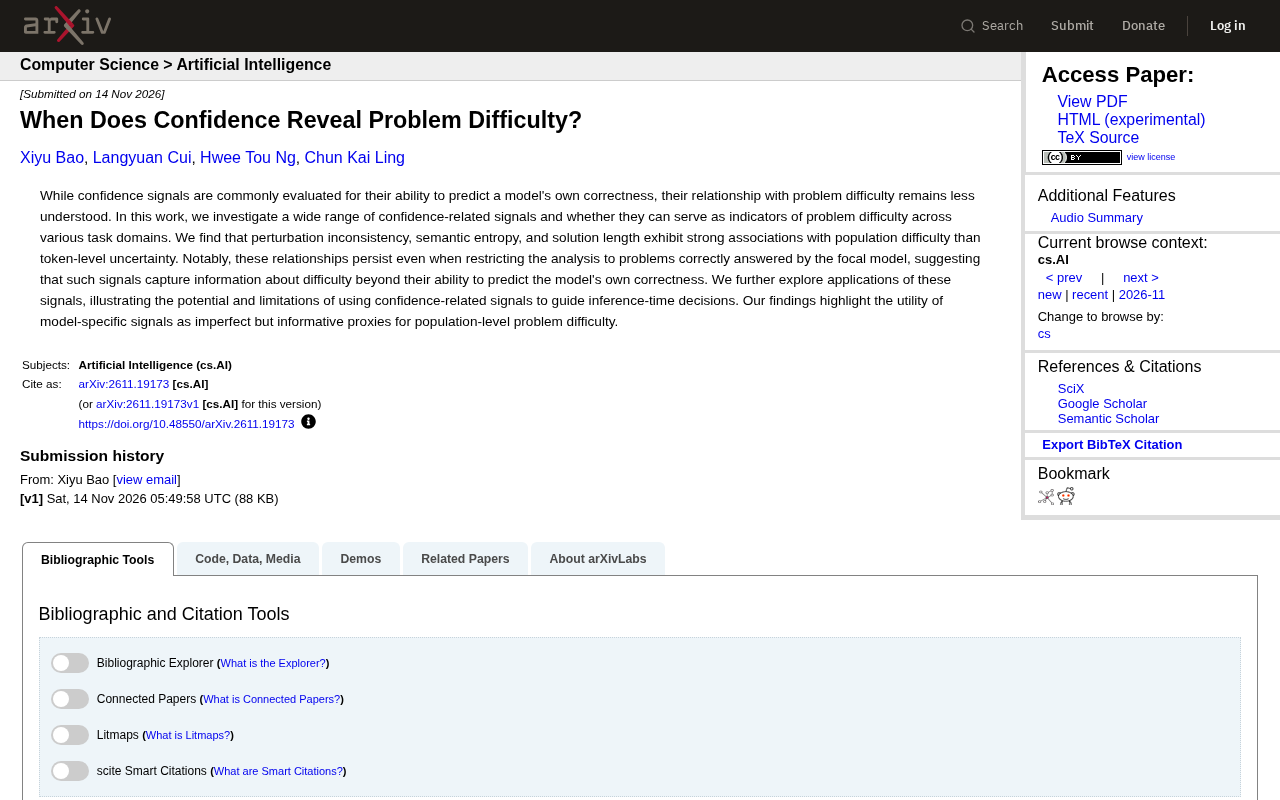
Study finds perturbation inconsistency, semantic entropy, and solution length reflect problem difficulty better than token-level uncertainty, independent of correctness.
This study systematically examines the relationship between confidence signals and problem difficulty, finding that perturbation inconsistency, semantic entropy, and solution length are significantly more strongly associated with population difficulty than token-level uncertainty. Even on correctly answered questions, these associations persist, indicating they capture difficulty information beyond predicting correctness. The study also discusses inference-time applications and notes the signals are model-specific and imperfect proxies.
Introduction: Confidence Goes Beyond Judging Right or Wrong
For a long time, confidence signals have been widely used to assess how confident a model is in the correctness of its own predictions. However, a recent study turns its attention to a less-explored question: can confidence signals reflect the difficulty of the problem itself?
This study systematically examines various confidence-related signals and finds that perturbation inconsistency, semantic entropy, and solution length are significantly more strongly associated with population difficulty than token-level uncertainty. More importantly, these associations persist even when analyzing only questions the model answered correctly, indicating that such signals capture difficulty information beyond "predicting one's own correctness."
Semantic entropy is an uncertainty measure for generative models. Traditional entropy is computed based on token probability distributions, but the same meaning can be expressed in many different ways, so token-level entropy overestimates uncertainty. Semantic entropy works by clustering multiple model-generated responses by semantic equivalence and then computing entropy at the cluster level, thereby ignoring surface wording differences and retaining only semantic divergence. The higher the entropy, the more uncertain the model is at the "meaning" level. This concept was originally used to improve reliability detection in large-model question answering; its advantage is that it can identify cases of "surface confidence, semantic divergence," and is therefore also considered potentially reflective of the ambiguity or difficulty of the problem itself.
Research Background: Re-examining Confidence Signals
In the fields of model evaluation and inference, confidence signals are typically regarded as a measure of a model's reliability regarding its own outputs. The traditional view holds that high confidence means the model is more certain about the answer, while low confidence suggests a possible error. However, problem difficulty itself is a dimension independent of model correctness—a model may make a mistake on an easy question or luckily answer a hard one correctly.
This study attempts to answer: Do confidence signals carry information about problem difficulty? If so, which signals are more effective? Do these signals remain effective on questions the model answered correctly?
Core Finding: Three Types of Signals Stand Out
The research team compared various confidence-related signals, including perturbation inconsistency, semantic entropy, solution length, and token-level uncertainty. The results show that the first three have significantly stronger associations with population difficulty.
Perturbation inconsistency measures the consistency of the model's output when the input is slightly perturbed; semantic entropy captures the model's uncertainty at the semantic level; solution length reflects the number of reasoning steps or the text length required to generate an answer. These signals may be more effective because they reflect the complexity of the problem itself from different angles, rather than merely mapping the model's internal momentary uncertainty.
Perturbation inconsistency measures uncertainty by applying slight, semantics-preserving perturbations to the input (such as paraphrasing, adding or removing irrelevant words, or adjusting word order) and observing whether the model's output remains stable. If the answers are highly consistent after multiple perturbations, the model has a relatively firm grasp of the question; if the output changes frequently, it suggests the model is near a decision boundary. Unlike token probabilities obtained from a single forward pass, perturbation inconsistency characterizes the stability of the model's behavior within a neighborhood of the input space, and therefore is more likely to reflect the cognitive pressure the problem itself exerts on the model, rather than merely the momentary confidence of a single generation.
Key Validation: Associations Persist Under Correct Answers
A potential objection is that these signals are related to difficulty merely because they can predict whether the model is correct. To rule out this explanation, the researchers restricted the analysis to questions the model answered correctly. The results show that the associations of perturbation inconsistency, semantic entropy, and solution length with difficulty remain significant. This indicates that these signals indeed capture difficulty information independent of model correctness.
This finding has important theoretical significance: it shows that confidence signals are not only tools for model self-evaluation but may also serve as proxy indicators of problem difficulty.
Population difficulty generally refers to group-level answering performance on a given set of questions, such as the average accuracy across multiple models or multiple samples, or the average number of reasoning steps required. It is a relatively objective statistic independent of a single model's single output. Correlating confidence signals with population difficulty can test whether the signals carry information about "how hard the question itself is," rather than merely predicting the correctness of a particular response. The fact that the association remains significant after controlling for correctness (analyzing only correctly answered questions) is precisely the key statistical means of ruling out the competing explanation that "the signal is merely a proxy for correctness."
Applications and Limitations: Potential for Inference-Time Decision-Making
The study further explores the potential application of these signals in inference-time decision-making. For example, under limited resources, computational resources can be dynamically allocated based on these signals—investing more reasoning steps or invoking more complex strategies for questions that the signals indicate are more difficult.
However, the researchers also point out limitations. These signals are model-specific, and their relationship with difficulty may vary across models and cannot be simply generalized to other models or tasks. In addition, these signals are only imperfect proxies, not direct measures of difficulty.
Insights from Multi-Source Cross-Validation
Although this study is mainly based on analysis from a single source, its conclusions echo other recent work on semantic entropy and perturbation consistency. For example, semantic entropy has been shown in multiple studies to effectively identify model uncertainty, and perturbation inconsistency also aligns with findings in model robustness research. This cross-study consensus strengthens the credibility of the above signals as proxies for difficulty.
Conclusion: Imperfect but Valuable Proxies for Difficulty
This study reveals a deep connection between confidence signals and problem difficulty. Perturbation inconsistency, semantic entropy, and solution length are not only related to model correctness but can also continue to reflect difficulty differences on questions the model answered correctly. Although these signals are not perfect measures of difficulty, they provide valuable references for inference-time decision-making.
For AI researchers and developers, this means that when evaluating models or designing inference strategies, these signals can be used more deliberately, rather than being regarded solely as predictors of correctness. Future work can further explore how to combine these signals with other difficulty estimation methods to improve inference efficiency and reliability.
One-line Summary
Research finds that perturbation inconsistency, semantic entropy, and solution length reflect problem difficulty better than token-level uncertainty, independent of model correctness.
Paragraph Summary
This study systematically examines the relationship between various confidence signals and problem difficulty, finding that perturbation inconsistency, semantic entropy, and solution length are significantly more strongly associated with population difficulty than token-level uncertainty. More importantly, even when analyzing only questions the model answered correctly, these associations persist, indicating that they capture difficulty information beyond "predicting one's own correctness." The study further discusses the potential of these signals in inference-time decision-making, such as dynamically allocating computational resources based on the signals, while noting that the signals are model-specific and only imperfect proxies for difficulty, requiring cautious generalization.
Related articles

Daybreak Red Deployment Guide: A Reference Architecture for Supervised Security Investigation
A breakdown of the Daybreak Red reference architecture: security control design, deployment configuration process, and runtime monitoring for supervised security investigation.

Gemini 4 Neon Tops the Models Engineering Index
Gemini 4 Neon tops the Models Engineering Index, sparking Hacker News debate over ranking credibility and evaluation methods. Here's what it means for developers.

Apple's Self-Developed AI Agent: An Agent That Can Operate Your Mac Is Coming
Apple is reportedly developing an AI agent that can operate a Mac, targeting Meta Muse, Claude, OpenAI Dots, and others. This article analyzes Apple's system-level advantages, the competitive landscape, and likely rollout paths in the agent race.