How Do Cursor, Claude, and ChatGPT Actually Work? A Full Breakdown of the AI Tech Stack
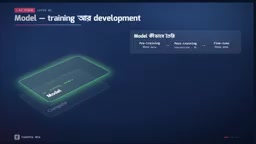
AI products are a five-layer tech stack extending from the input box to the GPU, and troubleshooting requires checking layer by layer.
The article breaks down the systems behind everyday Cursor, Claude, and ChatGPT use into five layers: application, agent loop, model, inference optimization, and GPU infrastructure. Agents run in a plan-execute-observe loop, frameworks like LangGraph organize steps into graph-like state machines, and the MCP protocol standardizes APIs as tools to reduce integration costs. The model layer goes through pretraining, instruction tuning, and reinforcement learning, with token-by-token generation, VRAM, KV Cache, and quantization forming the core constraints on the inference side. The inference optimization layer balances accuracy, cost, and perceived latency through RAG retrieval, model routing, and streaming output. Ultimately everything rests on GPU compute and networking. The value of the layered view: wrong answers → check retrieval; stuck agents → check loop and permissions; slowness → check streaming and routing; high costs → use quantization and route between large and small models.
From Product UI to GPU: AI Is Really a Multi-Layer Tech Stack
When we use Cursor to write code, discuss problems in Claude, or chat with ChatGPT, all we see is a clean input box. But behind that input box lies a layered system that extends all the way down to bare-metal GPUs. According to an analysis by a YouTube tech channel (presented in Bengali), the entire AI stack can be broken down top-down into the application layer, the agent loop layer, the model layer, the inference optimization layer, and the infrastructure layer. Each layer solves a different problem and involves its own engineering trade-offs.
The value of understanding this stack is this: when a model gives a wrong answer, fails to call a tool, or responds slowly, you can tell which layer the problem is in—whether retrieval failed to recall the right document, the agent got stuck in an error loop, or the compute and memory bandwidth on the inference side hit a ceiling.
The Agent Loop: A Software Entity That Takes Action on Its Own
The Plan-Execute-Observe Loop
An agent is not a "model answers once and it's done" Q&A interface. According to the channel, an agent runs in a loop: first it plans, then it calls tools, edits files, runs tests, observes the results, and adjusts the next step accordingly. This loop lets it complete multi-step operations continuously without a human stepping in at every stage.
Common frameworks for implementing such loops include LangGraph, which organizes the agent's steps into a graph-like state machine structure, making the flow controllable and debuggable. The channel also mentions a dedicated permission/licensing layer within the loop—before an agent performs actions like writing files or running commands, it must first obtain authorization to avoid mistakes.
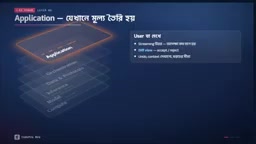
Why Tool Calling Needs a Standardized Protocol
If every model and every tool defined its own interface, integration costs would be absurdly high. This is where MCP (Model Context Protocol) comes in: it provides a standard way to wrap an API as a tool, then wrap the tool as an MCP Server, so the model can call it through a unified protocol. This way, switching models or tools doesn't require rewriting the entire pipeline.
MCP uses a client-server architecture: the host application containing the model acts as the MCP Client and communicates with one or more MCP Servers via standardized JSON-RPC messages. Each MCP Server exposes three types of capabilities—tools (executable functions), resources (readable data), and prompt templates (preset instructions). The client automatically discovers these capabilities and their parameter schemas during session initialization, then injects them into the model's context. This way the model needs no hardcoded tool details—it simply makes calls according to the schema. Because the protocol layer is decoupled from the model, the same MCP Server can be reused by models from different vendors, and swapping models doesn't require changing tool implementations. This is the composability that standardization enables.
The Model Layer: Pretraining, Instruction Tuning, and Reinforcement Learning
From Raw Text to a Usable Assistant
Training a large model roughly follows three steps. The first is pretraining: using massive amounts of text to teach the model to predict the next token, which produces the model's "knowledge foundation." The second is instruction tuning, which teaches the model to respond in the form of human instructions. The third is reinforcement learning (RL), which uses feedback signals to steer the model's behavior toward what is desired.
According to the channel, in actual products, user input is not directly used as instruction-tuning training data; behavior calibration is mainly accomplished through reinforcement learning. The key engineering constraint here is that pretraining is extremely expensive, while fine-tuning and subsequent inference are the parts that recur during product iteration.
The Economics of Tokens, VRAM, and Quantization
Model output is generated token by token, and each token goes through a forward pass, so response time is directly tied to generation length. The bigger bottleneck is memory: for models with billions of parameters, the weights alone consume a large amount of VRAM, and the runtime KV Cache pushes usage even higher. Quantization compresses weights and VRAM usage by reducing numerical precision, and is a key means of running large models on limited hardware. The channel notes that quantization incurs some loss in capability, requiring measurement and trade-offs between actual performance and resource consumption.
KV Cache is the key memory overhead in autoregressive generation: for each new token generated, the model must compute attention over the Key and Value vectors of all previous tokens. To avoid redundant computation, the inference engine caches them. The cache size is proportional to sequence length, number of layers, number of attention heads, and batch size, and in long-context scenarios it may exceed the model weights themselves. Therefore, production deployments commonly use techniques like paged management (e.g., vLLM's PagedAttention) and grouped-query attention (GQA) to compress the KV Cache. This also explains why long conversations and high concurrency significantly increase VRAM usage and latency—the bottleneck is often not compute, but VRAM capacity and memory bandwidth.
Inference Optimization: RAG, Routing, and Streaming Output
Retrieval and Model Routing
Before a request reaches the model, it often passes through two layers of optimization. The first is retrieval augmentation (RAG): documents are converted into vectors (embeddings) and indexed in a vector database, and when a question arrives, the most relevant chunks are recalled. The channel emphasizes that if the retrieved files themselves are irrelevant or are "garbage in," the model's answer will be wrong—retrieval quality directly determines answer quality.
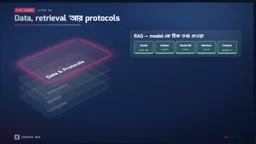
The second is model routing: based on request difficulty, simple tasks go to a small model (faster, cheaper) and complex tasks go to a large model; when the large-model side is unavailable or errors out, the system falls back to an alternate provider. This routing mechanism directly determines the product's cost structure and availability.
Embedding is the process of mapping text into high-dimensional dense vectors, where texts with similar semantics are closer together in vector space. RAG typically uses a dual-tower structure: the document side is chunked offline, encoded, and stored in the database, while the query side is encoded online and then uses cosine similarity or approximate nearest neighbor (ANN) algorithms (such as HNSW or IVF) to quickly recall the Top-K chunks. Chunk granularity, whether to overlap, and whether to rerank all affect final retrieval quality. Pure vector retrieval is insensitive to exact keyword matches, so in practice it is often combined with sparse retrieval such as BM25 for hybrid recall, then passed to a cross-encoder for reranking to balance semantic and lexical matching.
Streaming Output Eliminates the Feeling of Waiting
Streaming output is a key optimization at the experience layer: the model pushes tokens as it generates, so users don't have to wait for the entire answer to be complete before seeing content, greatly reducing perceived latency. For developer tools, the interface also shows a real-time diff, letting users see exactly what changed and decide whether to accept or reject a given edit.
Streaming relies on underlying protocol support for incremental transmission: the server typically pushes tokens chunk by chunk via Server-Sent Events (SSE) or HTTP chunked encoding, and the frontend renders each increment as soon as it arrives. To reduce time-to-first-token, inference engines separate prefill and decode scheduling and use continuous batching to interleave progress across multiple requests. Streaming also introduces engineering complexity: errors can occur mid-stream, requiring recoverable handling of broken streams; and per-token rendering frequently triggers frontend repaints, requiring throttling and incremental DOM updates.
Infrastructure: GPUs, Compute, and Latency
The entire stack ultimately lands on hardware. Inference workloads depend primarily on GPUs, and tight GPU supply and high costs are a publicly acknowledged bottleneck in the industry. Large tech companies have their own data centers and compute reserves at this layer, while smaller teams rely more on cloud services. The channel also mentions the importance of networking and latency—low-latency interconnect directly affects the responsiveness of inference services.
Practical Takeaways from a Layered Perspective
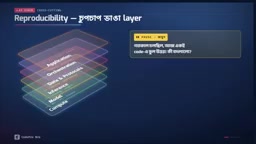
Viewing AI products as a tech stack rather than a single model changes many engineering decisions. When the model gives a wrong answer, check retrieval first; when the agent gets stuck, check the loop and permissions first; when responses are slow, look at streaming and routing first; when costs are high, quantization and routing between large and small models are the go-to tools. The trade-offs at each layer propagate up the stack and ultimately show up in that input box the user sees.
(This article is based on an explanation from a Bengali-language YouTube tech channel; some details are single-source claims from that channel.)
Related articles

Can Nuclear War Really End Civilization? A Scientific Look at Common Misconceptions
Can nuclear war end civilization? This article examines the physics of nuclear weapons—blast, fallout, and urban fires—distinguishing airbursts from groundbursts, dose from contamination, and explaining why nuclear war is a massive disaster but not an extinction event, while exploring key factors for post-strike social reconstruction.

The Truth Behind Titanic's Sinking: Key Decisions and Communication Failures in the National Geographic Documentary
National Geographic's The Unsinkable Ship uses survivor testimony to reconstruct Titanic's fatal decisions—from the missing MSG telegram prefix and the broken boiler-room-to-bridge link to how 'unsinkable' thinking delayed damage control and evacuation.

74M-Parameter Open-Source Model Partially Outperforms Jev AI in Testing
Fastino AI's Glider 2.5 models, with just 74M–300M parameters, reportedly outperform Jev AI in some guardrail benchmarks per YouTube testing, run on consumer hardware, and even play Doom. We analyze small models' competitiveness and deployment value on specific tasks.